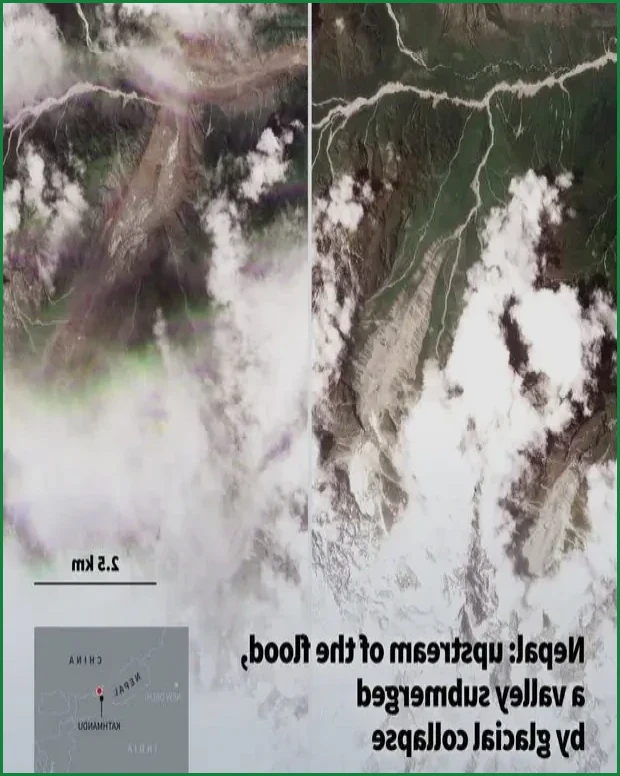
A devastating flash flood that struck Nepal on Wednesday was likely triggered by a massive portion of a glacier breaking off and temporarily blocking a river, according to preliminary assessments by scientists. Researchers suggest that this sudden blockage created a temporary dam, which eventually burst and sent a powerful torrent of backed-up water surging downstream with catastrophic force just a few hours later.
The disaster has exacted a heavy human toll, killing hundreds of people and leaving more than a thousand others missing, including foreign tourists and pilgrims. The region’s landscape has historically been a major draw for international travelers, attracting more than a million visitors annually in recent years. In addition to the human casualties, local officials have reported widespread destruction of critical infrastructure, including roads, buildings, bridges, and hydropower dams, while hundreds of families across the mountain region have lost their homes.
According to the U.S. Geological Survey, the catastrophe was initiated by a magnitude 5.2 glacier collapse that unleashed a massive flow of debris downstream. The agency based its initial determination on satellite imagery, long-period seismic waves, and data recorded by nearby seismic stations. Scientists are continuing to analyze both satellite and ground-level data to reconstruct the precise sequence of events that led to the deadly surge.
Jakob Steiner, a geoscientist at the University of Graz in Austria who is currently based in Bangladesh, described the visual evidence of the detachment. He noted that the lower section of a glacier had completely sheared off, remarking that the imagery looked as if someone had sliced through the entire lower part with a giant knife. Steiner explained that a massive block of glacial ice falling from such a significant height would have generated an impact akin to a bomb exploding, triggering the subsequent chaos.
While researchers emphasize that it is too early to establish a direct causal link between this specific disaster and global warming, they warned that rising global temperatures significantly elevate the frequency of such events. The Himalayan mountains are warming at a rate considerably faster than many other regions of the world due to human activities like burning coal, oil, and gas. Saswat Sanyal, a disaster risk reduction specialist at the Kathmandu-based International Centre for Integrated Mountain Development (ICIMOD), urged caution regarding immediate attribution but noted that rising temperatures are actively transforming the Hindu Kush Himalaya region and melting its glaciers.
The Hindu Kush Himalaya region stretches approximately 2,175 miles from Afghanistan to Myanmar and contains the largest volume of ice on Earth outside of the polar regions. Home to the world's highest peaks, including Mount Everest, the region serves as the primary water source for 12 major rivers that flow through 16 Asian nations. A 2023 report by ICIMOD warned that the ongoing melting of these glaciers poses an existential threat, as these rivers supply fresh water to roughly 240 million people living in the mountain valleys and another 1.65 billion people living further downstream.
Initial evidence from the recent flood suggests that a colossal volume of ice and rock plunged directly into the Lhende Khola, which is a tributary of the Bhote Koshi River. Researchers believe this massive impact displaced water and gathered loose sediment and boulders, creating a highly destructive debris flow. Scientists are also investigating whether this debris temporarily dammed the river channel before the impounded water broke through, which would have significantly amplified the scale of the flood. ICIMOD researchers reported that water levels in rivers across the affected area rose by up to 9 meters, or about 29.5 feet, in a span of just 30 minutes, which Sanyal described as a sudden and massive surge of water.
The valley has a documented history of severe mountain hazards. Glacial lake floods hit the exact same valley in 2025, and a separate ice and rock avalanche occurred in the broader area in 2024. Additionally, the wider Langtang region suffered devastating avalanches during the catastrophic earthquake that struck Nepal in 2015. Scientists point out that rapid warming in the Hindu Kush Himalaya is driving profound changes in glaciers, snow cover, permafrost, and the stability of mountain slopes. Approximately 78 percent of the region's glacier area, situated between 14,760 and 19,685 feet above sea level, is highly exposed to rising temperatures.
Steiner warned that events like Wednesday's collapse represent a grim new reality, noting that the situation is expected to worsen. The last decade was recorded as the warmest multi-year period globally since record-keeping began, with 2024 marking the hottest single year on record. United Nations reports indicate that between the years 2000 and 2019, global glaciers lost an average of 267 gigatons of ice annually, a mass roughly equivalent to 46,500 Great Pyramids of Giza. Even if global warming is successfully capped at 1.5 degrees Celsius (2.7 degrees Fahrenheit), projections show that up to 50 percent of all global glaciers—excluding those in Greenland and Antarctica—could disappear by the year 2100. Under current global policies, the planet is on track to warm by approximately 2.8 degrees Celsius (5 degrees Fahrenheit) above preindustrial levels by the end of the century.
Research by ICIMOD indicates that glacier melt across these mountain ranges is accelerating, with ice-loss rates doubling since 2000. This rapid melting can expand existing glacial lakes and create new ones, dramatically increasing the risk of sudden, catastrophic floods. Furthermore, as glaciers retreat, the mountain rock that was once insulated and physically supported by ice is exposed to warmer air, rain, and repeated freeze-thaw cycles. Permafrost, which is ground that has remained frozen for years, is also thawing, which weakens steep slopes and rock faces. Steiner noted that these changes significantly increase the likelihood of mountain materials sliding downward.
Sanyal explained that Wednesday's disaster in Nepal may have been the result of such cascading hazards, where an initial avalanche or glacier collapse triggers a sequence of events including debris flows, river blockages, and sudden flash floods. The consequences of this rapid glacial retreat will not be confined to the immediate region. Izabella Koziell, deputy director general of ICIMOD, previously warned that the melting of Himalayan glaciers, alongside the melting of ice sheets in Greenland, the Arctic, and the Antarctic, will drive global sea-level rise and disrupt ocean circulation patterns, carrying dramatic consequences worldwide.
To mitigate these growing dangers, scientists emphasize the urgent need for robust early warning systems, enhanced environmental monitoring, and rapid cross-border data sharing. However, monitoring thousands of glaciers, unstable slopes, and remote river valleys across the vast Himalayan arc presents immense logistical challenges. When cascading disasters occur, communities and emergency responders may have only a tiny window of time to react. Sanyal pointed out that in such situations, there are no hours to spare, and sometimes only a few minutes are available to prepare.
Steiner observed that a critical threshold has already been crossed, suggesting that certain regions of Nepal have become too hazardous for human habitation. While scientists hoped that previous disasters would serve as a wake-up call for governments across the Himalayan region, Steiner expressed frustration that the scale of destruction never seems to prompt sufficient action. He added that while the solutions are known, different stakeholders must coordinate effectively to implement them, noting that he remains skeptical about immediate, clear resolutions being enacted.
"What happened yesterday is unfortunately the new normal. It's going to get worse from here onwards," Steiner said.
"I'm not super optimistic that from tomorrow onwards there will be clear solutions," he added. "We know what can be done, but various stakeholders need to coordinate and make things happen."
Related Articles

Md. Kazi Bijoy is a dedicated tech enthusiast and content creator with a passion for digital innovation. With years of experience in the tech industry, he specializes in breaking down complex topics into easy-to-understand guides. When he isn’t writing, he explores the latest gadgets and researches emerging trends in the digital world.
1 thought on “Glacier Collapse Caused Deadly Nepal Flash Flood, Scientists Say”