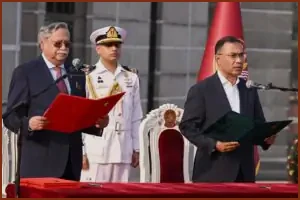
Eight months after taking office on February 17, Prime Minister Tarique Rahman and the Bangladesh Nationalist Party (BNP) government face a complex mix of economic struggles, public safety challenges, foreign policy recalibrations, and growing scrutiny over political and institutional reforms. Rahman had been in power for just 11 days when war broke out in the Middle East following United States and Israeli attacks on Iran on February 28, disrupting fuel supplies and forcing Bangladesh to introduce energy rationing by March, adding immediate pressure to an already fragile economy.
Economic indicators present a mixed picture. Consumer price inflation slowed slightly to 8.34 percent in September, down from a peak of 9.42 percent in May and a March reading of 8.71 percent, though it remained nearly unchanged from the 8.36 percent recorded in September 2025. Household costs remain high, particularly as wage growth trails price increases. The Bangladesh Bureau of Statistics reported an 8.05 percent rise in its wage index for low-paid agricultural, construction, and transport workers in August, indicating that purchasing power continues to erode. To ease international energy losses, the Energy Ministry raised domestic diesel prices in September from 115 to 135 taka per liter, threatening further spillover into transport and production costs.
In contrast, overseas workers provided financial relief. Remittances reached $18.94 billion between March and August, marking a 13.1 percent increase compared to the same period in 2025, according to Bangladesh Bank. These inflows helped stabilize foreign exchange reserves and cushion household budgets. However, private sector investment remains muted. Sohail R. K. Hussain, managing director of Bank Asia, noted that local factories continue to operate with unused capacity due to weak demand, elevated borrowing costs, and energy shortages.
Bangladesh Bank has maintained a tight monetary stance to curb inflation, while high loan defaults constrain overall lending. Acknowledging that interest rate hikes alone cannot resolve structural supply chain issues, the central bank unveiled a 600 billion taka policy financing package for industry, agriculture, and small businesses. Meanwhile, fiscal pressure is mounting. The government's record 9.38 trillion taka national budget relies on nearly 7 trillion taka in total revenue, but National Board of Revenue data shows collections for July and August totaled 518.9 billion taka—down from 547.7 billion taka a year earlier and 291.6 billion taka below the target for those two months.
Dr. Khondaker Golam Moazzem, an industrial economist and president of the Knowledge Hub Institute, described the state of the economy as stagnation marked by high inflation, weak growth, and rising unemployment. Moazzem questioned the government's decision to increase public sector salaries and expand costly commitments, such as Biman Bangladesh Airlines' plans to acquire 35 new aircraft, including 25 Boeing jets from the United States and 10 Airbus jets from the European Union. Warning against heavy debt burdens without management reforms, Moazzem pointed out that while the administration inherited deep problems, initial promises to reverse economic deterioration limit how long past mismanagement can serve as an excuse.
Law enforcement and public safety remain major public concerns. Monthly data from Bangladesh Police shows mixed criminal trends between March and September compared to the same period in 2025. Registered murder cases decreased from 2,317 to 2,122, robbery cases fell from 1,159 to 1,077, and kidnapping cases dropped slightly from 628 to 618. However, burglary incidents rose nearly 13 percent, from 1,796 to 2,022 cases. Total registered police cases grew 14 percent from 110,296 to 125,763, driven overwhelmingly by a surge in narcotics cases, which climbed from 31,111 to 45,091.
Mob violence has persisted. Human rights organization Ain o Salish Kendra (ASK) recorded 131 deaths from mob beatings between March and August 2026. Notable incidents include the April 11 killing of a Sufi spiritual leader in Kushtia's Daulatpur upazila, whose shrine was set on fire following blasphemy allegations while law enforcement failed to intervene. On September 25, more than 200 masked attackers looted and demolished the Radda MCH-FP Center, a maternal and child healthcare facility in Dhaka, with police officers present but failing to stop the destruction. The following day, attackers vandalized content creator Salman Muqtadir's Dhaka studio during a land dispute involving the property owner.
Police officers themselves have been repeatedly targeted. Mobs assaulted officers in Savar in June and in Kutubdia in July while suspects were being taken into custody. On September 5, Special Branch Sub-Inspector Altaf Hossain was beaten to death in Savar, and on October 10, a police inspector suffered severe injuries during an attack by muggers in Khulna. Home Minister Salahuddin Ahmed defended law enforcement performance on August 26, stating that suspects in almost all primary cases filed in the government's first six months were arrested within a reasonable timeframe, adding that police morale was being rebuilt after inheriting a fragile security apparatus.
Dr. Md Tawohidul Haque, a crime analyst at the University of Dhaka's Institute of Social Welfare and Research, characterized the law and order situation as largely unchanged compared to the previous 18 months. Haque cited uneven enforcement and a lack of political discipline as key factors, stating that political parties must confront wrongdoing within their own ranks to achieve real safety gains. He also noted that narcotics enforcement frequently targets small-scale couriers while influential trade patrons retain political protection, adding that the Bangladesh Police structure remains politically affiliated and structurally unreformed.
Political competition and governance debates have intensified. The 11-party opposition alliance led by Jamaat-e-Islami criticized the government in August over rising prices, power cuts, and public security, while National Citizen Party leader Nahid Islam accused the administration of blocking opposition figures from parliamentary committee chairmanships. Meanwhile, the legal ban on Awami League political activities, imposed by the interim government in May 2025 ahead of trials at the International Crimes Tribunal, remains in effect under the BNP, keeping a major political segment organized outside the formal process.
Human rights organizations have raised continuing concerns. ASK recorded 242 incidents of journalist harassment between March and September. In August, Human Rights Watch reported that hundreds of people connected to the former Awami League administration remained detained without charge, with at least 10 dying in custody since the BNP took office. Proposed amendments to cybersecurity legislation drew criticism from the Committee to Protect Journalists over provisions allowing up to 10-year prison terms for circulating alleged rumors or misinformation and enabling courts to cancel media licenses. In late September, the government formed two advisory committees to recommend protections following pushback from news editors.
Human rights activist Nur Khan Liton noted some positive efforts compared to the previous administration but emphasized that extrajudicial killings, custody deaths, attacks on religious minority communities, and mob attacks require much firmer intervention. Liton highlighted a September 26 incident at the Jatiya Samajtantrik Dal headquarters in Dhaka, where opposition participants were allegedly assaulted by BNP and Jubo Dal activists before police detained attendees on claims of an illegal gathering. Liton also criticized legislative changes passed on September 6 governing the National Human Rights Commission and enforced disappearances, arguing they weakened oversight by allowing executive agencies to choose which security force investigates disappearances rather than empowering an independent commission.
Broader institutional and constitutional reforms endorsed in February's national referendum remain stalled. The opposition boycotted a parliamentary committee established in July after BNP lawmakers declined to take an oath forming a separate Constitutional Reform Council. Home Minister Salahuddin Ahmed stated on September 29 that parliamentary committee talks are expected to conclude by December, expressing willingness to compromise on opposition concerns regarding a 10-year limit on the prime minister's tenure and caretaker government structures. In police restructuring, September legislation converted the Rapid Action Battalion into the Special Response Battalion, though critics point out it lacks independent oversight. At the Anti-Corruption Commission, leadership was restored in August after a 168-day vacancy, but appointments were made under existing laws rather than the independent selection mechanisms outlined in reform charters. University of Dhaka development studies professor Asif M. Shahan warned that delaying reforms, such as an independent administrative office for the Supreme Court, risks preserving mechanisms that expand executive control over dissenting voices.
In foreign relations, Prime Minister Rahman has visited Malaysia, China, and the United Nations General Assembly in New York, but has not yet traveled to India. Bilateral friction persists over former Prime Minister Sheikh Hasina's presence in India and Dhaka's formal extradition request. On October 3, Indian High Commissioner Dinesh Trivedi noted in Dhaka that Hasina's return remains subject to judicial proceedings without a specified timeline. Diplomatic friction also surfaced when Rahman declined an invitation to the BRICS Summit outreach session over being addressed as BIMSTEC chair rather than prime minister, though both sides face urgent bilateral talks on trade, visas, and the renewal of the Ganges water treaty expiring in December.
Relations with Beijing and Washington have progressed through major agreements. During Rahman's June visit to China, Beijing pledged assistance for the Teesta river management feasibility study, Mongla Port upgrades, and the Chinese Economic and Industrial Zone in Chittagong, while initiating talks on defense and foreign ministry dialogues. In relations with the United States, Biman Bangladesh Airlines ordered 11 additional Boeing aircraft on September 23 during Rahman's UNGA trip, bringing total Boeing orders to 25 for the year as part of a strategy to mitigate trade friction and safeguard garment exports. At the UN, Rahman called for a structured plan for the voluntary return of Rohingya refugees to Myanmar, dependable humanitarian aid, and international support for Bangladesh's economic transition as it prepares to graduate from least-developed country status. Rahman's upcoming diplomatic schedule includes official visits to Japan and Saudi Arabia, alongside attending the COP31 climate conference in Turkiye.
Political Environment and Freedom of Expression
Related Articles

Md. Kazi Bijoy is a dedicated tech enthusiast and content creator with a passion for digital innovation. With years of experience in the tech industry, he specializes in breaking down complex topics into easy-to-understand guides. When he isn’t writing, he explores the latest gadgets and researches emerging trends in the digital world.