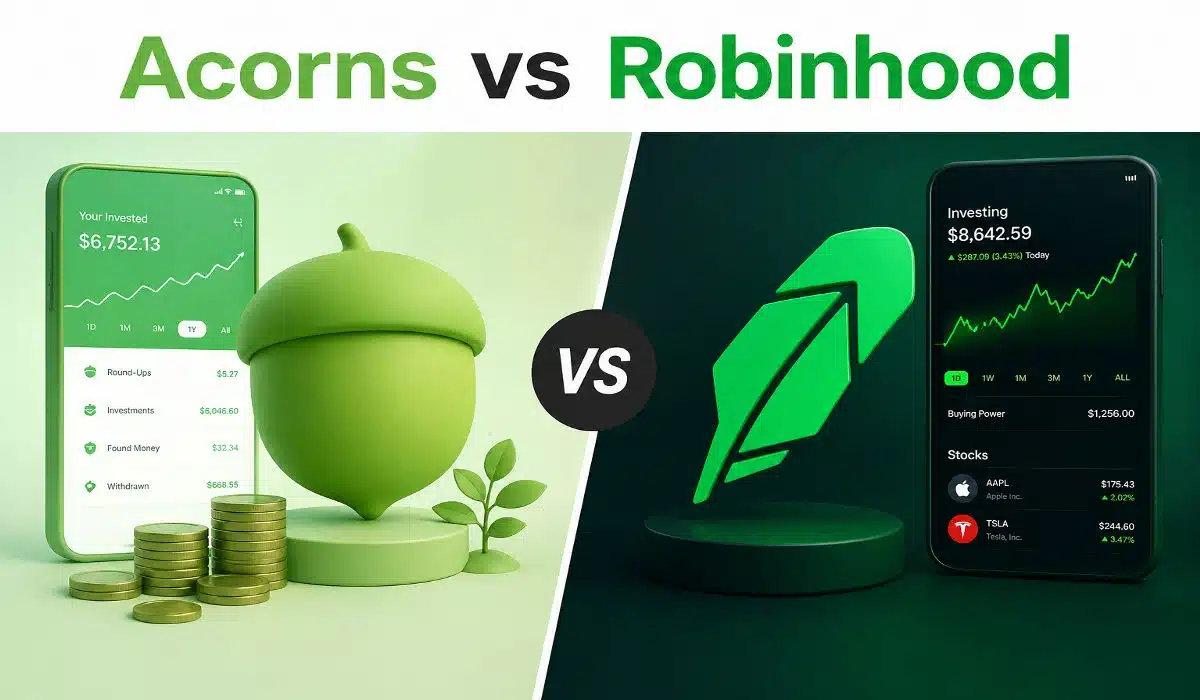
For small investors, the barrier to entry into the stock market has never been lower. However, the philosophy behind Acorns vs Robinhood couldn’t be more different. One app is designed to help you forget you’re even investing, while the other puts you in the driver’s seat of every trade.
The Fundamental Philosophy
When comparing Acorns vs Robinhood, you must first identify your investor personality. Acorns is built on the concept of “micro-investing.” It uses a “round-up” feature to invest your spare change from daily purchases. Conversely, Robinhood is a self-directed brokerage that pioneered commission-free trading, encouraging users to research and buy individual stocks, ETFs, and cryptocurrencies.
Passive Automation vs. Active Control
The biggest divide in the Acorns vs Robinhood debate is automation. Acorns is the king of “set it and forget it.” It automatically builds a diversified portfolio for you based on your risk tolerance. Robinhood, while it has added recurring investment features in 2026, still primarily requires you to pick the specific assets you want to hold.
Subscription vs. Free
Fees can eat into small balances, making this a critical point in Acorns vs Robinhood.
- Acorns operates on a subscription model (typically $3 to $12 per month). For someone with only $100, a $3 fee is a 3% monthly hit—which is high.
- Robinhood offers $0 commission trades and no monthly fee for its standard tier. For a small investor starting with very little capital, Robinhood’s free structure often wins on paper.
Fractional Shares and Diversification
Both platforms excel at allowing small investors to buy “fractional shares.” In the Acorns vs Robinhood comparison, both allow you to buy $1 worth of an expensive stock like Amazon or Costco. However, Acorns automatically spreads your $1 across an entire portfolio (ETFs), while Robinhood requires you to choose the specific stock.
Retirement Accounts
If you are looking for long-term growth, both apps offer IRAs. In the Acorns vs Robinhood matchup, Robinhood has gained an edge recently by offering an IRA “match” (1% to 3% depending on your tier), which is essentially free money for your retirement. Acorns offers “Acorns Later,” which is incredibly easy to set up but lacks the direct matching incentives found on Robinhood.
Educational Resources
Small investors need guidance. Acorns provides “Learn” content that is bite-sized and easy to digest, focusing on the power of compounding. Robinhood provides more technical data, including analyst ratings and “Robinhood Sherwood News,” which is better for those who want to learn the mechanics of the market.
Cryptocurrency Access
If you want exposure to Bitcoin or Ethereum, the winner in Acorns vs Robinhood is clear. Robinhood allows direct 24/7 trading of many cryptocurrencies. Acorns only allows a small, managed “Bitcoin ETF” exposure (usually 1-5%) within your existing diversified portfolio to keep your risk profile balanced.
Banking Integration
Both platforms now offer “Fintech” banking features. When looking at Acorns vs Robinhood for daily banking, Acorns’ “Mighty Oak” debit card offers impressive APY and automatic round-ups. Robinhood’s Gold card and spending account focus more on cash-back rewards and high interest on uninvested cash.
Safety and Security
Is your money safe in Acorns vs Robinhood? Both are members of SIPC, which protects your securities up to $500,000. They both use bank-level encryption and two-factor authentication (2FA). In terms of security, they are equally matched and highly regulated.
Which Should You Choose?
The Acorns vs Robinhood choice boils down to this:
- Choose Acorns if you have trouble saving money and want an app that builds wealth in the background without you having to check the news.
- Choose Robinhood if you want to learn how to pick stocks, trade crypto, and manage your own portfolio without paying a monthly subscription fee.
Family Investing and Custodial Accounts
When looking at Acorns vs Robinhood for the next generation, both have made big moves. Acorns Early (available in the $12 Gold tier) allows parents to set up UTMA/UGMA custodial accounts for their children, featuring automatic recurring investments. In 2026, Robinhood has introduced its own simplified custodial account with a 9.4/10 rating for simplicity. It allows family and friends to gift stocks directly to a child’s account, making it a strong competitor for parents who want more control over individual stock picks for their kids.
Subscription Tiers vs. Premium Memberships
The cost of Acorns vs Robinhood has become more complex in 2026.
- Acorns now uses a tiered system: Bronze ($3/mo), Silver ($6/mo), and Gold ($12/mo). The higher tiers include perks like emergency funds and a 3% IRA match.
- Robinhood Gold costs $5/mo and is packed with high-value features like a 3% IRA match, 3.35% APY on uninvested cash, and advanced Morningstar research. For a small investor, the Robinhood Gold tier often provides a faster “break-even” point than the Acorns Gold tier.
Cash Back and Shopping Rewards
For those who want to earn while they spend, the Acorns vs Robinhood battle extends to rewards. Acorns Earn allows you to get “Found Money” (investment bonuses) when you shop with over 15,000 partner brands. Robinhood, through its new Gold Card, offers up to 3% cash back on all categories, which can be automatically swept into your brokerage account to buy stocks. If you are a heavy spender, Robinhood’s cash-back model might build your portfolio faster than Acorns’ partner-specific rewards.
Hands-Off “Strategies” vs. Robo-Advising
In the Acorns vs Robinhood comparison, Robinhood has finally bridged the gap for passive investors with “Robinhood Strategies.” This is an expert-managed portfolio service that proactively adjusts your investments for a small 0.25% fee (which is capped at $250 for Gold members). While Acorns still remains the pioneer of the classic robo-advisor model with its five core portfolios, Robinhood now offers a competitive “pro-handled” option for those who want to stick with one app for both active and passive goals.
Tax Filing and Financial Tools
Managing taxes is a hidden burden for small investors. A standout feature in the Acorns vs Robinhood 2026 update is that Acorns Gold now includes free tax filing. If you get a refund, Acorns makes it easy to immediately save and invest it. Robinhood provides seamless integration with TurboTax and other major software, but the “built-in” free filing from Acorns is a major cost-saver for students and young professionals who want to keep their financial life under one roof.
FAQ
Q1: Can I use both Acorns and Robinhood?
Ans: Yes! Many small investors use Acorns for their “automated savings” and Robinhood for their “fun/active” money.
Q2: Is Acorns worth the $3 fee for small balances?
Ans: Only if the “Round-up” feature helps you save more money than you would have otherwise. If you are disciplined, the free tier of Robinhood is more cost-effective.
Q3: Does Robinhood offer a 2026 IRA match?
Ans: Yes, Robinhood continues to lead the market by offering percentage matches on IRA contributions for Gold members.
read more: Powerful Professional Development Wins in 2026
Brutal Clash vs Atalanta Ends 2-2 2026

Mr. Udoy is a professional Web Developer and Blogger with 7+ years of experience in the tech world. He specializes in web architecture and digital storytelling. As the driving force behind worldincidents.com, he focuses on delivering high-quality, well-researched content to a global audience.