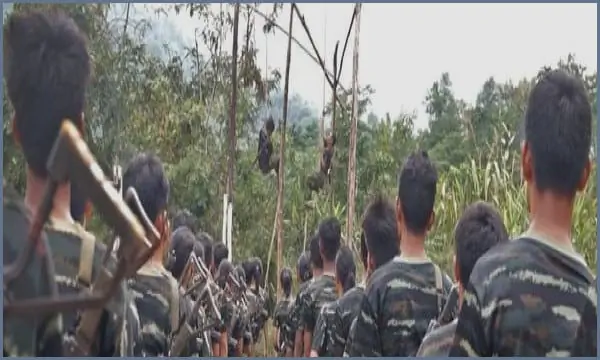
A recent investigative report from Human Rights Watch, titled “Skeletons and Skulls Scattered Everywhere,” has provided distressing evidence regarding the conduct of the Arakan Army in Myanmar’s Rakhine State. The report confirms that on May 2, 2024, the Arakan Army massacred at least 170 Rohingya civilians, including 90 children, in the village of Hoyyar Siri—also known as Htan Shauk Khan—within the Buthidaung Township. The investigation suggests that hundreds more were likely killed or wounded during the incident.
This massacre represents only a portion of the human rights violations attributed to the ethnic armed organization since it began seizing control of much of Rakhine State throughout 2023 and 2024. The organization has been implicated in war crimes including massacres, rape, and arson against Rohingya civilians. Furthermore, the group has subjected the Rohingya population to severe restrictions, forced conscription, and extortion. The Arakan Army has even prohibited the use of the term “Rohingya” under threat of harsh penalty. Major General Twan Mrat Naing, the commander-in-chief of the Arakan Army and Chairman of the United League of Arakan, has publicly denied the distinct identity of the Rohingya people, frequently referring to them as “Bengalis.”
Despite these actions, the Arakan Army is actively seeking international recognition for its de facto control over Rakhine State. The group is leveraging the region’s geostrategic importance to court external actors, including China, India, Bangladesh, and the United States. Rakhine State contains substantial oil and natural gas reserves, provides strategic access to the Indian Ocean, and hosts significant Chinese and Indian infrastructure projects. The Arakan Army is utilizing these factors as bargaining chips to legitimize its administrative control.
From the perspective of international law, the question of recognizing an independent Rakhine State remains moot as the Arakan Army has not issued a formal declaration of independence. Instead, the focus remains on the recognition of its government, the Arakan People’s Revolutionary Government (APRG), which is controlled by the United League of Arakan. This creates a dual-government scenario, as the military-backed Myanmar Union Government maintains a formal presence in the state capital, Sittwe. Currently, the Arakan Army controls approximately 90 percent of Rakhine State and the Paletwa Township of Chin State, while the military-backed government’s authority is largely restricted to Sittwe, the port of Kyaukphyu of Kyaukphyu, and parts of Ann Township.
While full de jure recognition remains unlikely as long as the military-backed government holds Sittwe, the Arakan Army may attempt to secure de facto recognition from states and humanitarian institutions that must engage with them to address the regional crisis. However, experts argue that granting such recognition would be premature. The region remains engulfed in war, and the Arakan Army faces opposition from Chin ethnic armed organizations regarding its control of Paletwa. Furthermore, the group’s confrontational behavior toward Bangladesh—including the abduction of citizens, seizure of vessels, and illicit taxation—has generated significant regional unease.
Ultimately, the international community should condition any recognition of the APRG on the Arakan Army’s willingness to recognize the distinct identity of the Rohingya, commit to their safe and dignified repatriation, and demonstrate a dedication to building an inclusive, democratic, and law-governed polity. Without such changes, granting recognition would be both a moral and pragmatic error that could embolden further reckless behavior.
This constitutes only a small fraction of the Arakan Army’s record of human rights violations against the Rohingyas. Since the ethnic armed organization (EAO) has wrested control of much of the Rakhine State in 2023-2024, it has expelled more than 150,000 Rohingyas into Bangladesh, committed war crimes — massacres, rap
Thus, while the Arakan Army is deliberately refusing to recognize the distinct identity of the Rohingyas, who constituted between 25 and 30 percent of the population of Rakhine State before the 2017 “cleansing operations,” it is seeking international recognition for its de facto control over Rakhine State.
Related Articles

Md. Kazi Bijoy is a dedicated tech enthusiast and content creator with a passion for digital innovation. With years of experience in the tech industry, he specializes in breaking down complex topics into easy-to-understand guides. When he isn’t writing, he explores the latest gadgets and researches emerging trends in the digital world.