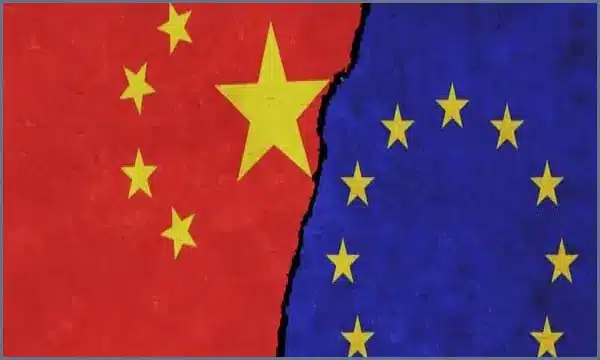
European Union leaders are facing mounting pressure to pivot their economic strategy toward China by placing human rights at the center of trade and industrial policies. For years, Europe's approach to Beijing has focused heavily on market access and technical trade defenses, but critics argue that ignoring systemic state-imposed abuses undermines both European values and economic security.
Recent diplomatic meetings highlight a growing consensus that European trade policy must adapt. At the European Council meeting on June 19, EU leaders instructed the European Commission to develop additional trade defense instruments to safeguard domestic markets against subsidized imports. This was followed by the Franco-German Ministerial Council on July 16–17, where France and Germany aligned to declare that China is "challenging our economy" and jointly demanded an EU roadmap to shield European industries from Chinese competition. Commenting on the shifting landscape, Austrian Chancellor Christian Stocker remarked, "The EU needs to have a strategic reorientation."
Historically, Europe’s reaction to Beijing’s long-term industrial planning has deepened its trade dependency on China, focusing primarily on technical economic issues like overcapacity, market distortions, subsidies, and unfair competition. However, analysts point out that any meaningful shift in EU strategy must address how deeply China's economic machinery is intertwined with human rights abuses. Key industries essential to Europe—such as electric battery manufacturing, solar and renewable energy supply chains, and technology—rely on state-imposed forced labor, forced labor transfers of Uyghur workers, coerced relocations, forced land seizures, and a total ban on independent labor unions.
For years, European governments have effectively overlooked these systemic violations as critical domestic sectors, particularly the automotive industry and raw material suppliers, sought access to Chinese markets. Meanwhile, Beijing has deployed mass surveillance, pervasive repression, and vague criminal laws to suppress domestic dissent and reshape entire industries with minimal resistance.
Beijing has also escalated measures to prevent foreign firms from investigating these abuses. Coercive tactics once reserved for Chinese activists and lawyers are now being directed at multinational companies through extraterritorial regulations. New Chinese decrees restrict the cross-border transfer of technology and data, effectively penalizing European firms that seek transparency or attempt to sever ties with suppliers linked to forced labor.
While the European Commission has developed trade defense mechanisms like anti-dumping duties, safeguard measures, and anti-subsidy duties, these tools fail to address the structural link between the Chinese Communist Party’s authoritarian governance and its economic policies. To counter this, policy advocates suggest the EU should strengthen its regulations banning forced labor products, enabling region-wide bans on goods from Xinjiang or those linked to state-imposed labor transfers. Additionally, strict enforcement of the Corporate Sustainability Due Diligence Directive could compel both European and Chinese firms operating in Europe to uphold strict human rights standards. Finally, the EU must leverage labor protections in International Labor Organization conventions and push Beijing to permit independent unions.
At theEuropean Councilon June 19, EU leadersgave the European Commissiona clear mandate to develop additional trade defense instruments to protect its markets against subsidized imports. At the Franco-German Ministerial Council on July 16-17, for the first time after years of division on the issue, France and Germany j
You have reached the limit of 2 free articles this month.
Related Articles

Md. Kazi Bijoy is a dedicated tech enthusiast and content creator with a passion for digital innovation. With years of experience in the tech industry, he specializes in breaking down complex topics into easy-to-understand guides. When he isn’t writing, he explores the latest gadgets and researches emerging trends in the digital world.