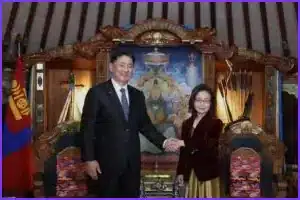
On July 29, 2026, China's Ministry of Foreign Affairs updated its official organizational roster, confirming that Shen Minjuan has assumed office as the director-general of the Department of Asian Affairs, succeeding Liu Jinsong. This diplomatic transition came barely a week after Mongolian President Khurelsukh Ukhnaa presented Shen, who had served as China's ambassador to Mongolia since 2023, with the Order of the Polar Star (Altan Gerege) on July 21, 2026. The honor is Mongolia's highest state award for foreign nationals.
From a regional perspective, this leadership change aligns with strategic adjustments in Beijing's approach to its neighbors. Years of assertive "wolf warrior" diplomacy have yielded diminishing returns across Asia, accelerating hedging behaviors in Southeast Asia, deepening security coordination between the United States and its regional allies, and complicating efforts by smaller states to maintain balanced, pragmatic relations. Historically, China's neighborhood diplomacy has cycled between assertive and cooperative modes roughly every five to seven years, most notably following the 2013 Neighborhood Diplomacy Work Conference and again after the 2018 and 2025 rounds of intensifying strategic competition with the United States.
To understand the significance of the reshuffle, observers point to the tenure of Liu Jinsong, who led the Department of Asian Affairs from 2021 through mid-2026. A career diplomat with previous postings in Japan, India, Afghanistan, and the United Kingdom, Liu brought a firm, unyielding style to the role. His tenure coincided with a period of intensifying regional friction, and his approach prioritized clear deterrence signaling, rigid line-drawing on sovereignty issues, and public displays of resolve. While this tone resonated with domestic nationalist audiences in China, it generated mounting pushback across the region.
A widely cited episode from Liu's tenure occurred in November 2025 during bilateral consultations with Kanai Masaaki, director-general of Japan's Asian and Oceanian Affairs Bureau. The meeting followed a diplomatic dispute triggered by Japanese Prime Minister Takaichi Sanae's parliamentary remarks framing a potential Taiwan contingency as an existential security threat to Japan. Photographs from the encounter showed Liu delivering China's formal protest with his hands tucked into his trouser pockets and his gaze directed downward toward his counterpart. The image circulated widely in regional media and was interpreted in several capitals as a deliberate display of dominance and displeasure.
Reports that Liu may be reassigned as China's next ambassador to Australia suggest Beijing is matching diplomatic temperament to specific theaters rather than repudiating his assertive style. In a bilateral relationship defined by deep structural distrust, AUKUS-driven security frictions, and values-based divergences, an unyielding envoy remains a fitting instrument. However, for China's immediate backyard, where economic interdependence is deep and smaller states resist binary geopolitical choices, Beijing appears to be adopting a different operational tone through Shen.
During her tenure in Mongolia, Shen prioritized practical deliverables over public confrontation. The long-delayed Gashuun Sukhait-Gants Mod cross-border railway, a critical artery for Mongolia's mineral exports that had languished in negotiations for nearly two decades, transitioned into active construction on her watch and is on track for a 2027 commissioning. Bilateral trade progressed steadily toward the $20 billion target set by both national leaders. Energy and infrastructure cooperation also advanced, including upstream oil projects positioned to supply Mongolia's first domestic refinery in Altanshiree soum, Dornogobi province. Furthermore, targeted humanitarian assistance during severe winter dzud disasters reinforced working relationships across the Mongolian political spectrum, while high-level exchanges remained consistent.
Crucially, these outcomes did not require Mongolia to abandon its "Third Neighbor" foreign policy. Shen did not attempt to force the landlocked democracy, situated between China and Russia, to make a binary choice. This combination reduced unnecessary friction without compromising Ulaanbaatar's strategic autonomy. Rather than representing a retreat from Chinese interests, this model acts as a more sophisticated tool for advancing them. By frontloading economic gains, Beijing lowers the domestic political cost for neighboring leaders to accommodate its preferences, while raising the implicit price of deviation from its core red lines.
However, scholarly observers note that this transactional focus carries long-term trade-offs. Prioritizing infrastructure and commodity deliverables over deeper societal, educational, and cultural exchange risks narrowing bilateral relations to a purely economic bargain, potentially eroding the public goodwill that underpins strategic trust.
Shen now inherits a portfolio of deep-seated structural problems that extend far beyond the Sino-Mongolian relationship, and which no change in personnel can fully resolve. The South China Sea remains a highly volatile flashpoint, characterized by repeated standoffs between China and the Philippines under the Ferdinand Marcos Jr. administration, which is backed by expanding minilateral naval coordination among the United States, Japan, and Australia. China-Japan relations remain frozen as Japan expands its defense capabilities and deepens security partnerships. The China-India border stalemate persists, and despite a recent thaw in overall relations, New Delhi continues to solidify border infrastructure and deepen its engagement with the Quad. Additionally, the Korean Peninsula continues to generate instability, with North Korea's advancing nuclear programs and deepening alignment with Russia limiting Beijing's room for maneuver.
The central test of Shen's tenure will be whether the "Mongolia model" can be scaled to China's broader neighborhood diplomacy. Skeptics note that Mongolia was a unique and manageable case, sharing a stable, long-demarcated border with China, possessing an economy structurally dependent on Chinese markets, and maintaining a Third Neighbor policy designed to complement rather than confront Chinese regional influence. The same logic does not apply cleanly to the South China Sea, the East China Sea, or the Sino-Indian border, where partners maintain active security alliances with the United States, hold competing territorial claims, and face strong domestic nationalist incentives to push back. In those areas, economic statecraft is sometimes perceived as economic coercion, further hardening positions.
Shen also faces internal constraints. Domestic nationalist public opinion in China acts as a de facto floor on diplomatic flexibility, as perceived softness on sovereignty reliably triggers backlash. She must also coordinate across bureaucratic silos—including the Ministry of Commerce, border control agencies, and the military—each with its own institutional priorities. Most fundamentally, the broader context of China-U.S. strategic competition remains unchanged. As long as Washington deepens its regional alliance architecture, Beijing will continue to prioritize deterrence, regardless of diplomatic style.
Shen's ascent to lead the Department of Asian Affairs represents a deliberate upgrading of Beijing's diplomatic execution rather than a dramatic policy reversal. For Mongolia, the forthcoming appointment of a new Chinese ambassador to Ulaanbaatar will provide an early signal of how broadly this pragmatic, project-focused playbook will be applied. If Beijing selects another pragmatic envoy from the standard Asian affairs pipeline, it will suggest that Shen's approach is being institutionalized. A more security- or ideology-focused appointee, by contrast, would indicate that the recalibration is limited in scope.
Related Articles

Md. Kazi Bijoy is a dedicated tech enthusiast and content creator with a passion for digital innovation. With years of experience in the tech industry, he specializes in breaking down complex topics into easy-to-understand guides. When he isn’t writing, he explores the latest gadgets and researches emerging trends in the digital world.