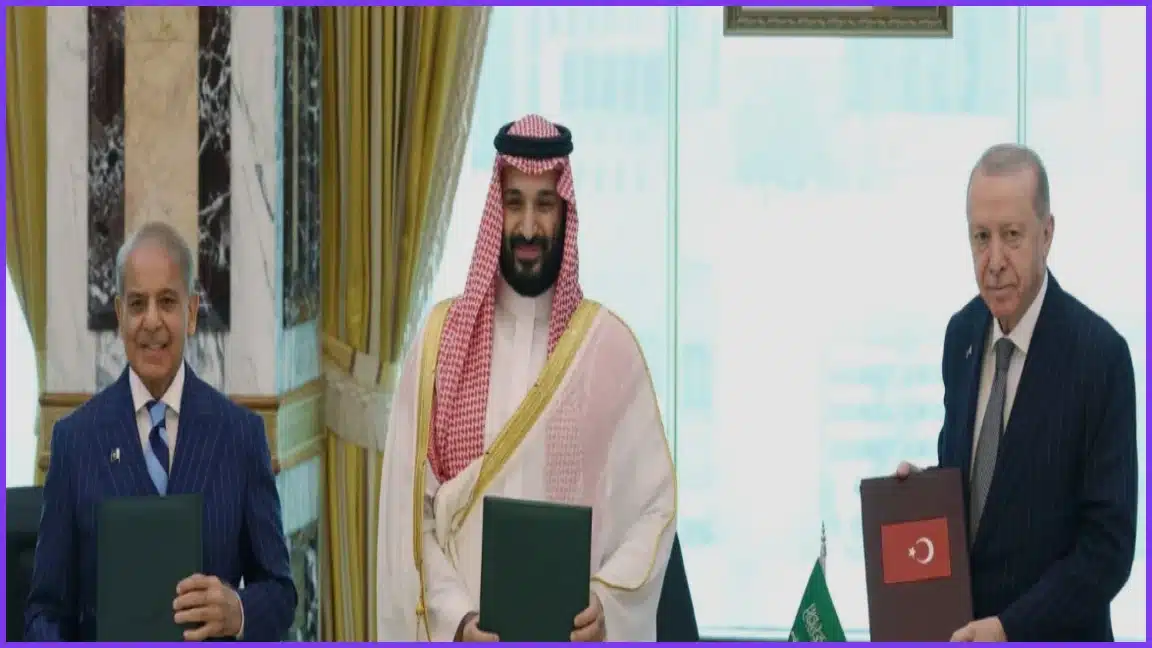
Saudi Arabia, Turkey, and Pakistan have officially entered into a joint defence agreement, establishing a pact that declares an armed attack against any one of the three nations will be viewed as an attack on all of them.
The agreement was finalized during a meeting in the Saudi city of Mecca, attended by Saudi Crown Prince Mohammed bin Salman, Turkish President Recep Tayyip Erdogan, and Pakistani Prime Minister Shehbaz Sharif.
According to a joint statement, the pact is designed to strengthen collective deterrence against any form of aggression. While the agreement commits the three states to mutual support and the enhancement of all aspects of defence cooperation, it does not outline specific obligations for each party.
A Turkish official, speaking to the Reuters news agency, described the agreement as being purely defensive in nature.
The signing of this pact occurs against the backdrop of significant regional instability. Following US and Israeli attacks on Iran on February 28, Tehran and its allies responded by striking targets within Saudi Arabia and other Gulf states.
These actions included the disruption of maritime traffic in the Red Sea and the Strait of Hormuz, a critical oil shipping channel.
Furthermore, Yemen's Iran-backed Houthi rebels have escalated tensions by announcing a maritime embargo against Saudi Arabia and targeting Saudi oil facilities, airports, and tankers.
The Mecca agreement has been met with criticism from Tehran. Ebrahim Rezaei, a senior member of the Iranian parliament’s National Security commission, dismissed the pact on the social media platform X, stating that a paper agreement with Turkey and Pakistan would not provide the security the Saudis seek, comparing it to previous reliance on the United States.
This new alliance follows a separate joint defence pact announced last year between Saudi Arabia and Pakistan. For Saudi Arabia, the agreement serves as a response to the shifting security landscape in the region, which has been significantly altered by the ongoing conflict between the US, Israel, and Iran.
Analysts from the Centre for Strategic and International Studies noted last year that Gulf states have been actively recalibrating their defence strategies in light of these regional threats.
Pakistan’s participation in the agreement also highlights its growing role in global diplomacy. Having served as an intermediary between the US and Iran, and hosting ceasefire negotiations, Pakistan’s status in the region has been bolstered, a position this new pact further cements.
While the agreement is intended to function as a deterrent by ensuring that potential aggressors face the combined weight of three regional powers, the practical application of the pact remains complex.
Questions persist regarding the specific circumstances under which these mutual obligations would be triggered, such as potential future conflicts involving the Houthis or tensions between Pakistan and India. Ultimately, the signatories are banking on the agreement to increase the potential cost of any future aggression against them.
Related Articles

Md. Kazi Bijoy is a dedicated tech enthusiast and content creator with a passion for digital innovation. With years of experience in the tech industry, he specializes in breaking down complex topics into easy-to-understand guides. When he isn’t writing, he explores the latest gadgets and researches emerging trends in the digital world.