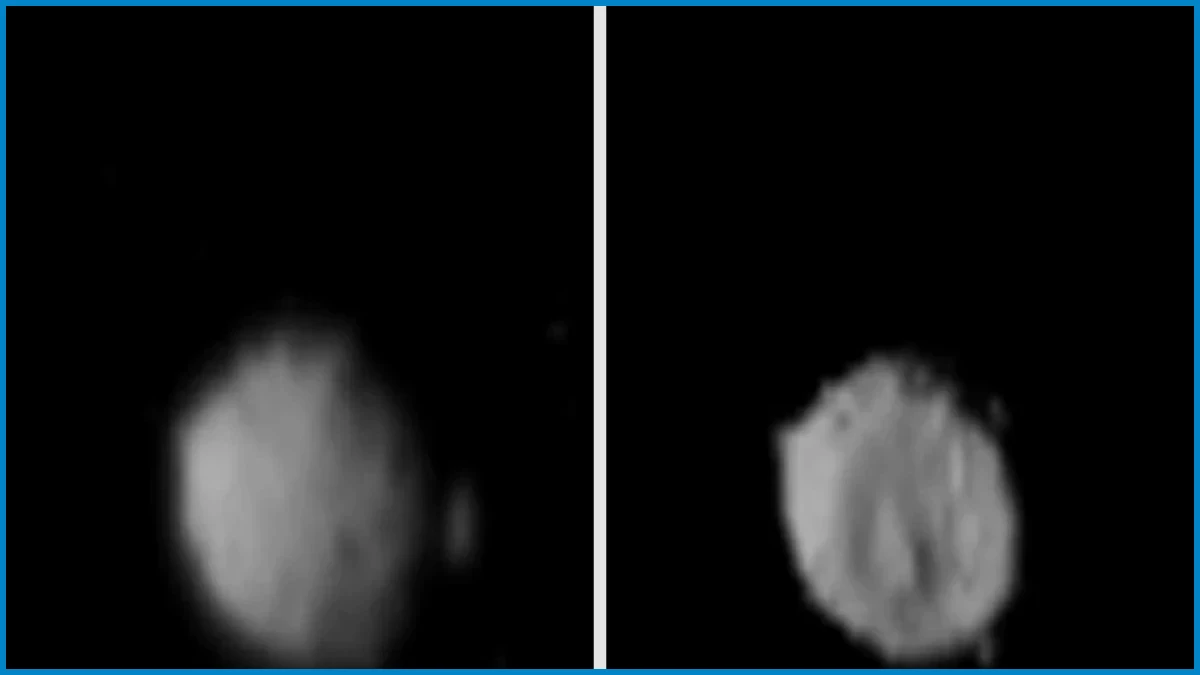
The first images returned by the European Space Agency spacecraft Hera have revealed a stadium-sized impact crater stretching across the surface of the asteroid Dimorphos, four years after a NASA probe intentionally slammed into the space rock.
The extensive structural damage was created during a 2022 planetary defense experiment when NASA's Double Asteroid Redirection Test (DART) spacecraft slammed into Dimorphos at a velocity of 14,000 mph (22,000 km/h). Although Dimorphos posed no threat to Earth, the mission was designed to test whether kinetic impact could successfully alter the trajectory of a celestial object.
"The crater is almost as large as the body itself, which is really, really spectacular," said Dr Sabina Raducan, a planetary scientist on the Hera science team. Reflecting on the initial images, she added: "It's hard to describe in words all the excitement to actually finally see what happened. And as a crater person, I can also say it's beautiful."
The initial collision in 2022 generated a violent smash-up, producing a massive trail of debris extending approximately 6,200 miles (10,000 km) into space, which was observed by space observatories, including the Hubble Space Telescope, as well as ground-based telescopes on Earth.
Dimorphos, measuring roughly 150m (500ft) across, was selected as the target in part because it forms a binary system with a larger asteroid, Didymos, which spans about 730m (2,400ft) wide. Prior to the impact, Dimorphos completed one orbit around Didymos every 11 hours and 55 minutes. The collision demonstrated the feasibility of kinetic deflection by shortening that orbital period by approximately 33 minutes.
Beyond altering its orbit, the impact fundamentally transformed the physical dynamics and rotation of Dimorphos. Before DART struck the asteroid, Dimorphos was tidally locked to Didymos much like Earth's Moon, consistently presenting the same face to its larger companion. Now, researchers observe that the asteroid is tumbling unpredictably. "Before the Dart impact, Dimorphos was more like our own Moon – so it was always showing the same face to Didymos, and it was behaving quite nicely," explained Raducan. "Now it's very, very chaotic – it's tumbling. Imagine a barrel that you throw down the stairs, and the barrel is rolling and it's moving, and basically that's what Dimorphos does right now around Didymos."
A central goal of the Hera mission is to precisely determine the mass of Dimorphos, providing critical measurements needed to evaluate the exact momentum transferred by DART's impact. Such data would prove essential if scientists ever detect an asteroid on a true collision trajectory toward Earth.
"It would help us to predict what would happen if we had to hit another asteroid," stated Prof Simon Green, a planetary scientist on the Hera science team. He noted that the measurements allow scientists to calculate the exact mass of a spacecraft and speed required early on to deflect a dangerous body enough so that it safely misses Earth.
Hera's arrival is also shedding light on the geology of the host asteroid, Didymos. Mission imagery reveals complex surface structures under ultra-low gravitational conditions, which are approximately 40,000 times weaker than Earth's surface gravity.
Naomi Murdoch, a member of the Hera mission team, pointed out that the smallest resolvable surface details in the imagery measure about 3m in size. "We can already see some fascinating and complex geology. We can see regions of boulders," Murdoch said. "The smallest details that we can make out in these images are about 3m in size. So that means that all the boulders that you can see with your eyes are at least 3m big, and some as big as 10m. So what we're seeing here is boulders the size of cars and buses sitting on a world with almost no gravity."
However, Hera's early findings also highlight major operational hurdles for space agencies. The images reveal that Dimorphos and Didymos are navigating space surrounded by a dense cloud containing hundreds of loose boulders, ranging in size from tens of centimetres to metre-size rocks. Navigating Hera and its onboard instruments through this hazardous boulder field presents significant operational challenges.
Hera carries two shoe-boxed sized satellites onboard designed to conduct close-up scientific observations of the impact site before eventually landing directly on the asteroid. Describing the spacecraft's role, Patrick Michel, principal investigator of ESA's Hera mission, said: "Hera is a sort of Inspector Columbo going back to the crash scene to investigate what is the outcome of this impact." Over the next six months, Hera will remain in orbit around the binary system, capturing increasingly close high-resolution photographs and gathering scientific data.
The findings are crucial because asteroids remain a potent threat to human civilization. While giant asteroids measuring more than a kilometre across could trigger global devastation, medium-sized objects comparable to the 150-metre Dimorphos possess enough force to wipe out an entire city.
"We all know what happened to the dinosaurs, right? And we don't want that to happen to us," remarked Carolyn Ernst of the Johns Hopkins Applied Physics Laboratory, who has worked on both the DART and Hera missions. "The good news for us is that there are far fewer potential threats out there in the Solar System than there were millions of years ago. But there are objects out there."
Ernst noted that astronomers have identified virtually all of the largest planet-killing asteroids and confirmed none are currently on a trajectory toward Earth. Atmospheric entry offers natural protection against the smallest debris, but medium-sized asteroids pose a blind spot. "The smallest stuff isn't too much of a threat because our atmosphere protects us," Ernst added. "But there's a size range in the middle where we don't know where all of them are, and it could, if impacted, cause problems for humanity. And if we can find out about that and know about that, well, we sure as heck would want to try to stop that."
Planetary defense efforts will expand further in 2027 with the launch of the Near-Earth Object (NEO) Surveyor, a specialized space telescope dedicated to searching for and tracking potentially hazardous asteroids. In addition, scientists are preparing to explore other prominent space rocks, including Apophis, a 450m (1,480ft) long asteroid discovered in 2004.
Initial calculations after Apophis's discovery suggested a potential Earth impact as early as 13 April 2029. Refined orbital models have since confirmed that Apophis will not pose a threat to Earth for at least the next 100 years. Instead, on 13 April 2029, Apophis will make an extraordinarily close flyby just 32,000km (20,000 miles) above Earth's surface, affording scientists a rare close-up observational window. Two spacecraft are scheduled to head to Apophis, including NASA's Osiris-Apex—which previously grabbed a sample from another asteroid called Bennu—and Ramses, a joint mission between ESA and the Japanese Space Agency (JAXA).
Related Articles

Mr. Udoy is a professional Web Developer and Blogger with 7+ years of experience in the tech world. He specializes in web architecture and digital storytelling. As the driving force behind worldincidents.com, he focuses on delivering high-quality, well-researched content to a global audience.