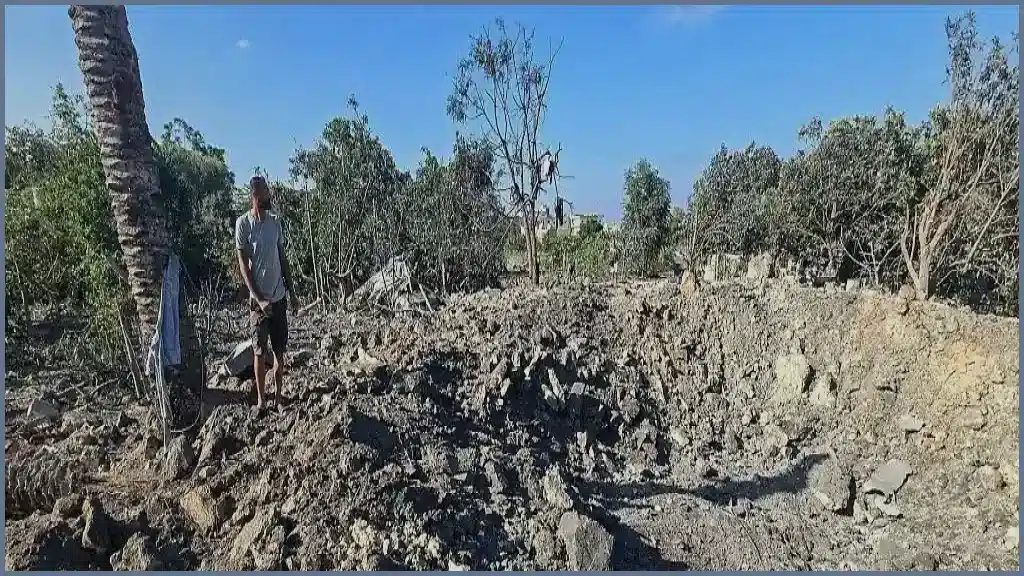
Israeli airstrikes in southern Lebanon have killed 11 people, marking one of the deadliest days of violence since a June agreement aimed at curbing hostilities. The strikes, which hit residential areas and displaced families, have sparked intense condemnation from Lebanese officials and a sharp exchange of accusations between Israel and Hezbollah.
In the early hours of Saturday, around 04:30 local time (01:30 GMT), an Israeli strike targeted a home on the outskirts of Ansar, a village located approximately 70 kilometers (43 miles) south of the capital city of Beirut. According to Lebanese Prime Minister Nawaf Salam, the attack killed seven people. Lebanese state media reported that the victims included three children and two women, who were part of displaced families sheltering in the building. Footage circulated on social media showed thick plumes of smoke rising through the streets of Ansar as emergency sirens wailed in the background.
Later on Saturday, another round of Israeli airstrikes struck the town of Deir al-Zahrani. The Lebanese Ministry of Health confirmed that this subsequent attack killed four people and left five others injured, raising the day's total death toll to eleven.
The Israel Defense Forces (IDF) defended the military action, stating that the strike in Ansar was a direct response to an earlier incident on the Ali al-Taher Ridge. This strategic high ground, which overlooks much of south-eastern Lebanon, has been one of the most fiercely contested positions throughout the conflict. The IDF announced that the strike successfully eliminated Ali Samir al-Haj Hassan, whom they identified as a Hezbollah battalion commander within the elite Radwan Force. According to the Israeli military, several other operatives involved in planning attacks against Israeli troops were also killed.
Addressing the civilian casualties, the IDF asserted that Commander Hassan was a lawful target under international law. They accused him of using his family and other civilians as "human shields" by hiding alongside them inside what Israel characterized as a military headquarters. The office of Israeli Prime Minister Benjamin Netanyahu released a matching statement, explaining that the military response was launched after a Hezbollah attack seriously injured three Israeli soldiers. Netanyahu's office claimed that the IDF targeted the specific headquarters that ordered the attack on their soldiers, adding that they only learned afterward that Hezbollah had placed civilians inside the compound. The Israeli Prime Minister's office accused Hezbollah of willingly using its own population to falsely accuse Israel of targeting civilians.
Lebanese leaders and Hezbollah strongly rejected Israel's explanations. Prime Minister Nawaf Salam condemned the strike in Ansar, emphasizing that the seven civilians killed were not part of any "military infrastructure." He urged Israel to halt its military escalation, stating that the security of the Lebanese people and their right to live on their land are non-negotiable. Hezbollah also dismissed Netanyahu's assertions as "false claims," countering that Lebanese civilians were intentionally targeted inside their homes, with many reduced to human remains before Israel falsely claimed the sites were military facilities.
Lebanon's President Joseph Aoun also condemned the strikes, particularly the attack that wiped out an entire family in Ansar. He characterized the strikes as "repeated violations" of the June ceasefire framework, suggesting they sent a "clear message" to the ongoing US-led diplomatic negotiations.
The broader conflict dates back to March 2, when Lebanon was drawn into the war involving Israel, the United States, and Iran. This occurred after Hezbollah, the Iran-backed Shia militia, fired rockets into Israel to retaliate for an airstrike that killed Iran's supreme leader. In response, Israel launched an extensive bombing campaign and invaded southern Lebanon, where its military still occupies about 5% of the territory. The ceasefire framework established in June outlines a gradual withdrawal of Israeli forces, the disarmament of Hezbollah, and the deployment of the Lebanese army in the southern region. However, Hezbollah was not a party to this agreement and has consistently rejected direct talks.
Despite a general reduction in hostilities following the June agreements, Israeli military operations, strikes, and demolitions have persisted in southern Lebanon. The IDF has maintained that it will continue its operations to neutralize threats against Israeli citizens and soldiers within its designated 10-kilometer-deep security buffer zone. Meanwhile, Lebanese and Israeli negotiators are scheduled to convene for an eighth round of talks in September, though an exact date has yet to be finalized.
Related Articles

Meet Md. Rubel Rana
As a core contributor to Worlddincidents.com, Rubel Rana brings a unique perspective to the world of journalism. Whether it’s deep-diving into historical trivia or covering the latest global headlines, Rubel Rana is committed to delivering high-quality, high-impact articles. Their writing blends meticulous research with a compelling voice, helping readers stay informed and curious about the world around them.