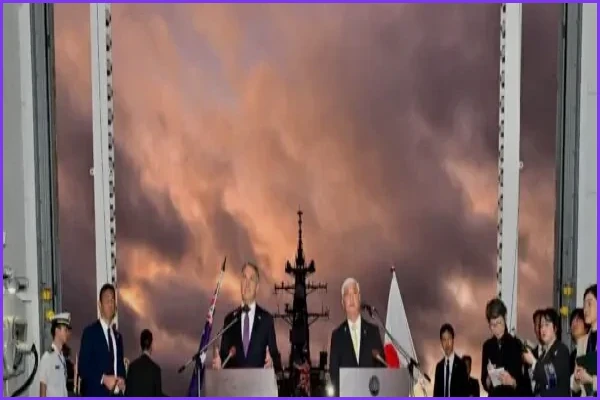
On September 5, 2025, Japanese Defense Minister Nakatani Gen and Australian Defense Minister Richard Marles held a joint press announcement aboard the Japan Maritime Self-Defense Force's Mogami-class stealth frigate JS Mikuma at the Yokosuka naval base in Japan. Their meeting highlighted a rapidly transforming Indo-Pacific security landscape, marked by the deepening alignment of revisionist powers—specifically China, Russia, and North Korea—and shifting strategic priorities for the United States. Concurrently, rapid technological advancements in artificial intelligence, autonomous systems, quantum technologies, and cyber capabilities are fundamentally redefining the nature of military advantage and warfare.
In response to these systemic shifts, Tokyo and Canberra are forging a comprehensive security and economic partnership aimed at building strategic autonomy and strategic resilience. Rather than seeking total independence from the United States, strategic autonomy in this context means minimizing excessive reliance on any single superpower to preserve broader strategic choices and freedom of action. Meanwhile, strategic resilience focuses on the capacity of both nations to endure and recover from major geopolitical shocks, whether they manifest as armed conflicts, supply-chain bottlenecks, energy crises, or economic coercion.
For decades following the Cold War, Japan and Australia operated under a "dual dependence" model. They relied heavily on the United States for national security while cultivating deep economic interdependence with China, allowing them to maintain low defense budgets while capitalizing on China's rapid economic expansion. However, as the rivalry between Washington and Beijing intensifies, this dual arrangement has become increasingly unsustainable. Because complete economic decoupling from China is unrealistic and replacing American security guarantees with Chinese dependence is not a viable option, both nations are actively working to diversify their dependencies and expand their network of partners.
A prime example of this evolving bilateral relationship is Australia's acquisition of Japanese-designed Mogami-class frigates. This collaboration extends far beyond a simple equipment transfer; it represents a long-term commitment to joint development, production, maintenance, and future technology sharing. Such cooperation strengthens the defense industrial bases of both countries, enhancing their collective capacity to manufacture and sustain military assets over time. Additionally, Australia's vast geography offers critical strategic depth. While Japan sits on the front lines of the First Island Chain, Australia can provide crucial logistics, maintenance, rear-area support, and expansive training grounds. Establishing these mechanisms during peacetime ensures both nations can sustain prolonged military operations during a crisis, especially as the Japan Self-Defense Forces expand their operational reach beyond the First Island Chain into the wider Pacific.
This collaborative logic also extends to economic security and regional stability. Tokyo and Canberra are working to diversify supply chains for critical minerals, energy, and advanced technologies. Initiatives like "POWERR Asia" seek to establish regional energy stockpiling, sharing, and emergency supply frameworks to absorb sudden external shocks. Furthermore, their engagement with Pacific Island nations focuses on building local resilience in infrastructure, communications, energy, and economic security. Rather than treating these smaller nations merely as arenas for great-power competition, the goal is to provide viable developmental alternatives so they are not forced to choose between the United States and China. Ultimately, this partnership does not aim to isolate China or abandon the vital U.S. security presence, but rather to empower Indo-Pacific nations to play a more active, autonomous role in shaping the regional order.
You have reached the limit of 2 free articles this month.
Related Articles

Md. Kazi Bijoy is a dedicated tech enthusiast and content creator with a passion for digital innovation. With years of experience in the tech industry, he specializes in breaking down complex topics into easy-to-understand guides. When he isn’t writing, he explores the latest gadgets and researches emerging trends in the digital world.