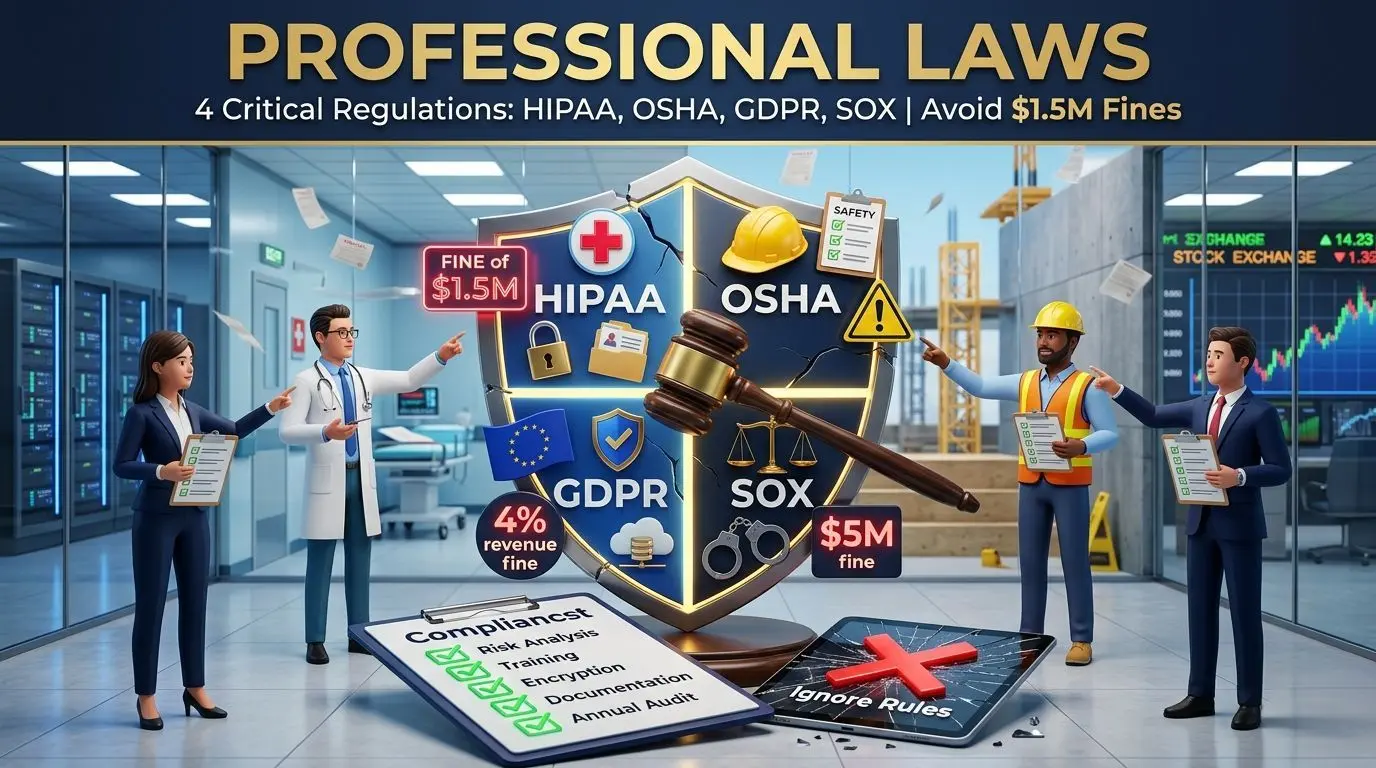
Professional Laws: 4 Critical Regulations to Follow in 2026
Every career pathway has rules. Whether you are in healthcare, finance, IT, or retail, there are professional laws you must follow. Non-compliance leads to fines, lawsuits, and reputational damage. For example, HIPAA violations can cost $1.5 million per incident. OSHA penalties reach tens of thousands per violation. This guide answers what are at least four laws or regulations professionals in this pathway must abide by or follow in 2026.
The most common professional laws cover data privacy, workplace safety, financial reporting, and payment security. These apply across industries. Understanding them protects your license, your company, and your clients. Let’s break down four critical regulations every professional should know.
1. HIPAA: The Core of Healthcare Professional Laws
The Health Insurance Portability and Accountability Act is the foundation of professional laws for anyone handling protected health information. This includes doctors, nurses, pharmacists, billing staff, IT vendors, and business associates.
HIPAA has four key rules: Privacy Rule, Security Rule, Enforcement Rule, and Omnibus Rule. Together they control how you access, use, disclose, and safeguard PHI. In 2026, 98% of small medical practices trust they are HIPAA compliant despite material compliance gaps. These failures are rarely intentional. They stem from misconceptions.
Key HIPAA Requirements for Professionals
- Risk Analysis: You must conduct a thorough risk analysis annually. It is not optional. HHS and OCR require it to identify threats and vulnerabilities.
- Administrative Safeguards: Background checks, termination procedures, training, and access controls. HIPAA compliance is not a box to check. It requires ongoing evaluation.
- Physical Safeguards: Facility access controls, workstation security, visitor badges, and device controls.
- Technical Safeguards: Encryption, passwords, audit controls, and automatic logoff. Email encryption is one of the strongest defenses against breaches.
- Documentation: Without written policies governing encryption and PHI use, you fail audits. OCR levied a $3.5 million fine against Triple-S for “widespread non-compliance” and no safeguards.
Common misconception: HIPAA is an IT issue only. In reality, it reaches every part of your organization. Violations range from $100 to $50,000 per incident, with a yearly cap of $1.5 million. For healthcare professionals, HIPAA is the most enforced of all professional laws.
2. OSHA: Workplace Safety Professional Laws
The Occupational Safety and Health Act governs workplace safety for healthcare, labs, manufacturing, and construction. OSHA and HIPAA often overlap. A breach of patient data could involve a safety violation if improper handling causes harm. Unsafe environments can also lead to privacy breaches, like improper disposal of documents.
OSHA requires employers to provide a workplace free from recognized hazards. For healthcare, this includes bloodborne pathogens, needlestick safety, hazard communication, and emergency action plans. Penalties vary by severity but can reach tens of thousands per violation.
How OSHA Connects to Other Professional Laws
Embedding OSHA and HIPAA training into your culture helps staff understand their roles. A hospital that promotes safety and privacy sees fewer breaches and accidents. Leadership commitment and clear policies are mandatory. For professionals in any pathway with physical risk, OSHA is non-negotiable among professional laws.
Read More: College Payment: 9 Proven Ways to Fund Your Degree 2026
3. GDPR: Global Data Privacy Professional Laws
The General Data Protection Regulation applies to any professional handling EU resident data. It sets strict standards for collection, storage, and transmission. GDPR compliance means following data protection laws to keep sensitive information safe from unauthorized access, breaches, and misuse.
In 2026, the EU proposed updates to clarify that information is not personal data if organizations lack the “means reasonably likely to be used to identify the natural person.” This could take many businesses handling pseudonymised datasets outside GDPR obligations. Still, most professional laws for data privacy mirror GDPR.
GDPR Requirements for Professionals
- Lawful Basis: You must have consent or another legal basis before collecting data.
- Privacy by Design: Build safeguards into systems from the start.
- Breach Notification: Report breaches within 72 hours to authorities.
- Data Subject Rights: Honor requests for access, deletion, and portability.
- Records of Processing: Document what data you hold and why.
GDPR fines are up to 4% of global annual revenue or €20 million. For IT, marketing, and SaaS professionals, GDPR is one of the most expensive professional laws to violate. CCPA in California imposes similar rules in the US.
4. SOX: Financial Reporting Professional Laws
The Sarbanes-Oxley Act of 2002 governs financial practices and corporate governance. It applies to all US public companies and their accountants, auditors, and executives. SOX was created after Enron and WorldCom to protect investors from fraudulent accounting.
SOX is critical for finance, accounting, and executive professionals. It is one of the strictest professional laws for corporate conduct.
Key SOX Requirements
- Section 302: CEOs and CFOs must personally certify financial reports are accurate.
- Section 404: Management and auditors must establish internal controls and report on their adequacy.
- Section 802: Criminal penalties for altering or destroying records. Fines up to $5 million and 20 years prison.
- Whistleblower Protection: Employees who report fraud cannot be retaliated against.
SOX compliance requires documented controls, risk assessments, and annual audits. For any professional in the financial pathway, SOX defines what you must abide by or follow daily.
Bonus: PCI DSS for Payment Professional Laws
If your pathway touches credit cards, PCI DSS applies. The Payment Card Industry Data Security Standard mandates encryption, access control, network monitoring, and regular testing. PCI DSS, HIPAA, and ISO 27001 are the top data-security standards in 2026. Violations lead to fines, higher transaction fees, or loss of card processing ability.
How These Professional Laws Overlap
Modern compliance means following multiple frameworks at once. A hospital uses HIPAA for patient data, OSHA for staff safety, PCI DSS for cafeteria payments, and SOX if publicly traded. 87% of organizations report negative outcomes from low compliance maturity.
A connectivity cloud simplifies compliance by unifying security controls across systems, users, and applications. It helps meet data localization, NIST, ISO 27001, HIPAA, and GDPR at once. This reduces tool sprawl and staff burnout, which are the biggest human impacts on compliance teams.
Steps to Follow Professional Laws in Your Pathway
1. Identify Which Laws Apply: Map your data and processes to HIPAA, OSHA, GDPR, SOX, or PCI DSS.
2. Perform Risk and Gap Analysis: Compare current practices to HHS, DOL, or SEC audit protocols. Identify weaknesses.
3. Implement Safeguards: Add administrative, physical, and technical controls appropriate for your size and complexity.
4. Train Staff Annually: Human error is the top breach cause. Training must cover fraud, abuse, privacy, and security.
5. Document Everything: Auditors require policies, training logs, and risk analyses. No documentation equals non-compliance.
6. Monitor and Update: HIPAA, GDPR, and SOX are not static. Review controls annually or after major changes.
These steps apply whether your pathway is healthcare, finance, tech, or education. They turn complex professional laws into operational checklists.
Cost of Ignoring Professional Laws
Non-compliance costs more than compliance. HIPAA: up to $1.5M per year. GDPR: up to 4% revenue. SOX: $5M fines and prison. OSHA: $16,000+ per serious violation. Beyond fines, you lose patient trust, investor confidence, and business licenses.
In 2026, compliance budgets are rising because AI-enabled breaches, third-party risk, and cloud adoption increase exposure. Yet staffing shortages remain. The solution is automation, clear policies, and a culture of compliance.
FAQ Section
1. What is the difference between a law and a regulation?
A law is passed by Congress, like HIPAA or SOX. A regulation is created by agencies like HHS or SEC to enforce the law. Both are legally binding.
2. Do small businesses need to follow GDPR?
Yes, if you collect data from EU residents. GDPR has no company size exemption. You must obtain explicit consent and honor data rights.
3. Is a risk analysis required annually?
Yes. HHS and OCR guidelines say risk analysis should be updated at least annually to reflect current operational practices.
4. Can one violation trigger multiple penalties?
Yes. A single breach can violate HIPAA, state law, and GDPR at once. You may pay fines to multiple regulators.
5. Does OSHA apply to office workers?
Yes. OSHA covers all workplaces. Office hazards include ergonomics, fire safety, and emergency exits, not just construction sites.
6. What is the penalty for SOX non-compliance?
Executives face up to $5 million in fines and 20 years prison for willful certification of false financials or destroying records.
7. Are Business Associates covered by HIPAA?
Yes. The 2013 Omnibus Rule made Business Associates directly liable. Vendors handling PHI must follow HIPAA too.
8. How often should staff be trained?
At hire and annually after. Also retrain after policy changes or a breach. Training must cover privacy, security, and fraud.

Meet Md. Rubel Rana
As a core contributor to Worlddincidents.com, Rubel Rana brings a unique perspective to the world of journalism. Whether it’s deep-diving into historical trivia or covering the latest global headlines, Rubel Rana is committed to delivering high-quality, high-impact articles. Their writing blends meticulous research with a compelling voice, helping readers stay informed and curious about the world around them.
2 thoughts on “Professional Laws: 4 Critical Regulations to Follow in 2026”