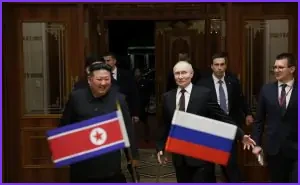
Russia’s long-standing diplomatic position regarding North Korea has undergone a profound transformation. Once a proponent of denuclearization and a participant in sanctions as a necessary diplomatic tool, Moscow has pivoted to a stance that characterizes denuclearization as an irrelevant objective and international sanctions as largely ineffective. This shift reflects Moscow's broader critique of United States foreign policy.
The roots of Russia’s skepticism toward sanctions can be traced back to the 2003-2009 Six-Party Talks. During that period, Russian officials consistently argued that sanctions should be used to encourage dialogue rather than to punish Pyongyang. After North Korea withdrew from the talks in April 2009, then-Vice Foreign Minister Alexey Borodavkin urged participants to prioritize the resumption of multilateral discussions over the intensification of economic pressure.
As the international sanctions regime expanded throughout the 2010s, Russia began to use the North Korean case to challenge the legitimacy of both unilateral and U.S.-led U.N. sanctions. Russian representatives frequently framed these measures as excessive and detrimental to the humanitarian situation within North Korea. Although Russia continued to vote for sanctions during this time—partly to address Chinese concerns—it increasingly criticized the negative consequences of such policies, particularly after the deterioration of Russia-U.S. relations following the 2022 invasion of Ukraine.
This opposition culminated in 2024 when Russia vetoed the resolution to extend the mandate of the 1718 Committee Panel of Experts. Vasily Nebenzya, Russia’s Permanent Representative to the U.N., argued that the panel had become a tool for Western interests, claiming that it targeted North Korea’s legitimate activities. Moscow later dismissed the subsequently formed Multilateral Sanctions Monitoring Team (MSMT) as illegitimate due to its lack of a U.N. mandate, with Nebenzya labeling its reports as fabrications and disinformation in 2026.
Russia’s discourse regarding North Korea’s nuclear program has also evolved from firm condemnation to an acknowledgment of Pyongyang’s actions as legitimate self-defense. While Moscow previously protested nuclear tests in 2006, 2009, 2013, 2016, and 2017, the signing of the 2024 Comprehensive Strategic Partnership agreement marked a definitive change. By September 2024, Foreign Minister Sergey Lavrov declared denuclearization a "closed issue," citing the intensifying military alliance between South Korea and the United States as the primary driver of regional tension.
During a 2025 visit to North Korea, Lavrov emphasized that Russia understands the reasoning behind Pyongyang’s nuclear program, explicitly pointing to the 2023 Washington Declaration and joint military exercises as justifications. In November 2026, Foreign Ministry Spokeswoman Maria Zakharova reaffirmed this stance, describing North Korea’s defense efforts as fully consistent with the right of self-defense under the U.N. Charter. This framing challenges traditional interpretations of international norms, as Moscow continues to position itself against what it describes as a Western-imposed "rules-based order."
You have reached the limit of 3 free articles this month.
Related Articles

Md. Kazi Bijoy is a dedicated tech enthusiast and content creator with a passion for digital innovation. With years of experience in the tech industry, he specializes in breaking down complex topics into easy-to-understand guides. When he isn’t writing, he explores the latest gadgets and researches emerging trends in the digital world.