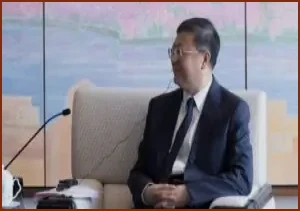
The sudden announcement on the night of November 24 that Shanghai Party Secretary Chen Jining is under official investigation has reverberated across Chinese political circles. Officially targeted for "severe violations of discipline and law," the former model technocrat oversaw China’s primary economic stronghold and was widely considered by international observers and China watchers as a leading potential successor to supreme leader Xi Jinping.
Chen’s foreign profile had steadily expanded in his high-profile position, highlighted by an official meeting in Shanghai on April 25, 2024, with then-U.S. Secretary of State Anthony Blinken. Over the years, prominent foreign politicians, corporate executives, and academics had publicly praised Chen as a highly capable technocrat and prospective future national leader. However, analysts note that in a system governed by absolute, personalized authority, high-profile international acclaim and visible competence can generate suspicion rather than political security, as only Xi controls official advancement.
Political purges among elite officials have become a frequent feature of governance in contemporary China, yet Chen's removal underlines a recurring historical pattern within comparable authoritarian regimes. Historical precedents from the Soviet Union under Joseph Stalin and China under Mao Zedong demonstrate that designated or prospective heirs routinely face profound political vulnerability, as the accumulation of influence by capable subordinates frequently triggers distrust from supreme leaders.
During his rule, Stalin initiated sweeping purges aimed at eliminating perceived counter-revolutionaries, plotters, and saboteurs, targeting close followers and potential successors alike. Although Stalin never named an official successor, his deputy Andrei Zhdanov was widely regarded as his likely heir until their relationship fractured in 1948. The Politburo subsequently sent Zhdanov to a sanatorium, where he died shortly after from cardiac arrest. Following Zhdanov's death, an investigation into his Leningrad network resulted in executions, imprisonments, and exiles. Stalin later initiated the Mingrelian Affair in 1951, which targeted secret police chief Lavrentiy Beria, another potential successor, though the campaign was cut short by Stalin’s death.
A similar pattern played out under Mao Zedong in the People's Republic of China. After 1949, Mao initially used his deputy Gao Gang to undermine another prospective heir, Liu Shaoqi, before abandoning Gao, who committed suicide in 1954 during political humiliation rituals. While Mao initially maintained working relations with Liu, their ties deteriorated after Liu criticized the Great Leap Forward in 1962. Mao subsequently launched the Cultural Revolution targeting Liu, who died in 1969 following physical and mental torture. Liu's designated successor, Lin Biao, later clashed with Mao over political authority, prompting Lin to flee China in 1971 before dying in a plane crash in Mongolia.
Other prominent Chinese leaders also suffered repeated downfalls during that era. Deng Xiaoping was purged twice, first at the start of the Cultural Revolution and again in 1976 after attempting to roll back some of its excesses. Meanwhile, Cultural Revolution faction leader Wang Hongwen was groomed for a year as Mao’s successor before being sidelined for incompetence. Towards the end of his life, Mao designated Hua Guofeng as his heir apparent, though historians suggest Hua too might have faced eventual purging had Mao lived longer, given the political rivalries surrounding heir-apparent status.
The removal of Chen Jining underscores ongoing unpredictability within China's top political ranks. Amid ongoing reports detailing the large-scale expansion of Qincheng Prison to accommodate disgraced former elites, political analysts expect further high-level purges ahead of the 21st Party Congress and throughout Xi's tenure, where ultimate succession is likely to favor ideological loyalty over technocratic reputation.
Related Articles
Md. Kazi Bijoy is a dedicated tech enthusiast and content creator with a passion for digital innovation. With years of experience in the tech industry, he specializes in breaking down complex topics into easy-to-understand guides. When he isn’t writing, he explores the latest gadgets and researches emerging trends in the digital world.