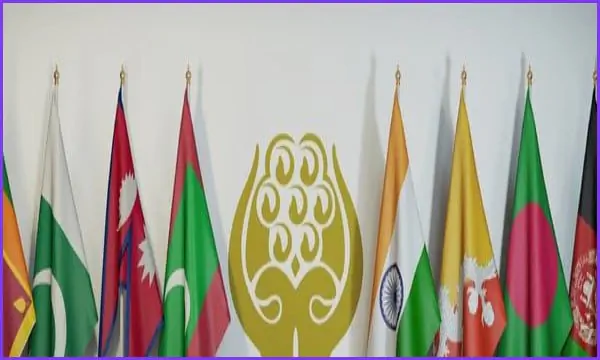
A familiar diplomatic movement is gaining momentum across South Asia as the region’s smaller nations once again unite in demanding the revitalization of the South Asian Association for Regional Cooperation (SAARC). Leading the renewed call, Maldivian President Mohamed Muizzu urged member states to return to the negotiating table, resume stalled summits, and set aside bilateral differences for the sake of regional peace and cooperation. Delivering his address during the Maldives’ Independence Day celebrations on July 26, Muizzu emphasized that the Maldives stands ready to facilitate discussions and mediate among member states. This is not the first time the Maldivian leader has championed this cause, having made a similar appeal during the 40th SAARC Charter Day in December 2025.
The push is strongly mirrored in Bangladesh, whose Foreign Minister, Khalilur Rahman, attended the Maldivian Independence Day ceremony as a special guest. Earlier in February, Rahman met with SAARC Secretary-General Golam Sarwar, affirming Bangladesh’s commitment to the regional body and its willingness to support its revival. Rahman identified key areas requiring urgent regional collaboration, including trade, connectivity, poverty reduction, energy, climate change, food security, education, and health. By April, Rahman declared the revival of SAARC as a central foreign-policy objective of Prime Minister Tarique Rahman’s administration. Historically, the formal establishment of SAARC was first proposed by the current prime minister’s father, the late Bangladeshi President Ziaur Rahman. Beyond Bangladesh and the Maldives, influential political voices in Sri Lanka and Nepal have also recently demanded the revitalization of the regional grouping.
The current diplomatic environment shares striking historical parallels with the late 1970s, when the concept of a pan-South Asian organization first gained traction. Although leaders of Asian nations had gathered in New Delhi as early as 1947 for the Asian Relations Conference, deep-seated tensions between India and Pakistan initially stifled any real prospects for regional integration. However, the landscape shifted in the late 1970s due to leadership changes in both New Delhi and Islamabad, the successful establishment of ASEAN, and evolving global economic and security trends.
When Bangladeshi President Ziaur Rahman formally proposed a South Asian economic, social, and technical cooperation bloc in May 1980, Nepal and Sri Lanka immediately backed the initiative. In contrast, India and Pakistan viewed the proposal with intense suspicion, each fearing the other was setting a geopolitical trap. This era also mirrors modern political shifts: General Ziaur Rahman assumed power in 1977 following a 1975 military coup that overthrew the India-backed government of Sheikh Mujibur Rahman. Similarly, the current Bangladeshi administration took office after the pro-Indian government of Sheikh Mujibur’s daughter, Sheikh Hasina, was toppled in 2024. In both periods, a Bangladeshi administration seeking to redefine its relationship with India placed regional cooperation at the heart of its foreign policy.
During SAARC's foundational years, India feared that a regional platform would allow its smaller neighbors to raise contentious bilateral disputes and collectively oppose its interests. Pakistan, on the other hand, worried that closer regional integration would cement India's dominant position in South Asia. Ultimately, both powers joined the association out of fear of being left out. Yet, the structural and political constraints built into the organization from its inception limited its effectiveness. The SAARC Charter, signed in Dhaka in December 1985, was diluted to focus strictly on functional cooperation while explicitly excluding contentious bilateral issues, leaving the organization powerless to address the core disputes between India and Pakistan.
This persistent hostility has repeatedly paralyzed SAARC’s operations. Scheduled annual summits of heads of state have been routinely delayed, and no summit has been convened since 2014. The 2016 summit, scheduled to take place in Islamabad, was cancelled after India and its allies pulled out, citing alleged Pakistani involvement in an attack on an Indian military base in Kashmir. Economic initiatives have faced similar hurdles. Both the South Asian Preferential Trade Arrangement (SAPTA) of 1993 and the South Asian Free Trade Area (SAFTA) of 2004 failed to meet their goals due to massive structural disparities. India’s economy accounts for roughly 80 percent of the region’s GDP, prompting smaller nations to impose protective trade barriers. Consequently, intra-regional trade remains at a mere 5 percent, which is lower than that of Sub-Saharan Africa. Recent economic crises in Pakistan, Sri Lanka, the Maldives, Bangladesh, and Nepal have only widened these disparities.
In response to SAARC’s deadlock, India has increasingly bypassed the organization, focusing on Pakistan-free alternatives like the Bay of Bengal Initiative for Multi-Sectoral Technical and Economic Cooperation (BIMSTEC), subregional initiatives, and the Indian Ocean Rim Association (IORA). Bangladesh, however, maintains that SAARC and BIMSTEC are not mutually exclusive and that the region requires both platforms. Despite these deep frustrations, no member state has formally withdrawn from SAARC, and the organization has managed to achieve notable successes when bilateral rivalries are set aside, such as the establishment of a $22 million COVID-19 Emergency Fund.
Geopolitical realities in 2026 are presenting new incentives for cooperation. The spillover of conflicts in the Middle East, particularly involving U.S. and Israeli actions against Iran, has positioned several South Asian nations on the frontlines of Indian Ocean security. Additionally, a wave of U.S. tariffs and the potential erosion of global trade rules have made regional blocs highly attractive to smaller nations seeking collective bargaining power, drawing inspiration from ASEAN’s success in managing relations with both China and the United States. Even India faces renewed trade pressures, including potential 100 percent tariffs from Washington for purchasing Russian oil, despite earlier U.S. statements acknowledging India as a "good actor." These mounting global pressures, combined with the persistence of the region's smaller states, have created a diplomatic environment reminiscent of the late 1970s. Whether India and Pakistan will set aside their long-standing differences and join the table remains to be seen, but the rising cost of isolation may eventually compel them to participate.
Related Articles

Md. Kazi Bijoy is a dedicated tech enthusiast and content creator with a passion for digital innovation. With years of experience in the tech industry, he specializes in breaking down complex topics into easy-to-understand guides. When he isn’t writing, he explores the latest gadgets and researches emerging trends in the digital world.