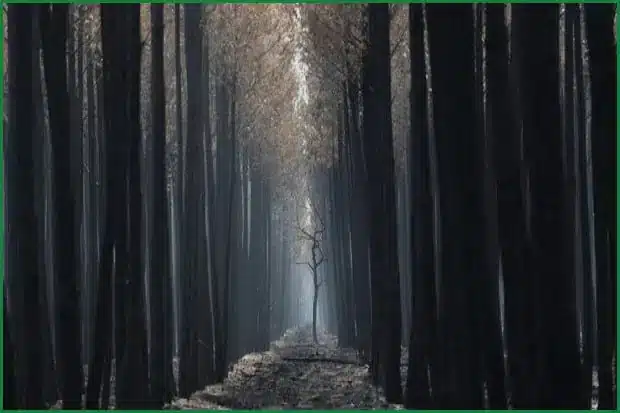
Europe’s severe wildfire crisis showed signs of easing across much of the western portion of the continent on Saturday, but the most dangerous front has now shifted to Greece. In Greece, gale-force winds have driven flames through a seaside resort, forcing hundreds of people to flee by sea and severely hampering the efforts of firefighting aircraft. This sudden escalation carries a grim historical weight for the country, recalling the devastating 2018 wildfire in the coastal community of Mati, near Athens, which claimed 104 lives and stands as Europe’s deadliest wildfire this century.
The current Greek blaze erupted on Friday near the coastal village of Agios Vasileios. In response to the fast-moving flames, authorities evacuated approximately 300 people by sea, with further evacuation orders issued on Saturday as conditions deteriorated. Theodore Giannaros, a wildfire meteorologist at the National Observatory of Athens, estimated that the fire has affected between 40 and 50 square kilometers (15 to 19 square miles), though officials have not yet released a formal assessment of the burned area. Local resident and 60-year-old farmer Minas Tzortzanis lamented the scale of the damage, stating that a pristine forest and paradise had been surrendered to the fire, leaving behind total destruction.
The firefighting operation in Greece has drawn international support, utilizing specialized forest-fire teams alongside crews temporarily deployed from France and Romania. The aerial response includes 19 water-dropping planes and 11 helicopters. However, strong winds continue to pose severe obstacles. Climate Crisis and Civil Protection Minister Evangelos Tournas noted that very strong to gale-force winds are creating exceptionally difficult conditions, with extreme turbulence preventing some aircraft from safely collecting water or approaching the flames closely enough to make effective drops. Meanwhile, new fires have broken out elsewhere in the country, including a blaze east of Nafpaktos that triggered evacuation alerts for at least four villages.
In southwestern France, firefighters have managed to hold a massive wildfire within its perimeter. This progress has allowed about 198,000 people to return to their homes following what has been described as the nation's largest peacetime evacuation. French Interior Minister Laurent Nunez announced that the fire in the Gironde region is now under control, though firefighters remain vigilant at specific points across several sectors. The Gironde blaze has consumed 420 square kilometers (162 square miles) of pine forest west of Bordeaux, an area four times the size of Paris.
While the Gironde fire remains contained within its perimeter, officials have stopped short of declaring it "fixed"—the stage at which crews are certain a fire will no longer advance. Active sectors and buried hot spots continue to pose a threat. Consequently, several communities remained largely deserted on Saturday, and much of the forested Cap Ferret peninsula remained evacuated due to fears that a nearby hot spot could flare up, blocking the limited road access and trapping residents. Lt. Col. Eric Pitault explained that the fire is contained but not yet fixed, noting that crews utilized tactical burns overnight. Along the 240-kilometer (149-mile) edge of the fire, heat remains trapped underground and could erupt at any time.
For returning residents in the Gironde zone, the easing of the immediate danger has brought a painful confrontation with their losses. In Le Porge, one of the hardest-hit communities, 40-year-old mechanic Matthieu Plessis returned to find the ruins of a home that had belonged to his family for seven generations. Driving through the blackened forest, Plessis struggled to recognize the landscape, noting that almost everything was unrecognizable and that only a chimney and twisted metal frames remained of the structure. The tools and machinery for his bicycle-repair business were completely destroyed, but Plessis expressed a determination to stay strong and help others rather than dwell on the tragedy.
In southeastern France's Mediterranean Var region, approximately 1,500 firefighters continue to battle another active wildfire. Var Prefect Simon Babre reported that defensive lines around the Gros Bessillon fire held overnight, preventing any additional ground from burning. This particular blaze had been declared fixed earlier in the week, but powerful mistral gusts on Friday revived smoldering embers, sending the fire racing through dry hills in temperatures that neared 42 degrees Celsius (108 degrees Fahrenheit). The sudden resurgence, which Babre described as defying understanding, left 1,300 firefighters deployed on Saturday, with 2,500 people still unable to return home. Across France, 20 departments were placed under an orange heat warning on Saturday, primarily in the east and southeast, while eight departments faced a high risk of forest fires.
Elsewhere in western Europe, another French fire stopped expanding overnight after burning through 10 square kilometers (4 square miles) in just six hours on Friday—a speed described by local authorities as faster than a horse at full gallop. However, the fire remained active on Saturday, keeping 2,500 people displaced. Meanwhile, major fires in Spain have stopped advancing, and Portugal’s primary wildfire has been brought under control. This progress marks a significant shift from the peak of the crisis, when fires in France and Spain displaced a third of a million people, emptied tourist towns during the summer holiday season, and pushed emergency services to their limits.
Scientists point to climate change as a key driver of these extreme events. According to the European Union's Copernicus climate service, Europe is the world's fastest-warming continent, heating at more than twice the global average since the 1980s. This rapid rise in temperature, combined with prolonged dry spells, leaves vegetation dry and highly combustible, causing wildfires to spread faster and burn with greater intensity.
Related Articles

Mr. Udoy is a professional Web Developer and Blogger with 7+ years of experience in the tech world. He specializes in web architecture and digital storytelling. As the driving force behind worldincidents.com, he focuses on delivering high-quality, well-researched content to a global audience.