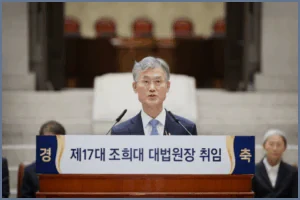
South Korea's ruling Democratic Party (DP) has formally resolved to file an impeachment motion against Supreme Court Chief Justice Cho Hee-dae, setting up a high-stakes constitutional confrontation between the legislature and the judiciary. Following a general meeting on November 20, the DP established a dedicated impeachment task force with plans to officially submit the motion to the National Assembly in early December. The decision marks a sharp escalation in tension surrounding Cho, whose standing has been under intense political scrutiny since before President Lee Jae-myung assumed office in June 2025.
Announcing the decision, DP leader Kim Min-seok stated that the party could no longer refrain from taking action despite earlier self-restraint. "Despite Cho’s violation of the Constitution, we have been restraining ourselves while awaiting the public’s understanding," Kim declared. "But now, we cannot further condone his attempt at justifying collaboration with insurrection and distorting history." The ruling party has structured its push for removal around three principal grievances involving Cho's actions during martial law, his handling of judicial nominations, and alleged procedural irregularities in high-profile criminal cases.
The primary rationale advanced by the DP centers on Cho's conduct on the night of December 3, 2024, when former President Yoon Suk-yeol mounted a failed self-coup by declaring martial law. The party argues that Cho and the Supreme Court stood by both legally and symbolically rather than acting as a safeguard for constitutional democracy. During an early morning emergency meeting presided over by Cho at the Supreme Court on December 4, 2024, the court concluded that "the command and supervision of the judiciary transfers to the martial law commander" and resolved to "prepare its future steps according to the martial law commander’s instructions and the martial law manual."
DP lawmakers maintain that the court abandoned its constitutional obligation to preserve the rule of law and protect citizens' rights to life and property at a time when the unconstitutionality of Yoon's declaration was glaringly obvious. The ruling party highlighted that because the Supreme Court serves under the constitution as the final arbiter over court-martial cases, Cho’s acquiescence could have provided legal legitimacy to Yoon's martial law had the coup succeeded.
A second major ground cited by the DP involves Cho’s refusal to consult with the executive branch over filling a Supreme Court vacancy created in March 2026. Although constitutional convention dictates that the chief justice coordinate with the president before recommending a candidate for presidential appointment, Cho delayed submitting a replacement until August and did so without prior consultation with President Lee Jae-myung. The Supreme Court's ideological composition currently leans heavily rightward, with former President Yoon having appointed eight of the twelve sitting justices alongside Chief Justice Cho. When President Lee rejected Cho's August recommendation to seek a more balanced bench, Cho refused to offer an alternative name.
The DP argues that Cho’s unilateral nomination process infringes upon the president's statutory appointment authority and leaves the bench incomplete, depriving citizens of fair trials. Cho, however, defended his position by publicly asserting that "there’s no constitutional ground for the National Assembly and the president to interfere with the procedure for the chief justice’s recommendation," going so far as to label the president's stance "unconstitutional." Critics note that while Cho publicly accused the democratically elected president of unconstitutional behavior, he remained entirely silent during Yoon's martial law declaration, which was later formally ruled unconstitutional by the Constitutional Court. The DP has characterized Cho's defiance of long-standing consultation conventions as an instance of "judicial elitism"—a belief among judges that they stand above elected officials and popular sovereignty.
The third justification put forward for impeachment concerns alleged procedural improprieties in criminal proceedings. In May 2024, ahead of the June snap presidential election, Cho was accused of bypassing established judicial deliberation rules to expedite an appellate review involving Lee Jae-myung, who was then the DP's leading presidential candidate. A bench composed of ten Yoon-appointed justices overturned an acquittal in just nine days after reviewing 70,000 pages of legal documents, a verdict that would have disqualified Lee from running had it stood. Furthermore, the Supreme Court faced criticism over its handling of the case against former Prime Minister Han Duck-soo, who received a 15-year sentence from the Seoul High Court for aiding Yoon's insurrection. The Supreme Court missed its statutory three-month review deadline of August 7 under special counsel rules, holding the case until November 19 before ultimately granting Han a partial acquittal. Eight of the nine justices supporting that ruling were appointed by Yoon or by Han himself during his tenure as acting president.
Despite the ruling party's resolve, the impeachment effort faces substantial legal, political, and strategic hurdles. Legal experts point out that even if Cho's conduct is deemed improper, the legal threshold for the Constitutional Court to remove an official requires a violation "significant enough to warrant dismissal." A rejection by the Constitutional Court would result in a severe political setback for the DP. Additionally, with Cho's statutory term set to expire next June and Constitutional Court deliberations taking up to six months, critics describe the impeachment push as unnecessary and melodramatic.
Political analysts also note that the move risks alienating centrist voters, many of whom perceive the initiative as the ruling party's attempt to intimidate the bench over rulings it dislikes rather than a genuine defense of the constitution. A public opinion survey published on November 25 revealed that nearly half of South Koreans opposed Cho's impeachment, compared to 33 percent in favor. Backlash across the legal sector has been sharp. On November 22, the chairman of the national conference of judges posted online that if court rulings become grounds for impeachment, judges will feel compelled to gauge political reactions before issuing verdicts, urging colleagues to take "action" if the National Assembly passes the motion. The Korean Bar Association similarly warned that the proposed impeachment risks eroding judicial independence and violating the separation of powers.
The opposition People Power Party (PPP) has fiercely denounced the impeachment plan, accusing the DP of seeking to pack the judiciary with left-leaning judges to secure favorable outcomes for President Lee if his suspended criminal trials resume. PPP leader Jang Dong-hyuk mocked the move on social media, writing that the impeachment motion was designed to facilitate "President Lee’s jailbreak." If the National Assembly votes to impeach Cho, he will be immediately suspended from his duties, and the most senior justice—Chun Dae-yup, a centrist appointed by former liberal President Moon Jae-in—would take over as acting chief justice. With periodic judicial appointments scheduled for February, an acting chief justice could potentially reshuffle key positions within the judicial hierarchy.
Addressing concerns over judicial autonomy, Seo Young-kyo, chair of the National Assembly's legislation and judiciary committee, rejected the premise that the judicial branch enjoys absolute immunity from legislative oversight. "There’s no such thing as the judicial branch’s independence under our constitution," Seo stated. "The judiciary is subject to the legislature’s checks and impeachment if it behaves wrongly." Supporters of the motion emphasize that while the constitution protects individual judges and specific trials from external interference, it does not shield the judicial institution itself from accountability when a chief justice engages in procedural manipulation and public political disputes.
Related Articles

Md. Kazi Bijoy is a dedicated tech enthusiast and content creator with a passion for digital innovation. With years of experience in the tech industry, he specializes in breaking down complex topics into easy-to-understand guides. When he isn’t writing, he explores the latest gadgets and researches emerging trends in the digital world.