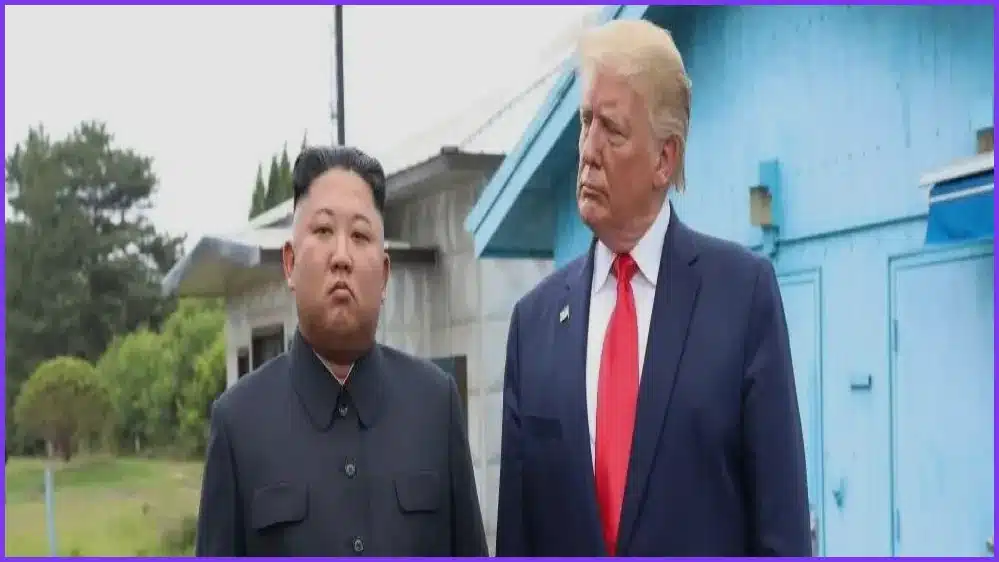
President Donald Trump has announced plans to "substantially reduce" joint military exercises with South Korea, pointing to his "very good relationship" with North Korean leader Kim Jong Un and expressing frustration over Seoul's refusal to assist with Iran.
Writing on his Truth Social platform on Sunday, Trump criticized the joint maneuvers as excessively expensive and provocative. "These exercises are not only costly, with much of these costs paid for by the United States of America (as usual!), but send a signal that is totally inappropriate and hostile," he posted. Despite Trump's declaration, officials in Seoul stated that the military drills would proceed "as scheduled." Pyongyang has not yet issued a direct response to Trump's remarks.
The timing of Trump's post came just a day before the United States and South Korea were scheduled to begin their major annual military exercises on Monday. Trump acknowledged that it was "too late to cancel" the upcoming drills. His announcement followed less than 24 hours after he shared a 2018 photograph of himself and Kim Jong Un, describing the North Korean leader as a great friend "despite the unfriendly look on this particular picture."
Trump also used his social media post to air grievances regarding South Korea's foreign policy choices. He revealed that he had recently asked the South Korean president if the country would join the U.S. in the "denuclearisation" of Iran, only to be told, "No thanks!" This pointed remark suggests frustration with Seoul's reluctance to offer direct military or logistical support in U.S. hostilities with Iran. Trump has previously voiced similar displeasure with other key allies, including Japan, France, and the United Kingdom, over their hesitation to engage in the Iranian conflict.
The scheduled 11-day military exercise, known as Ulchi Freedom Shield, was announced last week during a joint press conference by U.S. and South Korean military leaders. The drills are designed to be similar in scale to previous years, featuring the participation of approximately 18,000 South Korean soldiers. Currently, about 28,500 American military personnel are stationed in South Korea to bolster regional security.
During last week's press conference, military leaders highlighted the threat posed by North Korea's recent deployment of troops to assist Russia in its ongoing war against Ukraine. U.S. military spokesperson Ryan Donald emphasized that "our training accounts for that threat," referring to North Korean soldiers returning from the Ukrainian battlefield.
Pyongyang has consistently opposed these joint exercises. On Friday, North Korea's foreign ministry condemned the drills, labeling them "a rehearsal for an aggressive war." The exercises also follow a series of provocations, including a second banned ballistic missile test detected by South Korea, the U.S., and Japan just days ago. North Korea has aggressively expanded its nuclear and missile development since the 2019 collapse of high-profile diplomatic talks between Kim and Trump. Seven years ago, Trump made history as the first sitting U.S. president to set foot in North Korea.
This is not the first time Trump has moved to downsize military cooperation on the peninsula. During denuclearization talks with Kim in 2018, he suspended the joint exercises entirely, and the drills were scaled back again in 2020 amid the Covid-19 pandemic. The current tension comes shortly after South Korea's president proposed talks with North Korea last week to officially end the Korean War, which has technically remained active under an armistice signed in 1953.
Related Articles

Meet Md. Rubel Rana
As a core contributor to Worlddincidents.com, Rubel Rana brings a unique perspective to the world of journalism. Whether it’s deep-diving into historical trivia or covering the latest global headlines, Rubel Rana is committed to delivering high-quality, high-impact articles. Their writing blends meticulous research with a compelling voice, helping readers stay informed and curious about the world around them.