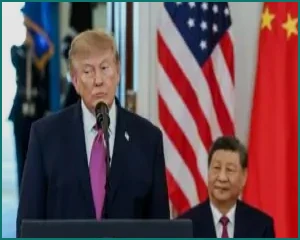
United States President Donald Trump and Chinese President Xi Jinping are scheduled to hold a summit meeting in Shenzhen next week, where discussions are expected to centre on potential tariff reductions, increased agricultural purchases, and regulations surrounding critical minerals. Delivering remarks to the press at the White House on September 24, 2026, ahead of the talks, Trump set the stage for negotiations that experts note could drive stock market gains. However, analysts point out that positive diplomatic outcomes and top-level government agreements do not automatically translate into broad-based commercial recovery across the broader business landscape.
While bilateral deals can lead to high-profile purchasing commitments, recent trade patterns highlight a growing divide between state-directed actions and private sector demand. Following a trade truce reached in October 2025, Chinese state-owned enterprises Sinograin and COFCO executed large-scale purchases, securing 12 million metric tons of U.S. soybeans by late January 2026. Although these orders provided tangible relief for American agricultural producers, private Chinese processors continued to source their supplies from Brazil, where significant tariff rate discrepancies allowed for lower profit margins. The divergence demonstrated that standard commercial demand among private market participants remained constrained despite high-level policy adjustments.
A similar gap between policy announcements and actual market behavior emerged within the critical minerals sector. Following the October 2025 negotiations, Beijing temporarily paused new export restrictions on critical minerals, delaying the implementation of several key control measures until January 2027. Despite the freeze, shipments of rare earth compounds to the United States and Japan dropped by 58 percent during the ten months following the agreement compared to the preceding ten-month period. Over the same timeline, Chinese rare earth exports to the rest of the world surged by 146 percent, driven in part by Chinese suppliers' anxieties over potential political or regulatory repercussions associated with shipping directly to American and Japanese buyers.
The structural challenges confronting commercial enterprises extend well beyond direct tariff payments. Research conducted by economists at the Federal Reserve Bank of Atlanta revealed that during President Trump's first term in office, finding replacement foreign suppliers cost the average importer an amount equivalent to 5 percent of its annual sales. Furthermore, establishing new international supplier relationships required an average of more than two and a half years. These substantial indirect expenses force companies to bear heavy financial burdens when reconfiguring supply chains or relocating production facilities, leaving firms with limited resources at risk of losing contracts or exiting the market entirely. Even after governments lift restrictions, many businesses do not revert to former commercial partners after having invested heavily in alternative supply lines.
The operational environment for transpacific trade has undergone a fundamental transformation over the past eight years or so. For decades, private companies decided independently how to build commercial partnerships based on cost and efficiency within established government rules. In recent years, however, state interventions—including export controls, investment restrictions, tariffs, and sovereign purchasing commitments—have increasingly determined which transactions remain feasible. As Trump and Xi prepare for their upcoming discussions in Shenzhen, experts emphasize that future trade agreements must be evaluated beyond top-line figures to examine whether private buyers return, how many individual firms participate, and whether government-approved licenses result in physical deliveries.
You have reached the limit of 3 free articles this month.
If commercial opportunities are dependent on a changing regulatory landscape, an apparent recovery in China-U.S. trade numbers might conceal reduced economic participation. Therefore, the real test of a Trump-Xi agreement will be not only how much trade it restores, but whether businesses can compete for and participate in that trade on workable commercial terms.
Related Articles

Meet Md. Rubel Rana
As a core contributor to Worlddincidents.com, Rubel Rana brings a unique perspective to the world of journalism. Whether it’s deep-diving into historical trivia or covering the latest global headlines, Rubel Rana is committed to delivering high-quality, high-impact articles. Their writing blends meticulous research with a compelling voice, helping readers stay informed and curious about the world around them.