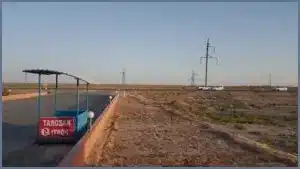
Changing an alphabet involves more than just replacing letters; it requires a profound transformation of a state’s institutional and cultural fabric. In Uzbekistan, the transition from the Cyrillic to the Latin alphabet has evolved into a protracted, thirty-year process. While routine administrative, commercial, and public signage—such as roadside checkpoints marked "Nazorat Posti 5" ("Checkpoint 5")—frequently showcase the Latin script, the Cyrillic alphabet remains deeply entrenched in daily life, bureaucracy, and academia alongside the Russian language.
Since declaring independence in 1991, Tashkent has repeatedly revised its linguistic policies. The initial transition process was launched with comprehensive legislation in 1993, which established new spelling standards for Uzbek in the Latin script and introduced a phased implementation plan. School curricula were updated, new textbooks were published, public signs were redesigned, and official government correspondence began a gradual conversion. This linguistic shift was designed to accompany broader efforts to dismantle the most visible remnants of Soviet influence, such as renaming streets and removing statues. By 1996, all educational institutions in Uzbekistan began offering instruction in the Uzbek language using the Latin alphabet.
However, the transition proved far more complex than policymakers anticipated. The original deadline for a complete transition was set for 2000, which was subsequently extended to 2005, then to 2010. Even the most recent deadline of 2023 passed with the Cyrillic alphabet remaining firmly in use. The incomplete transition is not due to a lack of political will, but rather because institutions, generations, and economic realities continue to favor the old script.
Under the leadership of President Shavkat Mirziyoyev, who assumed power in 2016, the alphabet reform has received renewed systematic momentum. The government established key institutions to accelerate the process, including the State Language Development Department (Davlat Tilini Rivojlantirish Departementi) in 2019 and the Uzbek Language Development Fund (O’zbek Tilini Rivojlantirish Jamg’armasi) in 2020. These bodies have worked to standardize the Latin alphabet across government agencies, banks, and other organizations, publishing guidebooks, dictionaries, terminology guides, and instructional materials. The fund also works to integrate the Latin script into social life, education, culture, and the international arena.
As part of these efforts, university faculty and staff have undergone training programs in the Latin script. During field observations at Samarkand State University between 2022 and 2023, these training sessions attracted a diverse group of participants, ranging from 35-year-old researchers to retired 65-year-old professors. While older academics acknowledged the difficulty of relearning the alphabet of their native language late in their careers, many recognized it as an indispensable step for the nation. One experienced academic summarized this commitment with the Uzbek saying, "Ilm olish uchun hech qachon kech emas" ("It’s never too late to learn").
Despite this institutional push, deeply ingrained habits and technical limitations continue to slow down the transition. Faculty members and political scientists point out that older generations raised under the Soviet education system naturally favor Cyrillic. Sayliyeva Rakhmiddinova, a faculty member at Bukhara State University, noted that for these generations, the Cyrillic alphabet is not merely a writing system but a fundamental cognitive and practical tool. Abandoning it requires overturning habits developed over decades. Similarly, philology lecturer Shohista Akramova observed that because many high-ranking officials and institutional employees were educated in Cyrillic, they naturally prefer it for official correspondence. Consequently, while the law promotes the Latin alphabet, established practices persist.
The preservation of the country's archives presents a massive technical bottleneck. For nearly the entire 20th century, Uzbekistan’s legal, academic, and historical infrastructure was built using the Cyrillic alphabet. Converting this vast repository of information cannot be accomplished by decree alone. Political scientist Ulugbek Mirzokhidov noted that the majority of academic and discipline-specific books in universities remain in Cyrillic. This creates a practical dilemma: younger generations are educated in the Latin alphabet, but if they cannot read Cyrillic, they risk being disconnected from their own history and professional fields.
This disconnect has created a "dual system" within government ministries. While public-facing signs are written in the Latin alphabet, internal files and memos—the core of the bureaucracy—regularly revert to Cyrillic. Akramova pointed out that the templates, software infrastructure, and archiving standards in government offices are fundamentally designed for Cyrillic, making the transition a complex technical challenge rather than a simple administrative task. Rakhmiddinova added that because both employees and the public are more accustomed to the old script, institutions often view the continued use of Cyrillic as a safer and less troublesome option. This dynamic draws younger professionals back into a Cyrillic-dominated professional environment despite their Latin-based education.
Demographically, approximately 60 percent of Uzbekistan's population is under the age of 30 and has been educated almost entirely in the Latin alphabet. However, the "middle generation" holding key administrative positions developed their expertise under the Soviet system. Rakhmiddinova noted that this inconsistency has led to a form of "fragmented literacy," where students are fluent in the new alphabet but struggle to study academic literature written in the old script. While primary and secondary schools have adapted, higher education remains a stronghold for Cyrillic.
The media landscape also reflects this hybrid state. Although official state media has largely adopted a two-alphabet system, private publishing houses and newspapers generally stick to Cyrillic for commercial reasons, as the readership for Cyrillic publications remains broader and more profitable. It is common to find books in bookstores with titles printed in the Latin alphabet, while the entire interior text is written in Cyrillic. Political scientist Komronbek Isroilov warned that this structural disconnect negatively affects the reading habits of the younger generation and acts as a barrier to accessing their cultural heritage. Conversely, public displays of cultural identity, such as a poster of literary figure Alisher Navoiy in the Tashkent Metro, use the Latin script to display the phrase "Tilga ixtiyorsiz — elga e’tiborsiz!" ("Indifferent to language, indifferent to the people").
Pragmatic economic factors also reinforce the position of the Cyrillic alphabet, particularly the necessity of the Russian language. Uzbekistan's economic links to Russia help preserve the social utility of Cyrillic. According to Russian government data, approximately 4.5 million Uzbek citizens were registered as migrant workers in Russia in 2021. For these individuals, the Russian language and the Cyrillic alphabet are essential for navigating employment contracts, residence permits, and daily life. These workers send billions of dollars back to Uzbekistan. Data from the Central Bank of Uzbekistan shows that remittances reached $14.8 billion in 2024, with $11.5 billion (77 percent) originating from Russia, making the Russian labor market a vital source of foreign currency and keeping Cyrillic economically relevant.
Geopolitically, the alphabet reform has drawn scrutiny from Moscow. The Russian press largely views Tashkent’s transition to the Latin alphabet as a strategic move by external powers to sever cultural ties between Russia and Central Asia. Media outlets like the Strategic Culture Foundation have characterized the transition as a Western-backed "cultural wedge" (культурный клин). Other portals, such as Krasnaya Vesna, have expressed concern that the reform could degrade educational quality and leave older generations illiterate in their own language. In 2025, Ryazan-based political scientist Yuriy Mostyayev argued that the reform creates artificial barriers with Russia, imposes high costs on businesses and the state budget, and warned that such linguistic reforms could contribute to an anti-Russian political trajectory similar to Ukraine. Meanwhile, analyst Antoine Gyori noted that the transition is often viewed as an extension of Turkish soft power aimed at uniting Turkic-speaking peoples under a common linguistic model.
Under Mirziyoyev, Tashkent has pursued a balanced foreign policy, opening up to the global community while maintaining stable relations with Moscow. Maintaining a dual-alphabet status quo allows the government to project a nationalist stance domestically and to Turkic partners while assuring Moscow that Russian cultural heritage is respected. Furthermore, the government has had to prioritize other pressing issues, such as managing economic transformation, energy security, water resource sharing, regional relations, and security risks stemming from Afghanistan, often leaving alphabet reform lower on the policy agenda.
While deadlines have been missed, the transition process is ongoing. Complete success will require substantial investments, including the digitization of Cyrillic archives, the creation of economic incentives for local industries utilizing the Latin alphabet, and the finalization of a standardized writing system optimized for the digital age. Until then, Uzbekistan remains a country in transition, where the linguistic past and future continue to meet on every street sign and official document.
The Generational Gap and Media Hybridity
The Russian Factor: A Means of Survival and a Geopolitical Divide
Related Articles

Md. Kazi Bijoy is a dedicated tech enthusiast and content creator with a passion for digital innovation. With years of experience in the tech industry, he specializes in breaking down complex topics into easy-to-understand guides. When he isn’t writing, he explores the latest gadgets and researches emerging trends in the digital world.