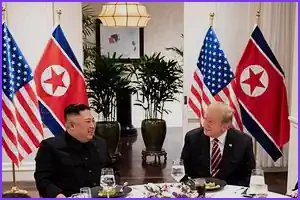
North Korean leader Kim Jong Un has so far rebuffed pushes from U.S. President Donald Trump for a fourth summit, but strategic calculations inside Pyongyang suggest North Korea could reap significant foreign policy advantages by ultimately agreeing to a meeting. Longtime foreign policy analysts who have engaged in official and unofficial talks with North Korea observe that while Washington might view renewed discussions as an avenue for nuclear negotiation, officials in Pyongyang see a fresh summit as an opportunity to weaken American global influence and solidify North Korea's standing alongside its strategic allies.
According to assessments of North Korea's positioning, Pyongyang's Foreign Ministry would likely advise Kim that the regime now speaks from a position of strength. Unlike during earlier diplomatic rounds, North Korea's recent military developments, internal economic policies, and deepening geopolitical ties with Russia and China have reshaped its international standing. Conversely, analysts argue that the United States enters prospective negotiations in a far weaker posture, with Trump's erratic leadership style and overconfidence creating openings that Pyongyang could leverage to undermine Washington's broader strategic goals.
Pyongyang's diplomatic framework has fundamentally evolved since the previous summits held in Singapore, Hanoi, and at the Demilitarized Zone during Trump's first presidential term. In those earlier engagements, Kim focused on offering discussions on his nuclear arsenal in exchange for economic modernization and improved bilateral relations with Washington. Today, however, Pyongyang views those former frameworks as outdated. A fourth summit would instead serve to bolster North Korea's aligned partners—particularly Russia and China—while pressuring Trump toward tacitly accepting Pyongyang as an established nuclear power and straining the South Korea-U.S. alliance.
North Korea's strategic delay in agreeing to a meeting has already yielded tangible diplomatic benefits. By taking advantage of Trump's eagerness for a high-profile summit, Pyongyang has extracted unilateral concessions without entering formal negotiations. Trump has already shortened one joint South Korea-U.S. military exercise and left lingering uncertainty over remaining drills. Furthermore, Trump's incremental shift away from Washington's long-standing pursuit of denuclearization toward recognizing North Korea's nuclear status has sparked internal conflict in Washington, where the State Department continues to advocate for full denuclearization, sending conflicting signals to American allies.
North Korean strategic planners are also monitoring internal U.S. political dynamics, anticipating that the Republican Party may lose the upcoming November congressional elections. A weakened domestic standing could leave Trump increasingly anxious to secure a diplomatic headline, potentially compelling him to make additional concessions simply to present holding a meeting with Kim as a personal success. Negotiations over the timing and location of a potential summit would involve detailed tactical maneuvering, with Pyongyang calculating that Trump's personality and domestic political vulnerabilities could produce more consequential outcomes than past meetings.
While North Korean state media continues to avoid direct personal criticism of Trump and highlights Kim's personal relationship with him, foreign ministry analysts privately hold a sharp assessment of the U.S. leader's character. Analysts in Pyongyang assess that behavioral patterns visible during the 2018 and 2019 summits have intensified, identifying seven specific traits that North Korea could exploit during summit proceedings.
First, at age 80—seven years older than during his last meeting with Kim—Trump displays physical and mental decline, resulting in inconsistent performance. Second, his responsiveness to flattery has grown even more pronounced. Third, Trump retains an inflated view of his personal negotiating prowess despite repeated diplomatic failures. Fourth, he routinely relies on gut instincts over expert foreign policy advice, causing him to act impulsively. Fifth, analysts observe a diminishing grasp of reality, noting that many of his public statements draw widespread skepticism in American media. Sixth, his willingness to host elaborate summits with leaders like Russian President Vladimir Putin and Chinese President Xi Jinping reflects a mistaken belief that personal charm can overcome structural policy conflicts.
Finally, North Korean advisors emphasize that Trump lacks comprehensive strategic thinking. Demonstrating a pattern of short-sightedness similar to the U.S. conflict with Iran, Trump is viewed as failing to grasp the wider geopolitical context or recognize that Pyongyang's updated strategic objectives differ radically from past negotiations and directly oppose U.S. national interests.
Related Articles

Md. Kazi Bijoy is a dedicated tech enthusiast and content creator with a passion for digital innovation. With years of experience in the tech industry, he specializes in breaking down complex topics into easy-to-understand guides. When he isn’t writing, he explores the latest gadgets and researches emerging trends in the digital world.