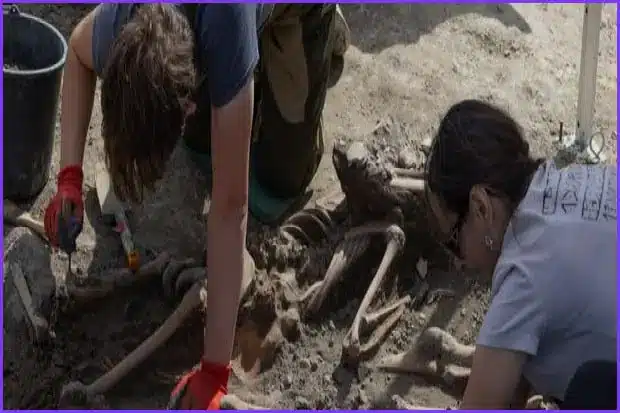
Under sunflower fields and quiet forests in western Ukraine, archaeologists are uncovering human remains that lie at the heart of a deep diplomatic dispute between Poland and Ukraine. The joint excavations of the World War II-era Volyn massacres represent an effort to identify victims and mend a historical rift that continues to strain relations between the two neighboring allies.
Between 1943 and 1945, the Ukrainian Insurgent Army (UPA) killed tens of thousands of civilians in territory occupied by Nazi Germany. Warsaw officially designates this campaign as a genocide against the region's Polish minority, estimating that approximately 100,000 Poles died across the Volhynia, Eastern Galicia, and Lublin regions.
Conversely, Ukraine views the UPA as freedom fighters who resisted Soviet rule, characterizing the massacres as a wartime tragedy and pointing to Polish retaliatory attacks that claimed at least 10,000 Ukrainian lives.
In a white tent located about six miles from the Polish border, forensic experts and anthropologists are meticulously analyzing the bones of over 50 individuals recovered so far. The remains are currently unidentified.
Karol Polejowski, the deputy president of Poland's Institute of National Remembrance (IPN), emphasized the moral weight of the project, stating, "We want to restore their first and last names …
to fulfil the duty that rests on us as heirs of those who were murdered here." Polejowski noted that an estimated 30% to 40% of the remains discovered so far belong to children.
Alongside the skeletons, teams have unearthed a small number of personal items, including rosaries, shoes, and religious medallions. Olga Mineiko, an anthropologist at the Ukrainian Memorial and Search Center, described the chaotic nature of the burial site.
"The remains were arranged in a highly disordered manner. Most of the bodies had been brought to the burial pit and simply dumped into it," Mineiko observed.
Polejowski added that the victims were likely driven to their deaths barefoot and stripped of their personal belongings. To aid in identification, the IPN is gathering genetic material and has urged Polish citizens who suspect they lost relatives in the massacres to provide DNA samples for matching.
The historical dispute has repeatedly disrupted modern diplomacy. Tensions flared earlier this year when Ukrainian President Volodymyr Zelenskyy named a military unit after the UPA, a paramilitary group that fought the Soviet Red Army but also collaborated with Nazi forces during their initial invasion of the Soviet Union, clashing with Polish resistance and killing civilians.
In response, Polish President Karol Nawrocki withdrew Poland's highest honor from Zelenskyy. In a show of solidarity, three former Ukrainian presidents subsequently returned their own White Eagle awards to Poland.
Within Poland, the issue has become highly politicized. Nationalist parties are leveraging historical grievances to mobilize their base ahead of next year's parliamentary elections, contributing to a rise in anti-Ukrainian sentiment.
This backlash has targeted the hundreds of thousands of Ukrainian refugees residing in Poland, a sentiment that previously surged during last year's divisive presidential election won by the right-wing Nawrocki.
Despite these tensions, Poland remains the primary transit hub for military and humanitarian aid flowing into Ukraine. The pro-European government of Polish Prime Minister Donald Tusk has actively sought to de-escalate the dispute. Warsaw has welcomed Zelenskyy's reconciliatory gestures, which include a pledge to open classified intelligence documents related to the period.
Last month, Tusk announced plans to establish a national memorial dedicated to the victims. "Truth is our duty toward the victims, but also a way to overcome a painful past for the sake of a better future," Tusk remarked, adding that "memory cannot be the servant of hatred. The answer to nationalism cannot be more nationalism."
Back in the quiet fields near the border, where only a handmade wooden cross marks the site of the long-abandoned villages, the joint teams hope to provide a dignified final resting place for the victims.
"We want them to be buried here, where they lived, where each of them had their dreams and plans, and wanted their life to unfold," Polejowski said. "In this soil they should rest."
The exact number of people killed at the time remains contested, but Poland's Institute of National Remembrance (IPN) estimates that about 100,000 people died in the 1943-45 anti-Polish campaign in the Volhynia, Eastern Galicia and Lublin regions. The institute also estimates that at least 10,000 died in Polish attacks
Since Russia invaded in 2022, the UPA has been honored in Ukraine as a force that fought for independence from Moscow under the Soviet Union. Kyiv insisted Zelenskyy's choice of name for the military unit was not directed against Warsaw.
Related Articles
Mr. Udoy is a professional Web Developer and Blogger with 7+ years of experience in the tech world. He specializes in web architecture and digital storytelling. As the driving force behind worldincidents.com, he focuses on delivering high-quality, well-researched content to a global audience.