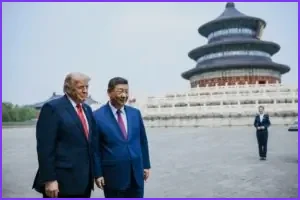
U.S. President Donald Trump and Chinese President Xi Jinping are scheduled to meet at the White House from September 23 to 25, setting a new stage for their high-stakes relationship. The upcoming Washington summit follows their previous encounter on May 14, 2026, when Xi escorted Trump through Beijing's historic Temple of Heaven. While that ancient site was built for Ming and Qing emperors to mediate between heaven and earth, the stroll between the two leaders transformed the complex into what observers described as a stage for distributing personal recognition—a "Temple of Thymos"—rather than cosmic concerns.
International relations experts frequently view the U.S.-China rivalry through the lens of the Thucydides Trap, a concept popularized by political scientist Graham Allison suggesting that a rising power and an established power are headed for inevitable conflict. Xi has a pattern of citing Allison and even referenced the phrase during the May meeting. However, an alternative and complementary framework for understanding their dynamic is the "Thymos Trap," which focuses on the deep-seated human desire for recognition and status.
Derived from the Greek word, thymos represents the part of the soul that craves the recognition of dignity, as popularized by political philosopher Francis Fukuyama. Fukuyama distinguishes between isothymia, the desire to be recognized as an equal, and megalothymia, the yearning to be recognized as superior. While liberal democracies are designed to satisfy isothymia, megalothymia persists, often fueled by the trauma of past humiliations. On a national level, this psychological dynamic is channeled into nationalism. Xi expresses this through China's "century of humiliation," the "hurt feelings of the Chinese people," and his "Chinese Dream" of national rejuvenation, while Trump projects it through his "Make America Great Again" slogans.
The pursuit of status can manifest in different ways. According to political philosopher Ye Xue, the United States and China have distinct cultural approaches to recognition. In the individualistic U.S. culture, status is relative and must be actively defended, leading to demands for personal honor. In contrast, China's traditional culture is rooted in a stable, relational hierarchy where harmony is sought. Trump and Xi embody these differences, with Trump's approach being deeply individualistic and antagonistic, while Xi focuses on a collective megalothymia that demands global deference to China as a whole.
This insistence on respect shapes how both leaders operate in public. Canadian Prime Minister Mark Carney reflected on a January 2026 meeting with Xi, noting that the Chinese leader essentially told him, "don't lecture me in public." While Xi was open to hearing complaints privately, being criticized publicly represented an unacceptable loss of face. Meanwhile, Trump's style aligns with what historian Walter Russell Mead identifies as the Jacksonian tradition: populist, informal, and quick to react to perceived insults. Consequently, Trump must be seen winning visibly, while Xi must avoid losing face at all costs.
Despite these cultural variations, both leaders exhibit the characteristics of strongman rule. In his book "The Age of the Strongman," columnist Gideon Rachman identifies four traits of this leadership style: a cult of personality, contempt for the rule of law, populism, and a politics of fear and nationalism. Rachman places leaders on a continuum, ranging from unchallenged autocrats like Xi and North Korea's Kim Jong Un, to hybrid regime leaders like Russia's Vladimir Putin, and finally to politicians operating within democratic systems, such as Trump. To prevent the rise of such figures, liberal democracies rely on institutional safeguards, echoing James Madison's warning in "The Federalist Papers" that "ambition must be made to counteract ambition."
Summits serve as the ultimate stage for these leaders, where carefully choreographed protocols display honor and status. During the May meeting in Beijing, Trump's effusive rhetoric stood in stark contrast to Xi's relatively aloof demeanor. Trump publicly referred to Xi as his "good friend" and "a man I admire greatly," and even praised the "beautiful roses" presented to him. This interaction aligns with research by political scientist Todd Hall on how affective ties—such as flattery and attachment—can be used to manipulate leaders. Chinese officials successfully used pageantry to induce warm feelings from Trump.
While Xi did not match Trump's rhapsodic language, he oversaw a lengthy Chinese readout of the meeting that detailed a new four-pillar framework of stability, or tifa, centered on Taiwan. In contrast, the White House released a readout consisting of only a single paragraph. For the Chinese Communist Party, a summit that portrays the U.S. president as an equal or subordinate statesman is vital for legitimizing its narrative of returning China to greatness, especially when a foreign leader seeking validation is swayed by the pageantry.
Trump's fascination with authoritarian strength is long-standing. In a 1990 interview with Playboy magazine, he praised China's leadership for showing "strength" in crushing the Tiananmen Square protests, while calling Soviet leader Mikhail Gorbachev "weak" for demonstrating restraint. Xi, on the other hand, is characterized by what analysts Ursula and Dennis Wilder describe as an "iron Machiavellian detachment," a trait honed during his calculated rise through the ranks of the Communist Party.
However, the fusion of a leader's ego with the state creates structural vulnerabilities, which is the core of the Thymos Trap. Personalist regimes often suffer from isolation, the suppression of critical feedback, overreaching, and overly centralized decision-making. Political scientist Milan W. Svolik has noted that most deposed dictators are overthrown not by popular uprisings, but by regime insiders who detect weakness. To prevent the decay that John Garnaut described as the "calcification and putrefaction" of dictatorship, Xi has engaged in a continuous struggle, illustrated by the sweeping purges within China's military over the past few years. Rather than demonstrating absolute strength, these purges highlight the regime's underlying brittleness and the heightened risk of a succession crisis in the absence of competent rivals.
There are notable differences in how these dynamics play out. Xi's face-saving political culture and the absence of electoral cycles allow him to be more patient than Trump, explaining why Beijing has occasionally accepted off-ramps during trade disputes. Furthermore, while Western disarray has led some commentators, like Hal Brands, to lament that "Xi sets the terms for everyone now," historian Stephen Kotkin points out in "The Weakness of the Strongmen" that such regimes often endure longer than expected, even though they remain highly vulnerable to sudden political crises.
In the United States, Trump's autocratic impulses are constrained by robust democratic institutions. The U.S. Constitution's system of checks and balances, an active civil society, and a powerful opposition party limit his power. Fiona Hill, a former National Security Council official, noted that Trump exhibits "autocrat envy," praising dictators while criticizing democratic leaders. Trump's former ambassador to Hungary remarked that Trump would love to have the level of control enjoyed by Hungarian Prime Minister Viktor Orban, who was eventually voted out of office by Hungarian citizens.
The historical context of the Temple of Heaven contains a final irony for the Chinese leadership. In Chinese cosmology, the emperor performed rites because the Mandate of Heaven could be withdrawn, linking magnificence directly with precarity. As Gideon Rachman observed, strongman rule is "an inherently flawed and unstable form of government" that "will ultimately collapse," though often after causing significant turmoil and suffering. While Xi projects the image of a contemplative philosopher-king, his official ideology, "Xi Jinping Thought," is highly propagandized and likely ghost-written by a committee. This stands in contrast to the Roman Emperor Marcus Aurelius, a rare historical leader who used Stoicism to actively question and restrain his own desire for recognition.
You have reached the limit of 2 free articles this month.
This desire for status, as the journalist Will Storr explained in “T he Status Game,” is pursued through dominance, virtue, or success. These differing tactics can depend on the cultures in which status-seeking individuals operate.
Related Articles

Mr. Udoy is a professional Web Developer and Blogger with 7+ years of experience in the tech world. He specializes in web architecture and digital storytelling. As the driving force behind worldincidents.com, he focuses on delivering high-quality, well-researched content to a global audience.