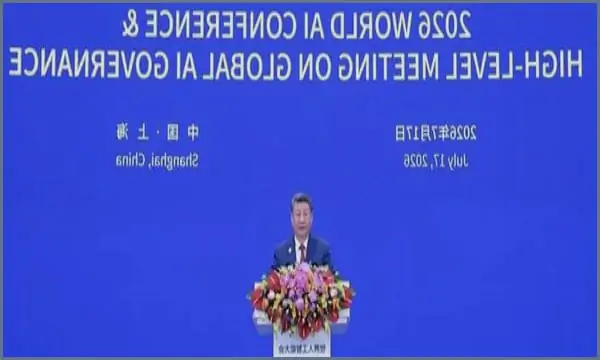
During his visit to Shanghai in mid-July 2026, Chinese President and General Secretary of the Chinese Communist Party (CCP) Xi Jinping personally opened the World Artificial Intelligence Conference. Departing from the established tradition where a lower-ranking CCP leader would preside, Xi’s presence on July 17 signaled his intent to take a central, hands-on role in the nation’s AI development strategy.
While the conference attendees were the immediate audience, Xi’s remarks were clearly aimed at the international community, particularly the United States, which remains China’s primary competitor in the field. In an uncharacteristic move for a Chinese leader, Xi acknowledged the Western origins of AI, noting that the concept was proposed 70 years ago by scholars at the Dartmouth Workshop in New Hampshire. He further contextualized technological progress by citing the steam engine, electricity, and the internet—all of which originated in Europe or the United States—as pillars of modern civilization.
Despite this nod to history, Xi underscored the profound uncertainties surrounding artificial intelligence. He posed critical questions regarding how humanity should interact with thinking machines, manage security when algorithms influence decision-making, address ethical challenges, and bridge the widening digital divide. Xi emphasized that these issues require serious, collaborative answers from the global community.
A core theme of his address was the necessity of maintaining control over the technology. Xi stated that China places significant emphasis on safety and security, aiming to improve laws, regulations, and ethical principles to ensure AI remains a stable and predictable force. He described the goal as ensuring that this "fine steed" of AI moves with both speed and stability, a concept that aligns with the CCP's broader priority of maintaining a controlled and secure society.
Xi’s vision involves China taking a leading role in shaping global AI protocols. He called for enhanced international coordination on governance rules and technical standards, proposing a consensus-based framework to benefit all of humanity. He specifically mentioned supporting Global South countries with capacity building to prevent new historical injustices in the digital age. This push for global leadership comes as the CCP faces the reality that AI, as a black-box technology, poses potential challenges to current methods of censorship and information control. Consequently, Xi emphasized that AI must be kept "secure and controllable" through technological monitoring, early warning systems, and emergency response mechanisms to prevent abuse.
For policymakers in open societies, Xi’s speech serves as a clear indication of Beijing's ambition to define the terms of the AI era. As the technology continues to evolve and permeate global systems, the call for "human control" reflects the CCP's internal drive to ensure that AI does not outgrow the party's capacity for oversight.
You have reached the limit of 2 free articles this month.
The reference to the foreign, indeed American, creators who were the progenitors of AI is an uncharacteristic acknowledgement for a Chinese leader to make.
Related Articles

Meet Md. Rubel Rana
As a core contributor to Worlddincidents.com, Rubel Rana brings a unique perspective to the world of journalism. Whether it’s deep-diving into historical trivia or covering the latest global headlines, Rubel Rana is committed to delivering high-quality, high-impact articles. Their writing blends meticulous research with a compelling voice, helping readers stay informed and curious about the world around them.
1 thought on “Xi Jinping Outlines China’s Strategy for AI Governance”