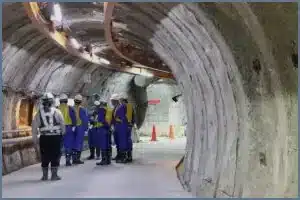
Deep beneath the windswept dairy farms and reindeer pastures of Hokkaido, Japanese researchers are working to solve one of the global nuclear industry's most enduring challenges. Located roughly 300 meters below the surface in Japan's northernmost prefecture, the Horonobe Underground Research Laboratory is a specialized facility where engineers test methods for isolating highly radioactive waste from the environment for tens of thousands of years.
Horonobe Underground Research Laboratory. Photo ©Piergiorgio Pescali.
Operated by the Japan Atomic Energy Agency (JAEA), Horonobe is now the only active underground research laboratory in Japan dedicated to studying the geological disposal of high-level nuclear waste. A second facility, the Mizunami Underground Research Laboratory in Gifu Prefecture, was constructed in crystalline rock but was decommissioned in 2022 following the expiration of its land lease. In contrast, the Horonobe facility is carved into Neogene-era sedimentary rock, offering researchers a distinct and complementary geological environment to analyze.
The origins of the Horonobe project date back to November 2000, when the governor of Hokkaido, the mayor of Horonobe town, and the president of the JAEA signed a formal agreement allowing research into the deep geological environment. Over the subsequent two decades, extensive construction and excavation shaped the underground facility, which now features a complex network of shafts and galleries. These subterranean structures allow scientists to observe how engineered barriers, groundwater, and the surrounding sedimentary rock interact over long periods to simulate a real-world repository.
Currently, the JAEA is conducting two primary large-scale experiments at the site. The first is a full-scale engineered barrier system performance experiment, and the second is a solute transport experiment. Both projects are designed to evaluate how bentonite buffers, canisters, and cement-based materials react at a realistic scale when subjected to water and pressure over several years. Additionally, researchers are analyzing how the surrounding sedimentary rock buffers natural disturbances, such as earthquakes and shifting groundwater, to ensure the long-term containment of radioactive waste.
Researchers conducting tests at Horonobe Underground Research Laboratory. Photo ©Piergiorgio Pescali.
You have reached the limit of 2 free articles this month.
Related Articles

Meet Md. Rubel Rana
As a core contributor to Worlddincidents.com, Rubel Rana brings a unique perspective to the world of journalism. Whether it’s deep-diving into historical trivia or covering the latest global headlines, Rubel Rana is committed to delivering high-quality, high-impact articles. Their writing blends meticulous research with a compelling voice, helping readers stay informed and curious about the world around them.