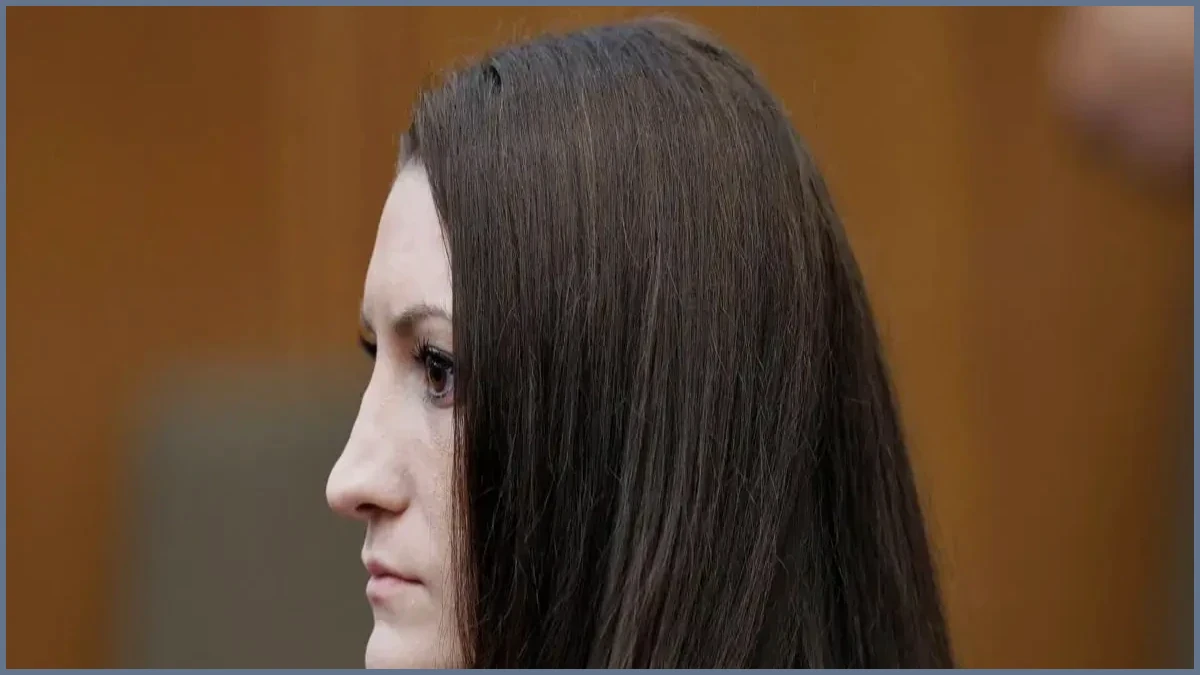
The high-profile murder trial of Lindsay Clancy in Massachusetts has reached a critical juncture as the jury of twelve remains deadlocked after five days of intense deliberations. The jury of nine women and three men have told the judge, two days in a row, that they cannot reach a unanimous decision. Despite the judge's continued urging that jurors keep at it, the struggle has raised the prospect of a mistrial in Clancy's case.
On Wednesday afternoon, after receiving a second formal notification of the deadlock, Judge William Sullivan urged the jurors to continue their efforts to reach a consensus. "It is desired that the case be decided," Judge Sullivan told the panel before reading a mandatory, formal set of instructions. Observers noted visible frustration on the faces of several jurors as they were sent back to the deliberation room to resume their work.
The 36-year-old former nurse is accused of killing her three young children—her two sons and her daughter—in the basement of their family home in 2023. While Clancy does not dispute that she committed the killings, her defense team contends that she was suffering from severe postpartum psychosis at the time and was unable to distinguish right from wrong. Conversely, the prosecution maintains that Clancy made a calculated, premeditated decision to end her children's lives and was fully aware of the wrongfulness of her actions. She faces three counts of first-degree murder.
Under United States law, any criminal verdict requires a unanimous decision from the jury beyond a reasonable doubt. If the jurors remain permanently deadlocked, the judge has the authority to declare a mistrial, which would bring the current proceedings to an end without a verdict. In Massachusetts, a judge typically exhausts multiple procedural steps to encourage a resolution before declaring a mistrial. The trial has already reached two of these steps.
The instructions delivered by Judge Sullivan on Wednesday are known in Massachusetts as a Tuey-Rodriguez charge. This legal measure serves as a final effort to break a jury deadlock. It instructs jurors to carefully re-examine their own viewpoints and remain open to other perspectives, while simultaneously advising them not to surrender their honest convictions or individual judgment just to reach an agreement.
A hung jury and subsequent mistrial would not represent an acquittal, nor would it mean the prosecution failed to prove its case. Instead, it leaves the charges unresolved. The prosecution can then either refile and restart with a new jury, or negotiate a plea agreement. Alternatively, prosecutors can dismiss the charges altogether. Regardless of the prosecution's next steps, Clancy would not be released. She would remain held under her current murder charges at the mental health facility where she is currently being treated.
The outcome of the trial heavily relies on the jury's evaluation of Clancy's postpartum psychosis defense. Her defense team presented evidence that she was experiencing command hallucinations, specifically hearing a voice that instructed her to kill her children. Family members testified about her deteriorating mental state, and expert witnesses detailed the severity of the illness.
Under Massachusetts state law, the defense is not required to prove that Clancy was mentally ill or lacked criminal responsibility. Instead, the burden lies entirely on the prosecution to prove beyond a reasonable doubt that she was criminally responsible at the time of the killings. According to criminal defense attorney Elyse Hershon, prosecutors must prove either that Clancy did not have a mental illness during the incident, or that she did have an illness but still maintained control over her actions and knew they were wrong.
A not guilty verdict would mean Clancy went free but that is considered highly unlikely. Much more likely is a not guilty by reason of insanity, which would result in Clancy being detained at a hospital. Hershon noted that the case essentially centers on where Clancy will spend the remainder of her life, with the defense advocating for a psychiatric facility and the prosecution pushing for a state prison.
The most severe potential outcome is a conviction for first-degree murder, defined as the intentional and premeditated killing of another person. In Massachusetts, this conviction carries a mandatory sentence of life in prison without the possibility of parole. Heather Cucolo, a professor at New York Law School and an expert in mental health law, explained that to reach this verdict, the jury would have to view Clancy as "a monster in the jury's eyes." Jurors would need to find evidence of extreme atrocity, cruelty, or premeditation, proving that no mitigating factors existed.
During closing arguments, prosecutor Jennifer Sprague acknowledged that Clancy suffered from mental illness but argued it was not severe enough to impair her ability to distinguish right from wrong. Prosecution experts also raised doubts about the defense's claim that Clancy heard command hallucinations ordering her to kill the children.
A second-degree murder conviction is another option available to the jury. Under state law, this applies to unlawful killings committed with malice or extreme recklessness but without premeditation. Cucolo noted that this verdict would apply if jurors believe Clancy did not pre-plan the murders but instead "consciously saw an opportunity to commit the killings at the specified time." This conviction also carries a life sentence, but with the possibility of parole.
The jury may also consider a manslaughter verdict, an option that was previously a point of contention between the defense and prosecution before being allowed by the judge. A manslaughter conviction, which carries a maximum sentence of 20 years in prison per count, would mean Clancy killed her children unintentionally through "wanton and reckless conduct." Hershon explained that this option allows the jury to consider whether involuntary intoxication—resulting from an overprescription of medication—caused a mental defect that mitigated her understanding of her actions. Experts emphasize that intent is the key distinction, allowing the jury to accept that the killings were not calculated but rather the result of a split-second decision.
As the jury continues its difficult deliberations, the legal teams and the public await whether the panel can bridge their differences or if the court will ultimately be forced to declare a mistrial.
Related Articles

Meet Md. Rubel Rana
As a core contributor to Worlddincidents.com, Rubel Rana brings a unique perspective to the world of journalism. Whether it’s deep-diving into historical trivia or covering the latest global headlines, Rubel Rana is committed to delivering high-quality, high-impact articles. Their writing blends meticulous research with a compelling voice, helping readers stay informed and curious about the world around them.