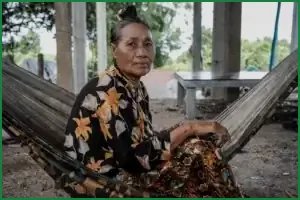
In mid-July 2026, 63-year-old Sok Rina sat beneath her high-stilted house in Pou village, located in Cambodia’s Siem Reap province, watching her two grandchildren play on the dry earth. Under normal circumstances, this wet-season month would see the area completely flooded by the rising waters of the nearby Tonle Sap lake. Stilted houses would tower over a vast expanse of water, while floating homes drifted along the bloated river. Today, however, the ground remains dry silt.
When Sok Rina was young, the annual floodwaters would begin rising in June, fully submerging the riverbanks and surrounding forests by July. These floods brought a wealth of fish that sustained the livelihoods of local water-bound communities. In recent years, however, the Tonle Sap has remained consistently low, signaling a profound shift in Cambodian weather patterns as climate change takes hold globally. Researchers observe that the traditional monsoon season in June and July is weakening, even as intense easterly storms from the Pacific Ocean increasingly strike later in September and October.
This climate disruption is compounded by infrastructure development. More than 200 large hydropower dams are currently planned, completed, or under construction across the lower Mekong basin. Together, climate change and these upstream dams are severely restricting the flow of water into the Tonle Sap. The lack of water has triggered a collapse in local fisheries, leaving residents of villages like Pou, Me Chrey, and Chong Khneas facing severe challenges to their survival.
For local fishers, the daily reality is stark. Cheim Oeurn, 40, managed to catch only about one kilogram of small climbing perch and moonlight gourami one July morning—fish that carry almost no market value. He explained that the Sangkae River is simply too low for fish to spawn in the flooded forests surrounding the Tonle Sap, while rising water temperatures in the shallow areas threaten to destroy fish eggs. "If there is a lot of water, there will be more fish; as the water rises, fish will breed. Less water means fewer fish," Cheim Oeurn said. Historically, fishers in Pou village could count on earning 50,000 to 100,000 riel ($12.50 to $25) daily from a 50- to 60-kilogram catch. Today, they often return with nothing of value.
A similar struggle is unfolding in Chong Khneas village. Choum Chreb reported that her son caught exactly five fish after working from 4 a.m. on July 23. "He hasn’t caught any in the past three days, and today’s five fish aren’t even enough to cover the cost of gasoline," she said. Her family has lived and fished on the Tonle Sap for 25 years. "We lack land to move to," she added. "We just earn enough to survive on the water."
As Southeast Asia’s largest freshwater lake, the Tonle Sap is vital to millions of people. Connected to the Mekong River, its flow famously reverses direction twice a year. During the wet season, the rising Mekong pushes water back into the Tonle Sap, causing the lake to expand and flood nearby forests, creating a unique ecosystem that supports the largest inland fishery in the world. In the dry season, the process reverses, and the lake drains back into the Mekong.
According to the Stimson Center’s Mekong Dam Monitor, this year's reverse flow started approximately six weeks late, and the volume is significantly weaker than average. The reverse flow was measured at just 4 billion cubic meters, far below the historical average of 11 billion cubic meters. Brian Eyler, the director of the Stimson Center’s Southeast Asia program, noted that June and July have seen below-normal rainfall for five consecutive years. "It seems like the traditional monsoon pattern that builds at the beginning of the wet season is weakening in strength," Eyler said.
Eyler explained that hydropower dams exacerbate the situation by filling their reservoirs during the early rains. Because these dams deplete their storage to produce electricity during the dry season, they are mostly empty when the wet season begins. "This all makes the expansion of the Tonle Sap Lake get off to a very weak start," Eyler said, adding that parts of the Mekong recently recorded all-time lows. He suggested that upstream operators could mitigate this by waiting until later in the wet season, when rainfall is more abundant, to fully fill their reservoirs. Data from the Mekong River Commission shows that water levels on the Tonle Sap River at Prek Kdam have remained below the historical average during the early wet season for eight consecutive years.
The ecological decline has triggered a severe economic and social crisis. In Me Chrey village, 43-year-old Pon Niem shared that her 21-year-old daughter dropped out of school in grade 12 to work at a garment factory in Kampong Speu province in 2025. This year, her 19-year-old son also dropped out in grade 11 to join his sister at the same factory. "They see the family’s hardships," Pon Niem said. "They told their two younger sisters to continue their school, not to worry."
Similarly, 40-year-old Preap Nakrei's eldest daughter left school in grade eight to work in a Siem Reap restaurant, and now, at 18, works at a cigarette factory in Phnom Penh to help repay family debts. While lower secondary education is available locally, upper secondary students must relocate to the district center, which presents an unaffordable financial burden. "If we could earn 30,000 riel a day, we could support our children’s education," Nakrei said. Her family currently owes 10 million riel (about $2,500) to a private lender for fishing nets and another 3 million riel ($750) to the microfinance institution AMK, requiring a monthly interest payment of 45,000 riel ($11.25). Nakrei was unable to make a scheduled 1.5 million riel repayment to AMK in July, though the institution agreed to delay the deadline until December.
Sorn Chavy, 28, of Pou village, faces a comparable debt burden, owing 2 million riel ($500) to the microfinance institution Chamroeun, 3 million riel to AMK, and roughly 17 million riel ($4,250) to a private lender for fishing nets and fish-raising expenses. She has delayed starting her fish-raising operations because the water levels are too low to keep the fish alive. "It’s hard for us to move out of this area; I’m three months pregnant and my first son is just six years old," Chavy said. "Since birth, we have known only fishing."
A recent study by researchers from the Cambodia Development Resource Institute and the Royal University of Phnom Penh confirmed these widespread disruptions. The study documented a 50 percent decline in fish production between 2018 and 2020, falling from 291,260 to 144,635 tons due to lower water volumes and shorter flood durations. "Fishing is no longer reliable, and fishing communities are shifting into farming by clearing the flooded forest areas," the study noted. It also highlighted physical changes in the communities, stating that "some floating communities are no longer floating," while others "stay on land longer than on water throughout the year."
To reach Pou village from the Puok district town, one must travel down a potholed red gravel road past rice fields and dense forests. The landscape immediately reveals the changing climate. While traditional homes stand high on five-meter wooden stilts marked by the faint waterlines of past floods, the ground beneath them remains dry. Along the Sangkae River, floating houses constructed on bamboo rafts and empty gasoline drums sit completely grounded on the dry riverbanks.
Sok Rina explained that her own children had to leave the village to find work. Her eldest son, 32, married in 2020 and moved to Sihanoukville last year, where he works in a plastic factory and his wife works in a garment factory. Two of her other children moved to Sihanoukville to work in tourism, while another relocated to Phnom Penh to work as a swiftlet nest cleaner. "They dropped out of school because they witnessed our impoverished living conditions," Sok Rina said. "They used to live with us, and fished, but they couldn’t earn a living. So they migrated for work." Last year, the area did not flood until August, and the waters receded by September. Looking out over the dry ground, she added, "I’m not sure about this year."
This article was first published by the Mekong Independent and is reprinted under a Creative Commons license.
Related Articles

Mr. Udoy is a professional Web Developer and Blogger with 7+ years of experience in the tech world. He specializes in web architecture and digital storytelling. As the driving force behind worldincidents.com, he focuses on delivering high-quality, well-researched content to a global audience.