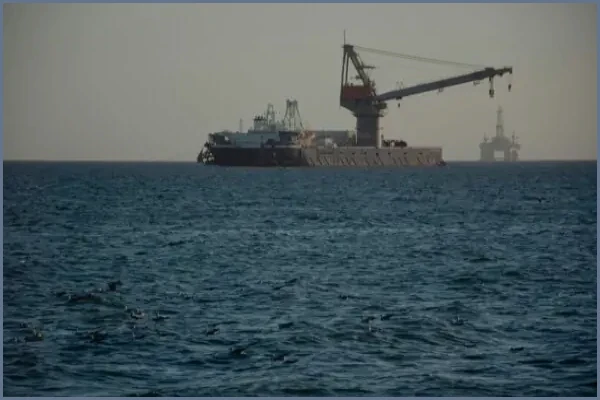
For years, the primary obstacles facing trade corridors across the Caspian Sea were seen as environmental and structural, dominated by inadequate port facilities and rapidly declining water levels. However, since 2022 and accelerating rapidly in 2026, hard maritime security threats have pushed their way to the forefront of regional concerns. Geopolitical conflicts have spilled directly into the waterway, transforming it into a military theater and making physical security a prerequisite for keeping the east-west trade route a viable alternative for global resources.
The transformation of the Caspian Sea into an active conflict zone became undeniable in 2026. On March 18, 2026, Israel launched an attack on the Iranian port of Bandar Anzali, marking its first strike on an Iranian target in the Caspian Sea. The operation aimed to disrupt the transit of military equipment from Russia to Iran. This was followed on July 25, 2026, by a Ukrainian drone attack on a cargo ship transporting Iranian military shipments, which resulted in the death of one Iranian sailor. Russia has regularly used its Caspian flotilla to launch missile attacks against Ukraine, prompting Kyiv to view Russian and Iranian vessels involved in the weapons trade as legitimate military targets.
These military escalations have sent shockwaves through regional trade initiatives, particularly the International North-South Transport Corridor (INSTC). Conceived over two decades ago, this 7,200-kilometer route connects Russia to the Persian Gulf via the Caucasus, the Caspian Sea, and India. The project has found new urgency due to Russia's isolation following its full-scale invasion of Ukraine, alongside India's desire to secure a route to the Arctic that bypasses China. India's involvement includes a 2024 agreement with Iran to operate the Shahid Beheshti terminal at Chabahar Port on the Gulf of Oman, as well as a December 2025 partnership with Moscow to expand Indian access to the Arctic using the north-south corridor. Russia has welcomed India's participation as a counterweight to China and "unfriendly countries" in the polar region.
Simultaneously, the East-West Middle Corridor has grown in strategic importance as a vital transit route for Western energy and mineral resources. Energy remains the dominant export, with over 90 percent of Azerbaijan's oil and gas production occurring offshore in the Caspian. Kazakhstan and Turkmenistan, which extract most of their hydrocarbon resources onshore, have historically relied on pipelines passing through Russia and China. To mitigate transit risks, Kazakhstan has increased its oil shipments across the Caspian Sea via the Baku-Tbilisi-Ceyhan (BTC) pipeline, even though these shipments currently account for only 2.3 percent of its total oil production. Meanwhile, Turkmenistan continues to operate three gas pipelines to China with a fourth in development, while U.S. and Turkish officials have advocated for a subsea Trans-Caspian Gas Pipeline.
Beyond fossil fuels, the United States and the European Union have signed agreements with Kazakhstan to secure access to critical minerals. Because the Caspian Sea is the only route out of Central Asia that does not require transit through Russia, China, Iran, or Afghanistan, developing this corridor is vital for supply chain diversification. To support this, the U.S. Department of State established the Trans-Caspian Enterprise Fund in 2026 to encourage private-sector investments in regional trade links. However, physical bottlenecks remain. The World Bank estimates that trade along the Middle Corridor could triple by 2030 if ten priority actions—including upgrading port infrastructure, expanding rail networks, increasing rolling stock, and streamlining customs and logistics—are implemented immediately.
These ambitions are severely threatened by the Caspian Sea's rapidly declining water level, which reached a historic low in 2026. Kazakhstan's Ministry of Natural Resources has blamed climate change and rising temperatures for accelerated evaporation, but human activity plays a massive role. Russia has heavily dammed the Volga River, which provides approximately 80 percent of the Caspian's water inflow. Although the shallowing began in the 1990s, the crisis prompted Kazakhstan to declare a state of emergency in 2023. Expensive dredging operations offer only temporary relief, and crucial ferry transport for Central Asian mineral exports has already been scaled back on several routes.
Geopolitical maneuvering further complicates the situation. Historically, Russia and Iran have blocked subsea pipeline projects that threaten their own energy export monopolies. China has also proceeded cautiously, treading carefully with projects like the China-Kyrgyzstan-Uzbekistan railway to avoid provoking a negative response from Moscow. Furthermore, Western efforts to bypass adversarial supply chains have run into local hurdles. U.S. opposition to a sanctioned Chinese company operating the new deepwater port of Anaklia on Georgia's Black Sea coast—a key link for the Middle Corridor—likely influenced the Georgian government's decision to retain state control of the project.
Ultimately, while Kazakhstan, Azerbaijan, and Turkmenistan stand to benefit from an independent Caspian export route, securing these waters is now the most pressing challenge. Russia and Iran have repeatedly demonstrated their ability to disrupt global supply chains. Future threats to trans-Caspian shipping could range from anchor drags and cyber sabotage to mine-laying, interdiction, or direct military attacks. Safeguarding these vital commercial corridors will require regional states and their Western allies to pivot from focusing solely on infrastructure to establishing robust maritime security measures.
You have reached the limit of 2 free articles this month.
The views expressed are those of the authors and do not represent those of CNA or its sponsors.
Related Articles

Md. Kazi Bijoy is a dedicated tech enthusiast and content creator with a passion for digital innovation. With years of experience in the tech industry, he specializes in breaking down complex topics into easy-to-understand guides. When he isn’t writing, he explores the latest gadgets and researches emerging trends in the digital world.