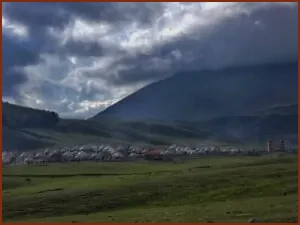
In early September 2026, Kyrgyzstan hosted both the World Nomad Games and the Shanghai Cooperation Organization (SCO) summit, executing a carefully choreographed spectacle designed to project national power and pride. The simultaneous events brought a dramatic contrast to the country, silencing the capital city of Bishkek under strict security lockdowns while transforming the mountain meadows of Kyrchyn gorge into a bustling, rain-soaked celebration of nomadic heritage.
The dual events marked the return of the World Nomad Games to Kyrgyzstan for the first time in eight years. Unlike previous editions, which were centered primarily along the shores of Issyk-Kul, the 2026 games opened on August 31 at the newly constructed Bishkek Arena, a massive 51,000-seat stadium. The opening ceremony coincided with the arrival of several high-profile global leaders attending the SCO summit, including Russian President Vladimir Putin, Chinese leader Xi Jinping, Indian Prime Minister Narendra Modi, and Turkish President Recep Tayyip Erdogan.
Addressing the audience at the opening ceremony, Kyrgyz President Sadyr Japarov emphasized the country's identity and future trajectory. "Our foundation is independence, and our roots are in nomadic civilization. Our course is international friendship and partnership, and our future lies in building a developed, strong new Kyrgyzstan," Japarov said. He also announced that Kazan, in Russia's Tatarstan region, would host the next edition of the games in 2028, noting that Moscow had sent a formal request and expressing his thanks to Putin.
The tight security surrounding the opening ceremony reflected Japarov's consolidated political authority. Snipers were positioned on the roof of the Bishkek Arena, and a three-kilometer radius around the venue was closed off for the day. This demonstration of control comes ahead of the presidential election scheduled for January 2027, and follows Japarov's February 2026 dismissal of his longtime ally Kamchybek Tashiev, the former head of the State Committee for National Security, which dissolved the ruling tandem that had governed the nation since 2020.
To accommodate the SCO summit, Bishkek was subjected to severe restrictions. Main roads leading from the airport and running through the center of the capital were shut down, public transport was rerouted, and major shopping malls and markets were closed. On September 1, the streets of Bishkek were virtually empty. Pedestrians on the main avenues were instructed to clear out as official motorcades passed, with security personnel directing people onto side streets or down into underpasses. The measures left many locals and visiting tourists bewildered. "I don’t understand why they treat their own people like this," a tourist from Germany remarked while waiting underground. "Why are they hiding them?"
In contrast to the locked-down capital, the festival grounds at Kyrchyn gorge came alive with activity. An extensive ethno-village featuring fortress walls, towers, and clay structures designed to resemble the ancient Silk Road era was constructed across the meadow. Organizers reported that 150,000 people visited the site on the first day alone. Each of Kyrgyzstan's seven regions, alongside the cities of Bishkek and Osh, established its own camp featuring traditional yurts, local food, and cultural performers. Despite rainy weather, the festival proceeded with high attendance, drawing significant attention on social media from international creators and visitors alike.
The sporting program of the World Nomad Games has expanded significantly, growing from 23 sports in 2016 to 43 in 2026. This expansion included increased participation by female athletes, notably in the Kyrgyz-style horseback archery competition, which featured 45 women from 32 countries. However, the inclusion of women also highlighted ongoing institutional challenges within the domestic sporting structure. Kyrgyzstan's women's horseback archery team was assembled just two weeks before the competition under a single coach who managed both the men's and women's squads, with resources and focus remaining heavily biased toward the men.
Aidana Usenbekova, a 28-year-old member of the Kyrgyz horseback archery team, spoke out about the difficulties faced by female competitors, particularly after their assigned horses were reassigned to visiting international competitors just before the start of the event. "We ride no worse. We shoot no worse. Sometimes better," Usenbekova said. "All the horse sports are still seen as men’s sports. For the few girls who even get seen and make the national team, it’s twice as hard. We’re still fighting the stereotypes here. We didn’t even have time to prepare properly. We still put in a strong performance." She described the last-minute horse reassignment as deeply frustrating. "They told us those girls were guests, and we had to take whatever horses were left. That’s the attitude toward women in this sport. It’s contempt. It happened right before we went out. We all walked into the competition like that."
The athletic highlight of the games occurred on September 6 at the hippodrome in Cholpon-Ata, where Kyrgyzstan secured dominant victories over Kazakhstan, winning 12-0 in Kok Boru and 7-2 in Kokpar. The matches drew passionate crowds from across the country, including 75-year-old Tashtan from Uzgen, who traveled specifically to watch the event. "I came for Manas," Tashtan said, referring to the legendary Kyrgyz epic hero. "I’m a big fan of his." The final matches were marred by ticketing issues, with more tickets sold than stadium seats available. In response to the crowd's frustration, President Japarov ordered the gates opened to all spectators, which allowed crowds to flood in but left some ticket holders unable to enter the venue.
Political analysts suggest the timing of the games and the SCO summit served a strategic domestic purpose. Analyst Temur Umarov noted that Japarov utilized the overlapping events to demonstrate order and present Kyrgyzstan as a regional peer to neighboring Kazakhstan and Uzbekistan. "The core audience this was aimed at was Kyrgyz citizens," Umarov observed. Japarov reinforced this message during a parliamentary address on September 9, asserting that the world had "seen Kyrgyzstan at a new level and in a new quality."
Political scientist Asel Doolotkeldieva argued that the events were designed to deliver a broader message of national sovereignty and identity, timed closely with the country's Independence Day. "Holding the SCO summit and the Nomad Games together is tied to Independence Day," Doolotkeldieva said. "That is a major date for Kyrgyz society. It is meant to scale both the domestic and the external message: Kyrgyzstan now has a stronger state and a sharper identity." She added that the spectacle successfully generated a strong sense of pride and belonging among domestic citizens and the Kyrgyz diaspora, solidifying Japarov's political position ahead of the 2027 election.
The scale of the 2026 games represents a vast departure from the inaugural World Nomad Games in 2014, which was initiated under former President Almazbek Atambayev. The original event was a modest gathering with minimal international media presence, held in a Kyrchyn gorge that was then just a simple mountain pasture accessed by a dirt road. By 2026, the venue had expanded to a 52-hectare staged nomadic village complete with asphalt roads and helipads, reflecting the state's evolution of the festival into a highly structured tool for national image-making and political messaging.
Related Articles
Mr. Udoy is a professional Web Developer and Blogger with 7+ years of experience in the tech world. He specializes in web architecture and digital storytelling. As the driving force behind worldincidents.com, he focuses on delivering high-quality, well-researched content to a global audience.