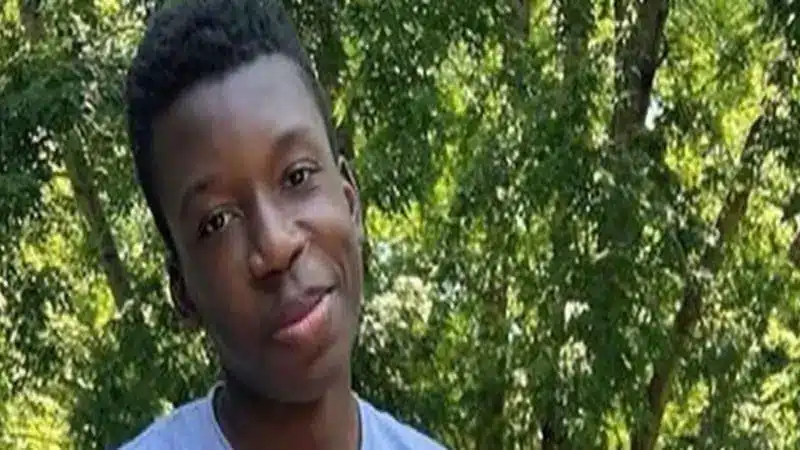
The 84-year-old White homeowner accused of shooting a Black teenager who mistakenly rang his doorbell in Kansas City turned himself in to authorities on Tuesday and was subsequently released on bail. Andrew Lester faces two felony charges, including assault in the first degree and armed criminal action, in connection with the April 13 shooting of 16-year-old Ralph Yarl. According to Yarl family attorney Lee Merritt, Lester is scheduled to be arraigned on Wednesday afternoon.
Lester surrendered at a local detention center on Tuesday and was released on a $200,000 bond just hours later. Sarah Boyd, a spokesperson for the Clay County Sheriff’s Office, confirmed that the conditions of Lester's bond strictly prohibit him from possessing any type of weapon. Additionally, Lester is barred from having any direct or indirect contact with Yarl or his family members.
The shooting occurred after Ralph went to the wrong address to pick up his younger siblings. Instead of arriving at NE 115th Terrace, the teenager went to a residence on NE 115th Street. Ralph was shot in both the head and the arm during the encounter. While he has since been discharged from the hospital, his family has emphasized that he faces a long and challenging road to recovery.
According to police documents, Lester and the teenager did not exchange any words before the homeowner fired his weapon through a locked glass storm door. Lester told investigators that he was lying in bed when he heard the doorbell ring. He grabbed his .32 caliber revolver and went to the front entrance of his home, which features an interior door and a locked glass exterior door. Upon opening the interior door, Lester claimed he saw a Black male approximately 6 feet tall pulling on the exterior storm door handle. Believing that someone was attempting to break into his home, Lester fired two shots within seconds of opening the door, stating he acted to protect himself from a physical confrontation and was "scared to death" due to the boy's size. Lester told police he immediately called 911 after the shooting.
However, Ralph's account of the event differs. Speaking to police while being treated at the hospital, the teenager stated that he rang the doorbell and waited. He said a man eventually opened the door and immediately shot him in the head, causing him to fall to the ground. While he was still down, the man fired a second shot, hitting him in the arm. Ralph told police he did not pull on the door handle. He recalled getting up and running away to avoid being shot again, hearing the homeowner call out, "Don't come around here." Responding officers who arrived at the scene just before 10 p.m. found Ralph wounded in the street, noting that the front storm door glass at Lester's home was shattered and blood was visible on the front porch and driveway.
The injured teenager had to run to three different homes before someone agreed to help him. A neighbor, who chose to remain anonymous, recalled calling 911 after Ralph arrived at her door bleeding. She was initially instructed by the emergency operator to stay inside for her own safety because the shooter's location was unknown. She eventually went outside with towels to help stop the bleeding, expressing her distress over the situation and noting that she had to clean blood off her own door and railing.
The decision to initially release Lester shortly after the shooting has drawn significant criticism. On the night of the incident, Lester was taken into custody but was released less than two hours later. Clay County Prosecuting Attorney Zachary Thompson explained that Lester was released because investigators recognized that more work needed to be done on the case file. Thompson noted that while Missouri law allows for a 24-hour hold, Lester was held for only two to three hours before going home. Yarl family attorney Ben Crump questioned this decision, arguing that if the racial roles had been reversed and a Black homeowner had shot a White teenager, the suspect would not have been allowed to return home to sleep in his own bed.
The shooting has sparked widespread protests in Kansas City, with demonstrators marching and chanting "Justice for Ralph." The incident has also renewed national discussions surrounding race and self-defense laws, evoking memories of the high-profile deaths of Trayvon Martin and Ahmaud Arbery. It also occurred just days before another incident in upstate New York, where a 20-year-old woman was shot and killed after accidentally turning into the wrong driveway.
Legal experts and attorneys are questioning whether Missouri's "stand your ground" law will be used in Lester's defense. These laws permit individuals to use force to defend themselves without a duty to retreat if they feel threatened in a place they have a right to be. However, Merritt argued that "stand your ground" is entirely inapplicable in this case because there is no evidence or claim from the suspect, the victim, or law enforcement that Ralph ever posed a physical threat to the homeowner.
Ralph's aunt, Faith Spoonmore, also challenged the assertion that Ralph's physical size posed a threat to Lester. She stated that Ralph is under 6 feet tall and likely weighs less than 170 pounds. Spoonmore expressed a sense of partial relief regarding the felony charges but emphasized that the family's journey toward justice and physical healing is far from over. To assist with medical bills, Spoonmore started a GoFundMe page, which had raised more than $2 million by Monday night. She described Ralph as a high school student and marching band section leader who plays the bass clarinet, who had been looking forward to graduating and visiting West Africa before starting college to study chemical engineering.
The physical recovery has been described as exceptionally fortunate. Merritt revealed that the first bullet struck Ralph's upper temple from less than five feet away, penetrating his skull. Doctors scraped bullet fragments off his frontal lobe on Thursday, and by Saturday, Ralph was back home playing with his dog. Crump called the survival a miracle but noted that the mental and emotional trauma Ralph must survive remains unimaginable.
The political response has reached the highest levels of government. President Joe Biden spoke with Ralph and his mother, Cleo Nagbe, by phone on Monday evening. During the call, Biden acknowledged how fortunate Ralph was to have a mother who is a nurse and physical therapist. The conversation also touched upon their shared love of music and Ralph's academic goal of attending Texas A&M University, with Biden lightheartedly suggesting his own alma mater, the University of Delaware, as an alternative. The White House confirmed that Biden reiterated his commitment to combating gun violence during the call.
Kansas City Mayor Quinton Lucas stated that he believes Ralph was racially profiled, saying the teenager was shot "because he was existing while Black." While Lucas acknowledged the role that race played in the incident, he also praised the hard work of the police officers, including White officers, who built the case file that allowed prosecutors to quickly bring charges against Lester. Prosecutor Thompson also acknowledged a "racial component" to the case but did not expand on the details.
He said God was telling the community and its leaders they cannot go on as business usual.
“Life looks a lot different right now. Even though he is doing well physically, he has a long road ahead mentally and emotionally. The trauma that he has to endure and survive is unimaginable,” the aunt wrote in the fundraiser.
Related Articles

Md. Kazi Bijoy is a dedicated tech enthusiast and content creator with a passion for digital innovation. With years of experience in the tech industry, he specializes in breaking down complex topics into easy-to-understand guides. When he isn’t writing, he explores the latest gadgets and researches emerging trends in the digital world.
1 thought on “Andrew Lester Released on Bond After Shooting Teen Ralph Yarl”