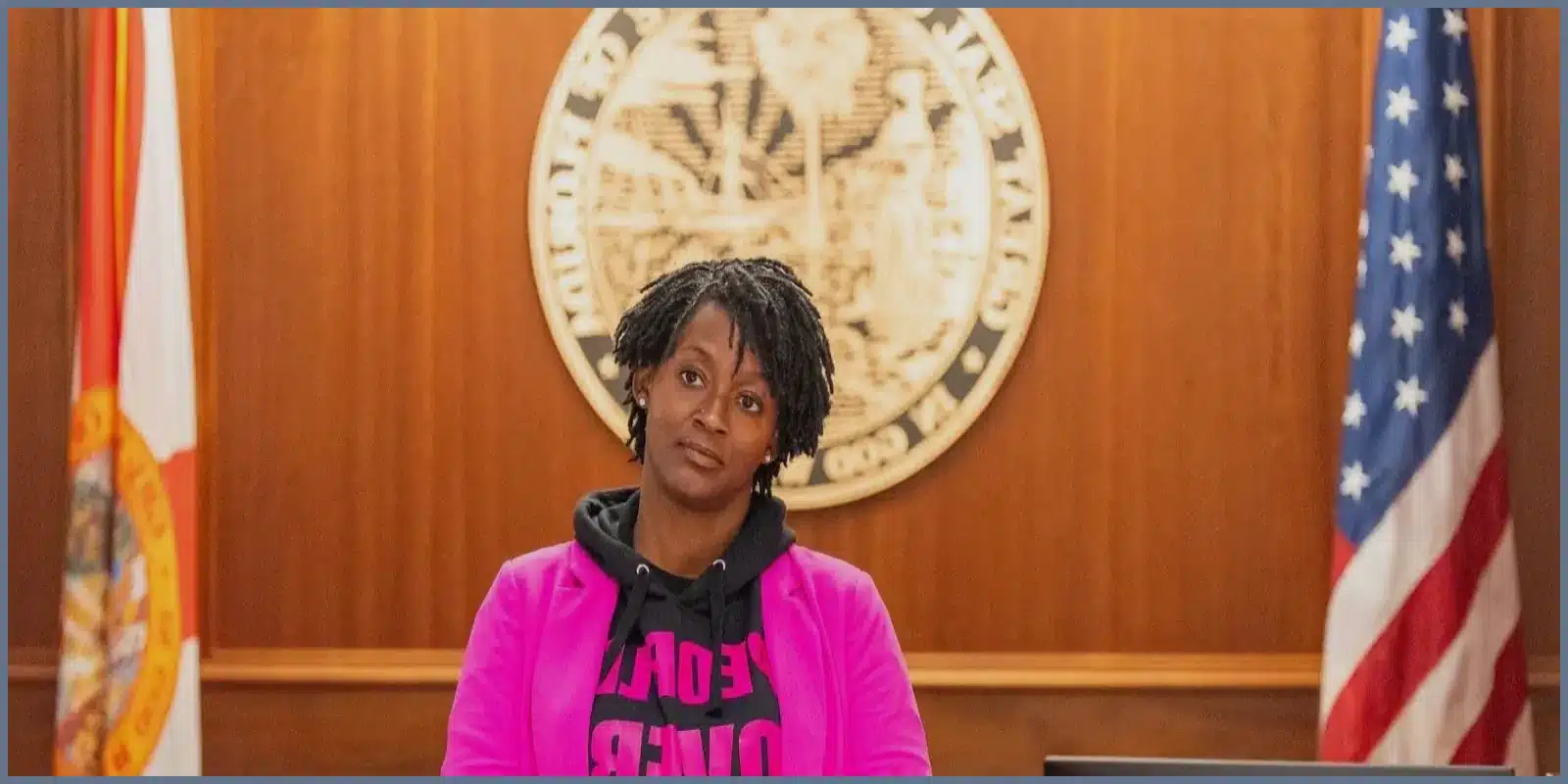
The primary elections in Florida on August 18 served as a major battleground for the ongoing factional struggle within the Democratic Party, delivering a stunning upset victory for a progressive democratic socialist alongside decisive wins for two high-profile centrist incumbents. The primary contests, which drew national attention to the Sunshine State, also set the stage for a historic gubernatorial matchup and saw a rare primary defeat for a Trump-endorsed Republican congressman.
In the most surprising result of the night, state Representative Angie Nixon, an outspoken member of the Democratic Socialists of America (DSA), secured a major upset victory in the Democratic primary for the U.S. Senate. Nixon defeated Alex Vindman, a retired Army lieutenant colonel and former national security official who gained national prominence for testifying against Donald Trump during his first impeachment trial.
Despite Vindman outraising Nixon by a substantial margin and being heavily favored by establishment Democrats who hoped to mount a competitive challenge in the fall, Nixon triumphed by approximately 11 percentage points with about 95 percent of precincts reporting.
"We showed the world what organized people can accomplish," Nixon declared during her victory speech. Celebrating on social media, she added in a post on X, "We did it ya'll … the fight has just begun." Nixon, a 32-year-old state legislator, campaigned on a progressive platform that advocated for universal healthcare and a $25-an-hour minimum wage.
She previously made headlines for staging a sit-in at Republican Governor Ron DeSantis' office to protest the state's redrawn congressional map, an action that led to charges of trespassing and resisting an officer without violence, with a trial scheduled for September.
With her victory, Nixon becomes the first Black woman to win a major party nomination for the U.S. Senate in Florida. She is set to face Republican Senator Ashley Moody in the general election, a race that political forecasters currently rate as solidly in the Republican column.
While progressives celebrated Nixon’s historic victory, establishment Democrats successfully held their ground in two highly competitive congressional primaries. Representatives Jared Moskowitz and Debbie Wasserman Schultz both secured primary victories against progressive challengers running under the democratic socialist banner. Both incumbents were running in newly gerrymandered districts designed by the state legislature at President Donald Trump's behest to favor Republicans in the upcoming midterm elections.
In both races, the insurgent challengers focused their campaigns on universal healthcare, rising cost of living concerns, and strong opposition to Israel.
In Florida's 23rd Congressional District, which forecasters have labeled as the state's only toss-up House seat, Jared Moskowitz secured a comfortable victory over progressive challenger Oliver Larkin. Moskowitz, a staunch defender of Israel, won by nearly 30 percentage points in a newly drawn district where 25 percent of the population is Jewish and includes a high concentration of Holocaust survivors. The primary was heavily defined by the U.S.
relationship with Israel, a recurring theme in Democratic primaries nationwide. Larkin ran as an "anti-Zionist" candidate, labeling Israel's military actions in Gaza as a genocide and gaining online traction for his televised clashes with conservative commentators. Moskowitz, who is Jewish, declined to debate Larkin, accusing his opponent of targeting him solely based on his religion—a claim that Larkin denied.
Meanwhile, in Florida's 20th Congressional District, veteran lawmaker and former Democratic National Committee chair Debbie Wasserman Schultz won a plurality of the vote to secure her nomination. Wasserman Schultz, who is White, faced criticism from fellow Democrats for entering the race for the newly created seat, which features a plurality-Black constituency.
The race took place amid heightened concerns among Black Democrats regarding the erosion of diversity initiatives and representation on Capitol Hill, particularly following a U.S. Supreme Court ruling that limited parts of the 1965 Voting Rights Act.
Wasserman Schultz argued that her extensive legislative experience would best serve South Florida constituents. She faced a crowded field of four Black candidates, including teacher and democratic socialist Elijah Manley, former U.S. Representative Sheila Cherfilus-McCormick—who resigned amid a fraud scandal—former Broward County Mayor Dale V.C. Holness, and Luther Campbell, the founder of the hip-hop group 2 Live Crew. Wasserman Schultz ultimately defeated Holness, her closest competitor, by about 25 percentage points.
On the Republican side, the primary elections determined the contenders who will vie to succeed Governor Ron DeSantis, who is term-limited. Representative Byron Donalds, a 47-year-old rising star in the Republican Party, secured the GOP gubernatorial nomination. Donalds, who received a key endorsement from Donald Trump, raised more than $100 million for his campaign.
His primary campaign was marked by intense attacks from conservative activist James Fishback, who lobbed anti-Black remarks at the congressman throughout the race. Donalds is only the second Black candidate to be nominated for governor of Florida, following former Tallahassee Mayor Andrew Gillum’s historic Democratic nomination in 2018.
Donalds will face former Representative David Jolly, a Republican-turned-Democrat and prominent Trump critic, who won the Democratic nomination by a decisive 55-point margin. Jolly hopes to build a coalition of Democrats, independents, and moderate Republicans, though the general election is expected to favor the GOP in a state that Trump carried by 13 percentage points in 2024.
The primary night also featured a significant setback for Donald Trump's endorsement record in Florida's Republican congressional primaries. Representative Cory Mills failed to secure renomination in Florida's 7th Congressional District following a series of misconduct allegations. Mills was the subject of a House ethics investigation regarding allegations of sexual misconduct and dating violence, stemming from a Washington, D.C. Metropolitan Police Department response to a report that he had assaulted a woman with whom he was in a relationship.
Although Mills strongly denied the allegations and retained Trump’s endorsement, many fellow Republicans called on him to resign. Republican voters ultimately rejected the incumbent, electing Ryan Elijah, a former Orlando-based news anchor, by a decisive 13-point margin. Elijah, who was endorsed by Representatives Mike Haridopolos and Anna Paulina Luna, defeated Mills and three other Republican candidates. Elijah will advance to the general election to face Democrat Bale Dalton, a former Navy Captain and NASA chief of staff.
Here are the key takeaways from Tuesday's election.
Everything was stacked against the 32-year-old state legislator in a race establishment Democrats had hoped to make somewhat competitive this fall.
Related Articles

Md. Kazi Bijoy is a dedicated tech enthusiast and content creator with a passion for digital innovation. With years of experience in the tech industry, he specializes in breaking down complex topics into easy-to-understand guides. When he isn’t writing, he explores the latest gadgets and researches emerging trends in the digital world.
1 thought on “Angie Nixon Pulls Off Stunning Florida Senate Primary Upset”