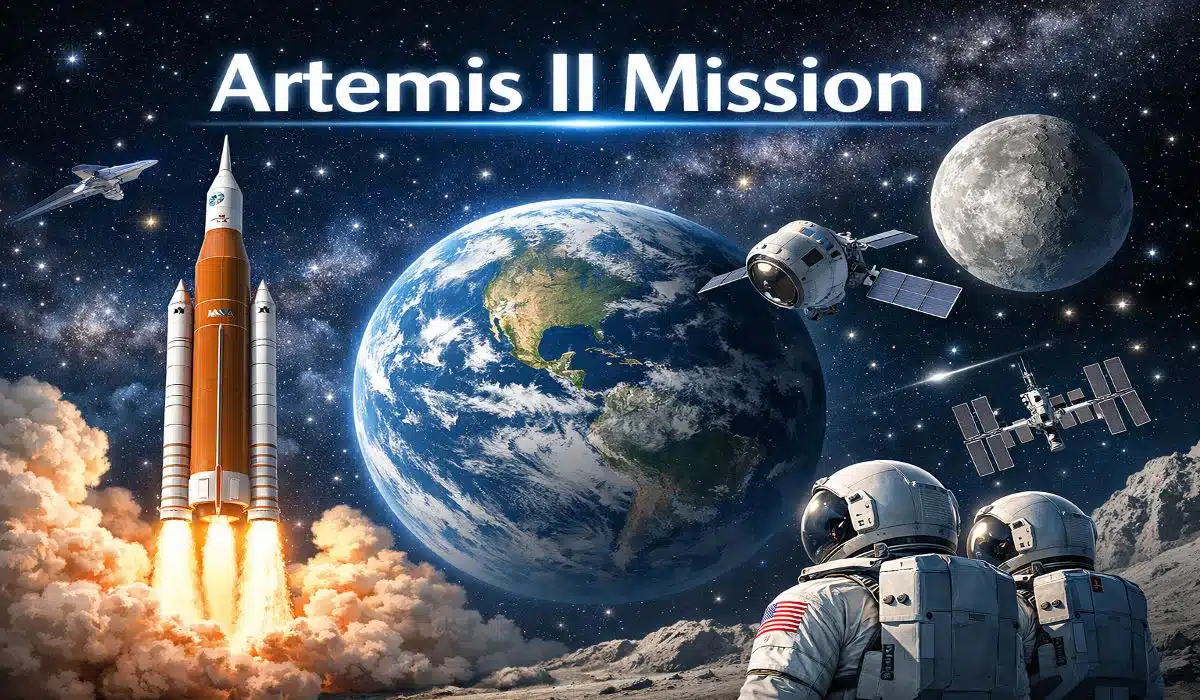
As of 2026, the global aerospace community is fixated on a singular event: the Artemis II Mission. Representing the first crewed voyage to the lunar vicinity since 1972, this mission is not merely a flight; it is a rigorous test of the systems that will eventually land the first woman and the next man on the Moon. By carrying humans aboard the Orion spacecraft, the Artemis II Mission transitions NASA’s lunar program from automated testing to active human exploration.
The Objectives of the Artemis II Mission
The primary goal of the Artemis II Mission is to confirm that the Orion spacecraft’s life-support systems are capable of sustaining astronauts in deep space. Unlike Artemis I, which was uncrewed, this flight will push the boundaries of manual flight control. The crew will perform proximity operations, testing how the spacecraft maneuvers in the vacuum of space. These maneuvers are critical for future phases where Orion must dock with the Gateway station or a lunar lander.
The Faces of a New Era
The Artemis II Mission is distinguished by its diverse and highly skilled crew. For the first time, a mission to the Moon includes a woman and a person of color, reflecting a global commitment to inclusive exploration.
Commander Reid Wiseman: A veteran leader overseeing the flight.
Pilot Victor Glover: Navigating the Orion through complex lunar trajectories.
Mission Specialist Christina Koch: Bringing record-breaking spaceflight experience.
Mission Specialist Jeremy Hansen: Representing the Canadian Space Agency (CSA).
The success of the Artemis II Mission rests on the synergy of these four individuals as they travel further into space than any human has in over five decades.
The Power Behind the Launch
To escape Earth’s gravity, the Artemis II Mission utilizes the Space Launch System (SLS), the most powerful rocket ever built. The SLS provides the massive thrust required to send the Orion capsule into a “High Earth Orbit” before a final burn propels it toward the Moon.
Once separated from the rocket, the Orion capsule becomes the primary home for the crew. During the Artemis II Mission, the spacecraft will follow a hybrid trajectory known as a “free-return trajectory.” This means that the Moon’s gravity will naturally pull the spacecraft back toward Earth, ensuring a safe return even if the primary engines encounter issues.
The Mission Timeline
The Artemis II Mission is expected to last approximately ten days.
Launch & Earth Orbit: The crew spends the first 24 hours checking systems in a high Earth orbit.
Trans-Lunar Injection: The engines fire to send Orion toward the Moon.
Lunar Flyby: The crew will swing around the far side of the Moon, reaching an altitude of thousands of miles above the lunar surface.
The Return: After the lunar swing-by, Orion will take four days to travel back, culminating in a high-speed atmospheric reentry and a splashdown in the Pacific Ocean.
Why the Artemis II Mission Matters for 2026 and Beyond
The Artemis II Mission serves as the bridge to Artemis III, the mission intended to actually land humans on the lunar south pole. By proving that humans can safely navigate the deep-space environment, NASA and its international partners are laying the groundwork for the Lunar Gateway and, eventually, a manned mission to Mars. Every data point collected during the Artemis II Mission helps mitigate the risks of radiation and long-duration isolation in space.
Revoluntionizing Space Communication
A major technical highlight of the Artemis II Mission is the debut of the Orion Artemis II Optical Communications (O2O) system. For the first time on a crewed lunar mission, NASA is moving beyond traditional radio waves to test laser-based communication. This infrared laser technology allows for a massive increase in data transmission speeds, reaching up to 260 Mbps.
During the Artemis II Mission, this system has already demonstrated its power by beaming high-definition 4K video from lunar orbit back to Earth. This leap in bandwidth means that future missions will not only send back grainy telemetry but will allow for live, ultra-high-definition streaming and rapid transfer of complex scientific data. By perfecting O2O during the Artemis II Mission, NASA is ensuring that when humans finally land on the lunar south pole, the entire world will be able to watch in crystal-clear quality.
Successful Splashdown
The Artemis II Mission officially entered the history books on April 11, 2026, following a flawless splashdown in the Pacific Ocean off the coast of Southern California. After a 10-day, 1.1 million-kilometer journey around the Moon, the Orion spacecraft (affectionately named Integrity) successfully executed a high-stakes atmospheric reentry. Traveling at nearly 40,000 km/h (Mach 33), the capsule’s heat shield endured temperatures of 2,760°C (5,000°F)—hot enough to turn the surrounding air into a glowing sheath of plasma.
Once through the communication blackout zone, a series of 11 parachutes deployed in stages, slowing the craft to a gentle 30 km/h for its final impact at 5:07 PM PDT. The recovery team aboard the USS John P. Murtha quickly extracted the four healthy astronauts, signaling the final validation of NASA’s next-generation life support and reentry systems. This successful conclusion to the Artemis II Mission provides the “green light” needed to begin final preparations for Artemis III and the eventual human return to the lunar surface.
FAQ
Q1: Will the Artemis II Mission land on the Moon?
Ans: No, the Artemis II Mission is a flyby mission. The crew will orbit the Moon and return to Earth to test the spacecraft’s safety before a landing is attempted in later missions.
Q2: How far will the crew travel?
Ans: The crew will travel roughly 6,400 miles beyond the far side of the Moon, farther than any human has ever traveled from Earth.
Q3: How does Orion protect the crew from radiation?
Ans: The Artemis II Mission utilizes advanced shielding in the Orion hull and specialized “radiation shelters” where the crew can retreat during solar flares.
Conclusion
The Artemis II Mission is more than a technical milestone; it is a symbol of human ingenuity and our innate desire to explore the unknown. As the crew looks back at a “Blue Marble” Earth from the far side of the Moon, they carry the hopes of a new generation—the Artemis Generation. This mission ensures that our return to the Moon is not a one-time visit, but a permanent step toward becoming a multi-planetary species.
read more: Deleted Signal Messages
Lenovo ThinkPad X1 Carbon Gen 13

Mr. Udoy is a professional Web Developer and Blogger with 7+ years of experience in the tech world. He specializes in web architecture and digital storytelling. As the driving force behind worldincidents.com, he focuses on delivering high-quality, well-researched content to a global audience.