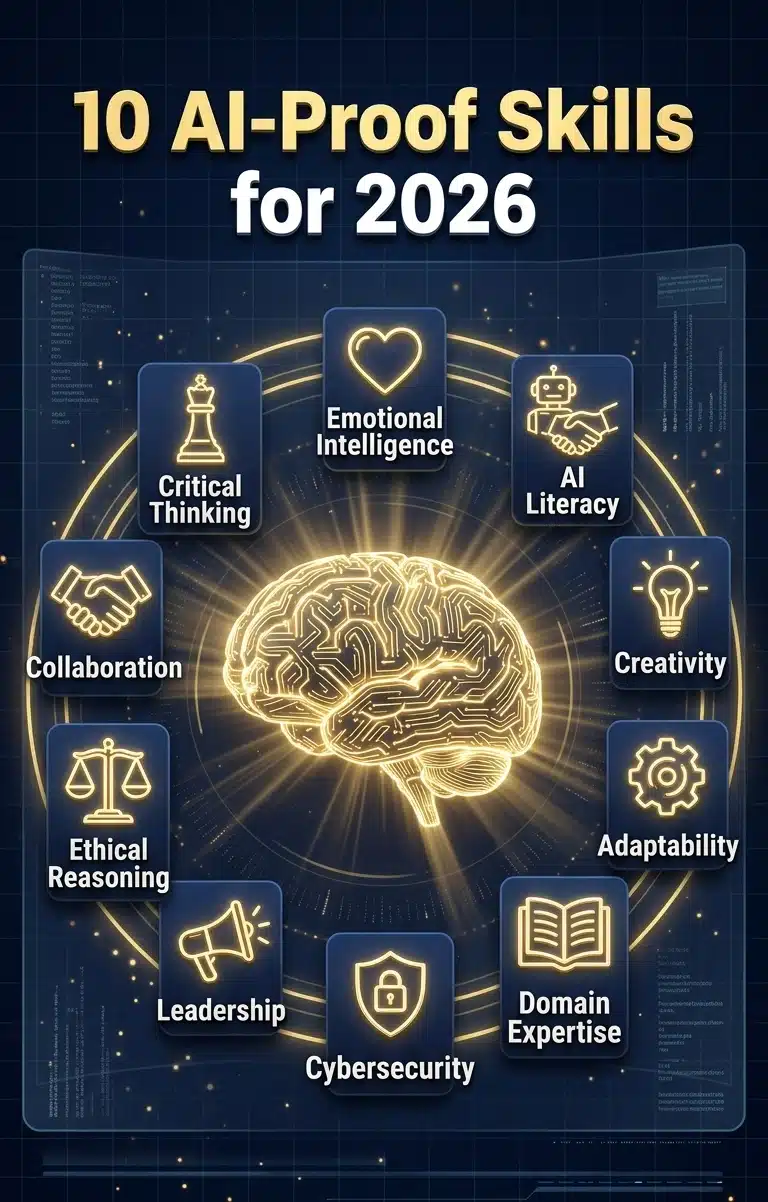
10 Incredible AI-proof skills That Will Make Your Career in 2026
The rise of artificial intelligence is no longer a distant warning — it is the present reality reshaping every industry on the planet. Millions of professionals are asking the same urgent question: will my job still exist tomorrow? The honest answer depends entirely on what you bring to the table. Workers who cultivate the right AI-proof skills are not just surviving the automation wave; they are thriving because of it. This guide breaks down the 10 most powerful human abilities you need to build right now — skills that machines simply cannot replicate — so you can future-proof your career and stay irreplaceable in 2026 and beyond.
Why Developing AI-Proof Skills Is the Career Move of the Decade
According to the World Economic Forum’s Future of Jobs Report 2025, the global economy is set to create 170 million new roles by 2030 while displacing around 92 million — a net gain of 78 million jobs. AI does not eliminate careers wholesale; it eliminates tasks. The professionals who understand this distinction and invest in distinctly human competencies will command higher salaries, stronger job security, and greater career mobility. Building robust AI-proof skills today is the single most strategic investment any worker can make.
1. Critical Thinking and Complex Problem-Solving
AI systems excel at pattern recognition, but they consistently struggle with context, ethical trade-offs, and accountability. The World Economic Forum ranks human judgment and decision-making among the most resilient competencies in AI-augmented workplaces. Employers increasingly value professionals who can frame the right problem before reaching for any tool — human or artificial. Practice dissecting complex scenarios, questioning assumptions, and evaluating competing solutions. This ability to reason under uncertainty is one of the clearest AI-proof skills you can demonstrate on any résumé.
2. Emotional Intelligence (EQ)
Empathy, social awareness, and relationship management remain firmly beyond the reach of any algorithm. Whether you work in healthcare, leadership, sales, or education, the capacity to read a room, respond to unspoken concerns, and build genuine trust is irreplaceable. Research consistently shows that high-EQ professionals outperform peers in leadership roles, team collaboration, and client retention — domains where AI acts as a supporting tool at best. Investing in emotional intelligence is one of the most future-proof career decisions you can make in 2026.
3. AI Literacy and Prompt Engineering
Understanding how AI tools work, where they fail, and how to direct them effectively has become a core professional skill. You do not need a computer-science degree. You need the ability to evaluate AI outputs critically, construct well-structured prompts, and integrate machine-generated content into human judgment loops. McKinsey research confirms that as AI spreads across workplaces, demand is growing rapidly for workers who can act as intelligent intermediaries between machines and business outcomes — making AI literacy one of the most bankable AI-proof skills available today.
Read More: Accountant: Epic Careers That Pay $110K+ in 2026
4. Creative Thinking and Original Ideation
Generative AI can produce content, images, and code at remarkable speed — but it recombines existing patterns rather than creating genuinely novel ideas. Human creativity involves cultural intuition, emotional resonance, and the willingness to take intellectual risks that no model is trained to replicate. In 2026, creative professionals who learn to collaborate with AI tools while injecting genuine originality are commanding premium rates across marketing, design, product development, and entertainment. Creativity is not just an artistic gift; it is a measurable professional asset and a defining AI-proof skill.
5. Adaptability and Continuous Learning
Business leaders now consistently describe adaptability as the new job security. The pace of AI development means static skill sets age faster than ever before. The most resilient workers are not specialists in a single tool; they are fast, intentional learners who update their knowledge base as technology evolves. Commit to deliberate upskilling — online courses, industry certifications, hands-on projects — and treat learning itself as a core professional practice. Adaptability transforms every other skill on this list into a living, evolving asset rather than a fixed credential.
6. Deep Domain Expertise
Ironically, the wider AI spreads, the more valuable deep subject-matter knowledge becomes. AI tools need informed humans to guide them, evaluate outputs, and apply results responsibly — especially in medicine, law, finance, and journalism, where accuracy and accountability are non-negotiable. A seasoned cardiologist, an experienced contract lawyer, or a senior financial analyst brings decades of contextual judgment that no model can shortcut. Stacking AI fluency on top of deep domain expertise is the most powerful professional combination available in 2026 and stands as one of the clearest AI-proof skills employers pay a premium to secure.
7. Cybersecurity Awareness
Every organization that deploys AI also expands its digital attack surface. Cybersecurity analysts who can protect sensitive data, monitor systems, and respond to threats remain in extraordinary demand. The U.S. Bureau of Labor Statistics projects information-security roles to grow far faster than average through the decade. Even non-technical professionals who understand basic cybersecurity hygiene — recognizing phishing, managing access controls, and flagging suspicious behavior — become substantially more valuable as organizations tighten their defenses. Security consciousness is rapidly becoming a baseline expectation rather than a specialist niche.
8. Leadership and Strategic Communication
AI can draft a report but it cannot inspire a team, navigate a boardroom conflict, or communicate a vision that makes people genuinely want to follow. Leadership skills — setting direction, managing diverse personalities, making high-stakes calls under pressure, and building organizational culture — depend on a richly human mix of experience, credibility, and interpersonal trust. Strong communication and storytelling abilities amplify every other skill on this list by making your expertise visible, persuasive, and memorable to the people who make hiring and promotion decisions.
9. Ethical Reasoning and AI Governance
As AI systems grow more powerful, so does the demand for professionals who can ensure they are used responsibly. Companies are investing heavily in responsible-AI frameworks, bias audits, and governance structures — and they need humans with sound ethical judgment to lead those efforts. Roles in AI ethics, compliance, and policy are among the fastest-growing in the technology sector. Understanding the social implications of automated decisions, data privacy, and algorithmic accountability positions you at the forefront of one of the defining professional challenges of the decade, making ethical reasoning a genuinely valuable set of AI-proof skills.
10. Interpersonal Collaboration and Cross-Functional Teamwork
The future of work is collaborative by design. As AI handles more routine tasks, human effort concentrates on the complex, high-value work that requires people from different disciplines to think together. Professionals who can bridge technical and non-technical teams, translate specialized knowledge for diverse audiences, and facilitate productive disagreement are consistently rated among the most valuable employees in AI-augmented organizations. Building strong networks, practicing active listening, and developing cross-functional fluency rounds out your portfolio of AI-proof skills and makes you indispensable in virtually any industry.
How to Start Building These AI-Proof Skills Today
You do not need to master all ten competencies at once. Start with an honest assessment of your current role and identify which two or three skills would have the highest immediate impact. Then build a deliberate 90-day learning plan: pick one online course, one real-world project, and one community or mentor to accelerate your growth. Update your résumé and LinkedIn profile to reflect new capabilities as you acquire them. Small, consistent steps taken now compound into a career-defining advantage within months.
Conclusion
The professionals who thrive in the AI era will not be the ones who resist technology — they will be the ones who combine machine capability with irreplaceable human strengths. The ten AI-proof skills outlined in this article represent your most strategic investment for 2026 and beyond: critical thinking, emotional intelligence, AI literacy, creativity, adaptability, deep expertise, cybersecurity awareness, leadership, ethical reasoning, and collaboration. Start building them today, and you will not just survive the AI revolution — you will lead it.
Frequently Asked Questions
Which human abilities are hardest for machines to replicate?
Empathy, complex ethical judgment, genuine creativity, and physical dexterity in unpredictable environments are consistently ranked among the hardest capabilities for automation to replicate. These qualities anchor the most resilient career paths heading into the next decade.
Do I need a technology background to stay competitive in an automated workplace?
No. While basic digital literacy is increasingly expected, many of the most in-demand roles in 2026 reward emotional intelligence, leadership, communication, and domain expertise far more than pure technical skills. Combining people skills with a working understanding of relevant tools is typically more valuable than deep technical specialization alone.
How quickly can I develop these future-ready competencies?
Significant progress is possible within three to six months of focused effort. Platforms like Coursera, LinkedIn Learning, and industry-specific certification programs offer structured pathways. Real-world application — through projects, side work, or volunteering — accelerates development faster than classroom study alone.
Will entry-level jobs be affected by automation more than senior roles?
IMF data from early 2026 shows that entry-level hiring is declining in sectors with high generative-AI adoption. The most effective response is to combine domain knowledge with demonstrable modern competencies early in a career, making yourself competitive for roles that require human judgment from day one.
Is creativity truly a professional skill, or just a personal trait?
Creativity is absolutely a professional skill — and a measurable one. Organizations routinely assess innovative thinking, original problem-framing, and novel idea generation during hiring. Professionals who practice creative exercises, embrace cross-disciplinary thinking, and document their original contributions build a compelling creative track record that commands premium compensation.

Meet Md. Rubel Rana
As a core contributor to Worlddincidents.com, Rubel Rana brings a unique perspective to the world of journalism. Whether it’s deep-diving into historical trivia or covering the latest global headlines, Rubel Rana is committed to delivering high-quality, high-impact articles. Their writing blends meticulous research with a compelling voice, helping readers stay informed and curious about the world around them.