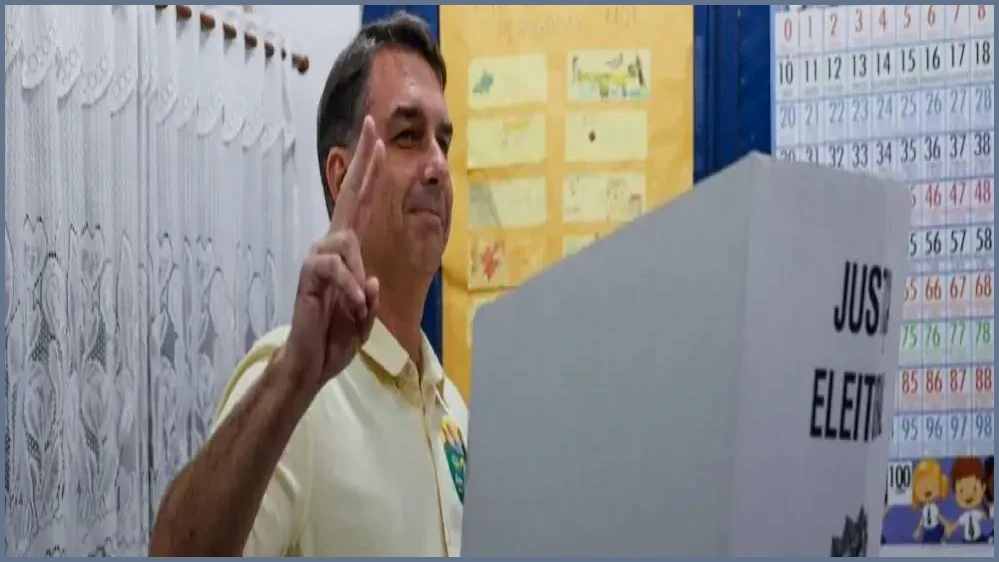
Right-wing candidate Flávio Bolsonaro has secured a first-round victory in Brazil's presidential election, defeating left-wing President Luiz Inácio Lula da Silva but falling short of the outright majority needed to avoid a second round. The two political rivals will face off in a decisive run-off election on 25 October.
Sunday's vote proved exceptionally close, defying campaign polls that had placed President Lula slightly ahead. With nearly all ballots counted, Bolsonaro captured 47.03% of the vote compared to Lula's 45.16%. The strong showing for Bolsonaro exceeded expectations and places him in a highly favorable position heading into the second round, particularly as several eliminated first-round candidates represented alternative right-wing factions whose supporters are likely to shift their backing to him.
Beyond the presidential race, Bolsonaro's Liberal Party (PL) secured the highest number of governors, senators, and federal deputies elected in the legislative contests. This sweep positions the PL to wield the most significant influence in the Brazilian Congress. Among those victorious on Sunday was Jair Bolsonaro's wife, Michelle Bolsonaro, who was elected to the Senate.
The election carries major geopolitical weight for Latin America, where a majority of nations have recently elected right-wing presidents aligned with the Trump administration. The upcoming run-off will decide whether Brazil, the largest country and economy in Latin America, will follow this regional trend.
After casting his vote in Rio de Janeiro, the 45-year-old Bolsonaro stated that he aimed to "free the Brazilian people." He later expressed great satisfaction with his lead over Lula, stating he was "very happy with the real possibility that, three weeks from now, Brazil will give a definitive answer by choosing a modern government."
In contrast, the 80-year-old Lula, who warned voters on Sunday that the election represented a choice between democracy and "barbarism," conceded that the first-round outcome was "unexpected." However, he maintained that the race is far from over. "I admit I was convinced I would win in the first round," Lula said. "The game is about to start. We are in extra time. In extra time, we will win over the Brazilian people."
Lula and Bolsonaro represent the dominant forces of the left and right in Brazilian politics. Their campaigns have deeply polarized the nation, centering on critical issues such as sovereignty, crime, the economy, and corruption.
Lula is pursuing a fourth presidential term, having previously served following victories in 2002 and 2006, and returning for a non-consecutive term after winning the 2022 election. In that 2022 contest, Lula defeated Jair Bolsonaro by less than 2%, marking the closest presidential election in Brazil's history. Following that defeat, supporters of the senior Bolsonaro stormed and vandalized government buildings on 8 January 2023.
Flávio Bolsonaro is the eldest son of former President Jair Bolsonaro, who is currently serving a 27-year prison sentence for masterminding the failed coup attempt after his 2022 loss. Although the former president was legally barred from seeking re-election prior to his imprisonment, he endorsed Flávio to run in his place. Flávio has pledged that, if elected, he will grant amnesty to his father and the supporters prosecuted for the January 8 riots.
Allegations of international interference also surfaced during the campaign. Lula made national sovereignty a central theme of his platform, occasionally accusing the United States of attempting to influence Brazil's elections—a claim the US has denied. On Sunday, the president of Brazil's supreme electoral court announced that investigators found no evidence of foreign interference in the voting process.
Geopolitical alignments remain a point of contention. Earlier this year, Flávio Bolsonaro successfully lobbied the US government to designate Brazil's two largest criminal gangs as terrorist organizations. Last year, Donald Trump cited the coup trial of Jair Bolsonaro to justify imposing tariffs on Brazil and sanctioning several top judges and officials. Analysts suggest a victory for Flávio Bolsonaro would likely align Brazil with the US-led "Shield of Americas" coalition against drug trafficking.
The campaign was also heavily impacted by a corruption scandal involving Daniel Vorcaro, a jailed banker who orchestrated one of Brazil's largest financial frauds, implicating political figures across the spectrum. Bolsonaro faced scrutiny after audio recordings emerged in which he could be heard asking Vorcaro for 134 million reais ($25.9 million; £19.5 million) to finance a biographical film about his father. Bolsonaro acknowledged making the request. Lula was also indirectly affected by the fallout after police suggested Vorcaro had contacted Supreme Court Judge Alexandre de Moraes to seek help evading arrest. Moraes, who presided over Jair Bolsonaro's coup trial and is viewed as an ally of Lula though not appointed by him, has denied any wrongdoing.
Public safety and rising crime rates were also major concerns for voters. Although Brazil's overall homicide rate has decreased, highly visible street crimes like mobile phone thefts have risen, and drug trafficking remains a severe challenge. Flávio Bolsonaro has promised to build maximum-security prisons modeled after El Salvador's penal system and formally label domestic gangs as terrorist organizations. His father had previously loosened gun ownership restrictions during his presidency. Lula, who criticized the US terror designation of Brazilian gangs, has instead focused on reforms targeting the financial operations of organized crime, improving homicide investigations, and increasing investment in the prison system.
On economic policy, the candidates offer contrasting visions to address high personal debt and sluggish growth. Lula has campaigned on his legacy of social welfare initiatives, most notably Bolsa Família, which provides financial aid to families on the condition that children remain in school and receive vaccinations. Lula's programs are credited with lifting millions out of poverty, and he has also expanded the university system. While he has supported controversial oil exploration projects that drew criticism from environmentalists, Lula has a record of reducing Amazon deforestation, which had surged under Jair Bolsonaro. Conversely, Flávio Bolsonaro has proposed a strict public debt ceiling, government spending cuts, revisions to social welfare programs, and measures to expand the critical minerals sector.
Related Articles

Mr. Udoy is a professional Web Developer and Blogger with 7+ years of experience in the tech world. He specializes in web architecture and digital storytelling. As the driving force behind worldincidents.com, he focuses on delivering high-quality, well-researched content to a global audience.