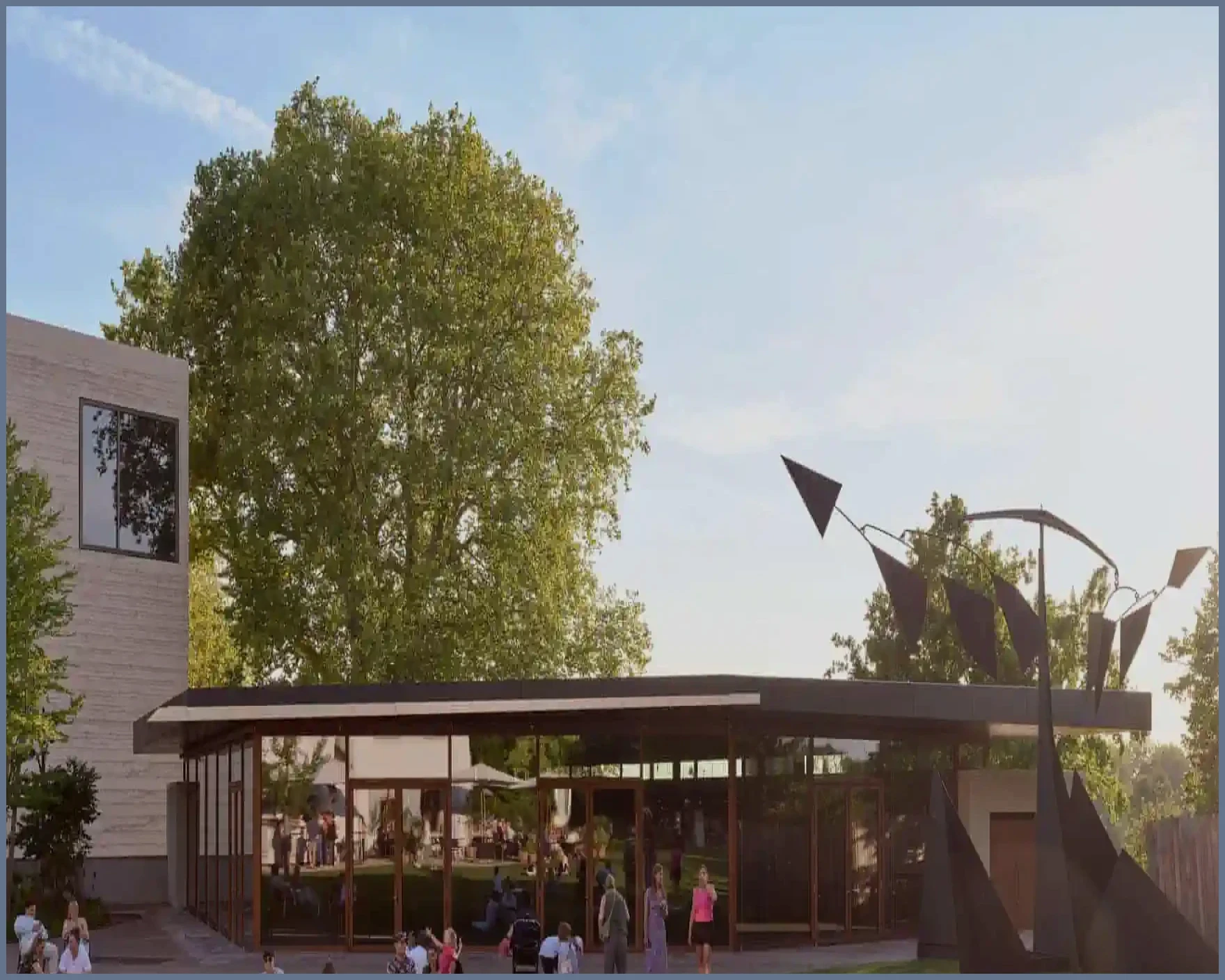
The Beyeler Foundation in Riehen, just outside Basel, Switzerland, houses one of the world's most prestigious modern art collections, featuring masterpieces by Claude Monet, Joan Miró, Henri Matisse, and Pablo Picasso. Now, the renowned Swiss architect Peter Zumthor has added a highly personal £110 million extension to this beloved institution. The project marks a significant homecoming for the Basel-born architect, who recently completed a grueling, two-decade-long, $724 million expansion of the Los Angeles County Museum of Art (LACMA). Visibly relieved to be working on home soil, Zumthor contrasted his Swiss experience with the American construction industry, criticizing the latter for relying on pre-sourced products rather than custom craftsmanship. In Switzerland, he noted, buildings are not merely an assembly of products, but are meticulously crafted by hand, down to the pear wood handrails, leather benches, and hand-blown glass lamps.
Zumthor’s connection to local craftsmanship dates back to the early 1960s, when he was a teenage apprentice in his father’s cabinet-making workshop. It was there that he designed his first cupboard, learning the satisfaction of fitting a door so precisely that it closed with a distinct sucking sound. His father instilled in him what he calls "the Basel pride in the well-built object." While working on the Beyeler addition, Zumthor encountered local craftspeople who remembered his father and possessed the specialized knowledge required for bespoke fabrication.
The original Beyeler Foundation museum, designed by Italian architect Renzo Piano, opened in October 1997—the same month Frank Gehry’s iconic Bilbao Guggenheim debuted. Commissioned by Ernst Beyeler, Europe’s pre-eminent modern art dealer and co-founder of Art Basel, and his wife Hildy, Piano's building was praised for its elegant restraint. Sited in the grounds of an 18th-century villa, Piano's long, low, temple-like structure wrapped a high-tech interior in a luxurious porphyry stone skin, letting daylight flood through rooftop louvers. However, the museum was too small from its inception. It was extended by 12 meters just two years later and eventually became Switzerland's most visited art museum, drawing 500,000 visitors annually. To address the space constraints, the foundation launched a search for an architect to design an extension, approaching 100 candidates before shortlisting 11 and ultimately selecting Zumthor in 2016.
While Piano's original building has an industrial quality, Zumthor describes his new addition as domestic, calling it "the villa that this garden was missing." The extension consists of three distinct buildings arranged across a lane, framing a public square. The layout features a drinking fountain trickling into a large stone trough, reminiscent of a traditional Swiss mountain village. Built-in stone benches line the museum's facade, offering visitors a place to rest beneath a parapet where Maurizio Cattelan’s sculpture of a drummer boy periodically beats his drum from the rooftop.
Zumthor's personal history heavily influenced the materials used in the new structure. In Wim Wenders’ new two-hour documentary, From Inside Out, the architect reflects on his childhood in Basel, identifying Jura limestone as "the stone of my youth." Seeking to make his building glow like the village fountains and cattle troughs of his memory, Zumthor mixed Jura stone into the concrete. Workers tamped the dry mixture by hand, advancing at a rate of no more than 45 centimeters a day. Zumthor chose to leave the wobbly joints between each day’s work visible, evoking sedimentary rock strata. He terms this rugged aesthetic "farmer concrete," noting its similarity to the rough, unvibrated concrete structures built by mountain farmers. This rammed concrete technique has become a signature for Zumthor, previously utilized in his Bruder Klaus field chapel in Germany and a holiday house in Devon designed for Alain de Botton’s Living Architecture company.
The new ensemble includes an administrative block featuring an elegant oak facade over a concrete frame, topped with a slender corrugated canopy that resembles Zumthor's own atelier in Haldenstein, Switzerland. A separate pavilion is designed as a warm, wooden space dug into the landscape, enclosed by glass walls and a low, upholstered acoustic ceiling with armchairs to encourage relaxation. Inside the main galleries, the atmosphere shifts away from Piano's bright, top-lit white cubes. The ground floor of Zumthor's building has a cave-like, somber quality, where Monet's waterlilies are displayed in a dim light. The upper floors grow brighter, featuring large picture windows that frame views of the Black Forest on one side and the Jura mountains on the other. The interior features limestone terrazzo floors, lime-washed walls, and pale concrete ceilings, creating an all-encompassing beige palette. Custom lozenge-shaped glass lamps, crafted by specialized artisans in Italy, provide ambient lighting alongside spotlights.
The design has drawn mixed reactions, with some critics noting that the beige interior and bespoke details evoke the atmosphere of a luxury boutique rather than a traditional art space, drawing comparisons to a high-end retail store. The journey through the museum culminates on a roof terrace with panoramic countryside views, leading visitors down a large external concrete stairway with triangular openings. The Y-shaped building wraps around a mature ginkgo tree in the park. When questioned about the environmental impact and carbon footprint of utilizing so much concrete, Zumthor defended his decision, stating that a wooden museum would not be suitable for classical art, which he believes requires more substance. Decades after Piano's original building was celebrated for resisting architectural trends, Zumthor's new addition joins a landscape of notable architecture in the region, including the nearby Vitra campus, adding another highly crafted object to the foundation's collection.
Related Articles

Meet Md. Rubel Rana
As a core contributor to Worlddincidents.com, Rubel Rana brings a unique perspective to the world of journalism. Whether it’s deep-diving into historical trivia or covering the latest global headlines, Rubel Rana is committed to delivering high-quality, high-impact articles. Their writing blends meticulous research with a compelling voice, helping readers stay informed and curious about the world around them.