When Chinese President Xi Jinping embarked on his visit to the United States from September 23 to 25, 2026, the diplomatic event was met with a notable disparity in domestic visibility. Beijing officially confirmed the trip on September 21, just two days before it commenced. In the immediate aftermath of this announcement, the news appeared to register very little among the public, with limited discussion visible across major platforms like Weibo, WeChat, and Xiaohongshu (RedNote).
This lack of public discourse stood in stark contrast to the period once the summit was underway. As President Xi arrived in the U.S., Chinese social media channels were quickly saturated with reports, primarily driven by official accounts and state-sanctioned outlets. These reports focused heavily on the diplomatic choreography of the visit, including the reception provided by U.S. President Donald Trump and the official push for what was termed “constructive strategic stability.”
Informal interviews conducted on September 22—the day after the announcement and one day before the visit—highlighted the uneven levels of awareness across different demographics in China and among the diaspora. While overseas students and professionals had already learned of the trip through international news sources or private groups, many domestic private-sector employees remained unaware of the event. Public-sector workers reported learning about the visit only after the formal announcement, noting that the schedules of high-level leaders are typically kept confidential until the last possible moment.
The absence of early discussion is difficult to attribute to a single factor, as it likely involves a combination of content controls, platform ranking, and self-censorship. One respondent noted that, in the current environment, certain sentiments feel inappropriate for public posting. Others suggested that interest simply had not yet been piqued by concrete outcomes or specific meeting details. The searches themselves could not reveal whether the lack of visible discussion reflected content controls, platform ranking, self-censorship, limited public interest, or some combination of these factors.
However, the visibility gap narrowed within specific, interest-driven online spaces. On WeChat financial blogs like “Liu Xiaobo Talk Finance” and their commentary threads, retail investors and market watchers debated the potential fallout of the summit on exchange rates, stock prices, and trade tariffs. These discussions were grounded in economic reality; according to the CGCC-USA 2026 Business Survey Report, 79 percent of Chinese companies operating in the U.S. reported negative impacts from tariffs, while 36 percent anticipated a slight improvement in bilateral trade relations.
Ultimately, the Trump-Xi summit demonstrated that while information became ubiquitous once the meetings began, the narrative remained almost entirely dominated by official sources. For outside observers, the challenge remains interpreting the silence of the Chinese public, as the internet landscape makes it difficult to discern whether a lack of visible discussion reflects a genuine lack of interest or the influence of a complex information control environment.
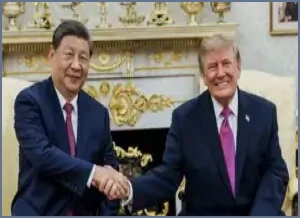
Chinese President Xi Jinping and U.S. President Donald Trump shake hands during their summit at the White House, Sep. 24, 2026.
Beijing formally confirmed Chinese President Xi Jinping’s September 23-25 visit to the United States on September 21, just two days before the trip began. The news had barely registered among many of the Chinese people I spoke with the following day. Official coverage began appearing online following the announcement,
Related Articles

Md. Kazi Bijoy is a dedicated tech enthusiast and content creator with a passion for digital innovation. With years of experience in the tech industry, he specializes in breaking down complex topics into easy-to-understand guides. When he isn’t writing, he explores the latest gadgets and researches emerging trends in the digital world.