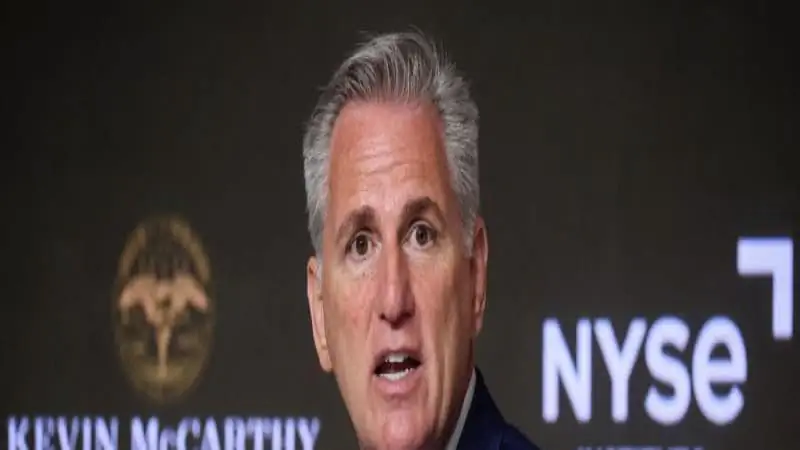
The looming confrontation over the United States debt ceiling is rapidly approaching a critical juncture, presenting a severe test for House Speaker Kevin McCarthy. The California Republican is attempting to navigate a high-stakes political standoff with President Joe Biden, but his strategy risks trapping his own narrow House majority. With the economic stability of millions of Americans hanging in the balance, McCarthy must find a way to unite a highly fractured Republican conference to pass an opening proposal, even as hardliners demand deeper spending cuts and some threaten to oppose any increase on principle.
McCarthy took his message directly to Wall Street on Monday, delivering a stern warning that House Republicans will not agree to raise the federal borrowing limit unless the White House accepts significant spending rollbacks. Such cuts would effectively dismantle much of President Biden's domestic legislative agenda and legacy. At the same time, the Speaker sought to reassure financial markets, pledging that he would never allow the federal government to default on its obligations. A default, which could occur by the fall if the limit is not raised, carries catastrophic risks, including the suspension of Social Security payments, a severe economic recession, and widespread job losses.
Achieving both of these goals presents an extraordinary challenge for a newly minted Speaker operating with a razor-thin majority. Unlike most nations, the United States requires its legislature to periodically approve increases to the government's borrowing capacity. This unique system has increasingly become a tool for partisan leverage in a deeply polarized Washington. Because the federal government consistently runs a budget deficit, it relies on borrowing to pay for expenditures that Congress has already authorized. Historically, the U.S. has maintained an exceptional credit rating due to its spotless record of meeting financial obligations, despite suffering a single downgrade during a previous default scare.
In an effort to build consensus, McCarthy held a closed-door meeting with House Republicans on Tuesday, urging them to rally behind a legislative proposal. The plan aims to raise the debt ceiling for one year in exchange for a series of major spending concessions from the Biden administration. McCarthy framed the bill as a tactical opening move designed to force the president to negotiate. However, the legislation has zero chance of passing the Democratic-controlled Senate, making its primary purpose a demonstration of Republican unity—a feat that is proving difficult to achieve.
Signs of internal division quickly emerged following the meeting. Representative Scott Perry, chairman of the hardline House Freedom Caucus, expressed frustration over the lack of concrete details in the proposal, arguing for more aggressive spending reductions. Perry told reporters, "I don’t know what’s in the package completely. That’s the issue." Other conservative lawmakers expressed similar hesitation, with Representative Tim Burchett of Tennessee telling reporters that while he remains open to the proposal, "I’m open to it but I’m still a ‘no’ vote."
This internal friction highlights a fundamental vulnerability in the Republican strategy, which depends on the assumption that Biden will eventually be forced to negotiate. The White House, however, has maintained a firm stance, insisting that Congress must fulfill its basic duty by passing a clean bill to raise the borrowing limit without any attached conditions. McCarthy's margin for error in the House is incredibly small; he can afford to lose no more than four Republican votes to pass the measure. Even if he successfully guides the bill through the House, it will represent an extreme conservative position that neither Biden nor Senate Democrats will accept. Any subsequent compromise negotiated with Democrats would likely alienate the very hardliners McCarthy needs to maintain his speakership.
Despite these steep hurdles, McCarthy expressed public confidence on Monday regarding his ability to secure the necessary support. "I think we got 218 to raise the debt ceiling," McCarthy told reporters. "We’ve got a lot of consensus within the conference. We’ll get together and work through it." However, critics view these predictions with skepticism, recalling McCarthy's repeated assurances during his grueling bid for the speakership in January. That contest dragged on for 15 ballots and required massive concessions to the party's most conservative faction before he finally secured the gavel. In this instance, the consequences of a miscalculation extend far beyond McCarthy's personal political future, threatening the broader global economy.
Republican lawmakers are currently struggling to negotiate amongst themselves. Representative Dusty Johnson of South Dakota, who has been involved in drafting the Republican proposal, acknowledged the difficulty of reconciling the diverse demands of the conference. Johnson noted that while the party aims to hold a vote on the bill next week, the hardest part of the process is narrowing down "thousands of desires" and an "unlimited number of conservative policy victories" into a manageable and credible set of demands. "The reality is that in a negotiation, you never get everything you want," Johnson said. "And so I think our biggest issue right now is how do we squeeze these thousands of desires down to a manageable and credible number of asks?"
The situation is further complicated by a faction of Republican lawmakers who refuse to vote for any debt ceiling increase under any circumstances. In a larger majority, these holdouts could be bypassed, but McCarthy's slim majority—resulting from an underperforming 2022 midterm election—gives individual dissenters immense leverage. Furthermore, Democrats have no incentive to rescue McCarthy from internal defections, as doing so would require them to vote for spending cuts they strongly oppose. McCarthy also cannot easily rely on Democratic votes to pass a compromise, as a rule he agreed to during his speakership battle allows any single member of the House to call for a vote to remove him from his post.
The impending battle over the debt limit represents a defining moment in the divided government shared by Biden and McCarthy. The outcome will heavily influence the political legacies of both men. While many Republicans and economists are genuinely concerned about the national debt, which has surpassed $31 trillion, critics accuse the GOP of hypocrisy. Republicans routinely raised the debt ceiling during Donald Trump's presidency, despite his administration's significant spending. Trump himself has previously stated on video that the debt ceiling should not be used as a negotiating wedge.
To win this political battle, McCarthy is attempting to shift public blame to the White House. On Monday, he argued that the national debt, rather than a potential default, poses the greatest danger to the American economy. "Without exaggeration American debt is a ticking time bomb that will detonate unless we take serious responsible action. Yet, how has President Biden reacted to this issue? He has done nothing. So in my view, and I think the rest of America, it’s irresponsible," he said. Historically, however, such fiscal standoffs have often backfired on Congressional Republicans. Presidents Bill Clinton and Barack Obama successfully depicted their Republican opponents as economic extremists, gaining significant political advantage.
McCarthy is trying to reverse this historical trend by portraying Biden as stubborn and unreasonable for refusing to negotiate. The two leaders have not met for 75 days, with the White House insisting that budget discussions should occur separately from raising the debt limit. White House spokesman Andrew Bates criticized McCarthy's approach on Monday, calling for a prompt resolution. "There is one responsible solution to the debt limit: addressing it promptly, without brinksmanship or hostage taking – as Republicans did three times in the last administration and as Presidents Trump and Reagan argued for in office," Bates said. Meanwhile, Senate Republicans have largely kept their distance from the House dispute, though Senate Republican Leader Mitch McConnell offered some moral support upon his return to the Capitol following a recovery from a fall. Democratic Senate Majority Leader Chuck Schumer sharply criticized McCarthy's Wall Street address, warning: "He went all the way to Wall Street and gave us no more details, no more facts, no new information, and I’ll be blunt: If Speaker McCarthy continues in this direction we are headed to default."
Related Articles

Md. Kazi Bijoy is a dedicated tech enthusiast and content creator with a passion for digital innovation. With years of experience in the tech industry, he specializes in breaking down complex topics into easy-to-understand guides. When he isn’t writing, he explores the latest gadgets and researches emerging trends in the digital world.