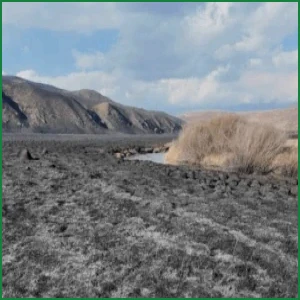
A massive wildfire ignited by a commercial vehicle convoy has scorched more than half a million hectares of land in eastern Mongolia, devastating over three-quarters of a strictly protected nature reserve and sparking an international environmental and geopolitical rift across Northeast Asia. Official statistics released on October 28 by the Ministry of Natural Environment and Climate Change of Mongolia confirmed that the blaze destroyed 504,960.4 hectares—approximately 5,050 square kilometers or 1.2 million acres—an area more than twice the size of Tokyo. The fire broke out on October 8 in Numrug, located within Khakhgol soum in Dornod aimag (province), and raged for eight days before emergency crews finally extinguished the flames on October 16.
The Ministry detailed that nearly all of the burned terrain, totaling 448,993.6 hectares, was situated directly within the Numrug Strictly Protected Area. The disaster affected 76.4 percent of the reserve's total landmass. Positioned in the ecological transitional zone between the eastern grasslands of Mongolia and the western foothills of the Greater Khingan Range, the Numrug reserve serves as a vital biodiversity reservoir and an essential ecological security barrier for Northeast Asia. The sanctuary hosts over 250 species of birds as well as rare wildlife listed in both the IUCN Red List and the Mongolian Red Book, including the Ussuri moose, the black-billed capercaillie, and the Far Eastern taimen fish.
Environmental experts warn that high-intensity autumn fires inflict long-term and irreversible harm on grassland ecosystems. The intense heat completely carbonizes surface soil organic matter, severely impairing the ground's capacity to retain water and essential nutrients. This degradation leaves the region vulnerable to extreme wind conditions in spring and autumn, drastically raising the risk of widespread desertification and severe sandstorms. Furthermore, the seed bank of native vegetation suffered a devastating blow; ecological data from cold, arid grasslands indicates that native plant communities will require between 20 and 100 years to recover, with some areas facing permanent species replacement.
Preliminary investigations conducted by Mongolian authorities established that the disaster was directly caused by a vehicle convoy operated by Mobicom, Mongolia's major mobile communications provider, which is 98.8 percent owned by the Japanese telecommunications corporation KDDI. According to investigators, dry plants became wrapped around the chassis of one of the convoy's vehicles, where continuous friction and heat generated during prolonged driving ignited the dried grasses, unleashing the wildfire. Mobicom stated its vehicles had entered the protected territory to carry out 4G network signal testing near the Sino-Mongolian Sumber-Rashaan Border Port.
Because the fire originated adjacent to the China-Mongolia frontier and involved a major Japanese-owned enterprise operating sensitive border communication infrastructure, the emergency rapidly transformed from a local conservation crisis into a complex geopolitical issue. The location of the project near the border port drew sharp public skepticism regarding its technical and economic rationale. Under the 2010 Sino-Mongolian Treaty on the Management of the Border Regime, both nations are obligated to provide advance notification prior to constructing major border projects or wireless facilities. The presence of foreign-backed communication equipment in sensitive border zones fueled additional scrutiny, with some Chinese media commentators raising concerns about border information security, though those claims remain officially unconfirmed.
As the fire line rushed toward the national boundary, it triggered a rapid cross-border emergency deployment. Operating under the 1999 agreement between China and Mongolia on Forest and Grassland Fire Prevention in Border Areas, authorities in Inner Mongolia, China, dispatched more than 3,400 professional emergency responders and firefighters to the frontier. Chinese forces successfully contained the blaze to prevent it from crossing into Chinese territory while maintaining open corridors for wild animals fleeing the flames across the border. Liu Zhiyan, a researcher at the Institute of Ecological Civilization of the Chinese Academy of Social Sciences, emphasized that eastern Mongolian grasslands share profound ecological links with northern China, warning that a transboundary fire risks catastrophic economic loss and serious diplomatic disputes. Labeled by analysts as suffering under an image of an "ecological risk exporting country," Mongolia saw China demand financial compensation for its extensive emergency containment efforts—directing its compensation demands not at Ulaanbaatar, but at Japan.
The catastrophic disruption shattered Japan's long-cultivated reputation as a responsible green investor in Mongolia. Between 1977 and 2021, Tokyo provided 364.107 billion yen in Official Development Assistance (ODA) to Mongolia across infrastructure, energy, and communications, with Mobicom previously viewed as a flagship project of bilateral trade cooperation. Public anger surged after Mobicom initially sought to deflect blame by asserting that it had operated under "complete legal procedures." The company issued a public apology and committed to cooperating with investigators only after public pressure mounted. Although Mobicom has now agreed to pay compensation once a joint working group completes a full loss assessment, the company maintains that it held valid permits and observed necessary precautions.
Critique also targeted the Japanese government's delayed official reaction. Japanese Chief Cabinet Secretary Kihara Minoru did not issue an official statement until October 26, over two weeks after the blaze began. When he finally spoke, Kihara outlined Japan's readiness to aid Mongolia in ecological restoration efforts but made no reference to the fire's impact on neighboring China, aggravating diplomatic friction. Opposition parties and media outlets in Japan blasted the prolonged silence as a "national shame," accusing the administration of diplomatic paralysis, corporate protectionism, and maintaining double standards by prioritizing minor domestic environmental rules while shielding severe overseas damage caused by a Japanese commercial giant.
On October 29, Japanese Prime Minister Takaichi Sanae conducted a 10-minute telephone call with Mongolian Prime Minister Uchral Nyam-Osor, marking the highest-level diplomatic exchange since the catastrophe. Prime Minister Takaichi declared that Japan "takes seriously the scale of the damage caused" and offered her "heartfelt sympathies to the people of Mongolia." She committed Japan to delivering a comprehensive cooperation package to support regional recovery, including supplying essential equipment and offering human resource training focused on wildfire recovery and environmental restoration. The initiative will be structured around findings from a Japan International Cooperation Agency (JICA) expert group of forestry and conservation specialists dispatched to Mongolia on October 27. Uchral detailed the full extent of the destruction, expressed deep gratitude for Tokyo's support, and welcomed a "science-based approach" for phased recovery, confirming Mongolia's readiness for close collaboration. Both leaders agreed to strengthen bilateral relations ahead of the 55th anniversary of Japan-Mongolia diplomatic relations in 2027. Official readouts from both governments noted that the call focused strictly on bilateral relief, making no mention of China's emergency firefighting response or the cross-border threats posed to Chinese territory.
Inside Mongolia, the disaster precipitated intense debate over state sovereignty, internal governance, and corruption. Prime Minister Uchral classified the wildfire as a "serious ecological incident" during a Cabinet meeting, firmly declaring that "foreign investors have no privilege above Mongolian law." He ordered a rigorous investigation into how entrance permits were issued for protected zones and pledged to enforce strict legal and financial accountability following ecological valuations. Opposition Member of Parliament Altangerel Oyunsaikhan, representing the Democratic Party, demanded that Mongolian courts freeze all financial accounts and physical assets of Mobicom as collateral for environmental damages. Conversely, former sumo champion Yokozuna Asashoryu (Dagvadorj Dolgorsuren) argued that "blindly condemning the Japanese side is one-sided," urging journalists to investigate the local officials who granted Mobicom's permit. Asashoryu's comments highlighted potential regulatory corruption and embroiled local leaders in scrutiny, including Dornod MP Otgonbayar Ukhnaa, brother of President Khurelsukh Ukhnaa. Otgonbayar forcefully denied approving the entry permit, condemning the allegations as a politically motivated smear campaign.
In Japan, political responses diverged across party lines. Shimba Kazuya, Secretary General of the Democratic Party for the People (DPFP), insisted that the disaster far exceeded routine civil corporate liability and demanded direct state intervention to show sincerity to Mongolia. Within the ruling Liberal Democratic Party (LDP), former State Minister for Foreign Affairs Nakayama Yasuhide argued on ABEMA News that while KDDI and Mobicom must bear full civil, financial, and moral liability, the incident must be kept separate from Japan's strategic alliance with Mongolia. Nakayama highlighted Ulaanbaatar's vital role as a diplomatic mediator regarding North Korean abductions and cautioned that compromising Japan's "third neighbor" standing along sensitive Chinese and Russian borders would create serious signal intelligence and security risks. Simultaneously, LDP lawmaker Nagashima Akihisa, head of the Japan-Mongolia Parliamentary Friendship League, emphasized that Mobicom entered under formal administrative clearance with local border port escorts, condemning premature outside conclusions and firmly rejecting Chinese media demands for an apology to Beijing.
Beyond geopolitical maneuvering, the disaster highlighted systemic weaknesses in corporate Environmental, Social, and Governance (ESG) standards. KDDI enforces strict environmental oversight domestically in Japan, yet its subsidiary's actions in Mongolia exposed a striking double standard. By dispatching a vehicle convoy deep into a strictly protected nature reserve during the peak autumn wildfire season, Mobicom demonstrated severe gaps in international risk management. Furthermore, the company's lack of open-grassland firefighting equipment left field crews unable to suppress the initial ignition, allowing the blaze to rapidly spiral out of control. Critics noted that corporate ESG frameworks often function as public relations assets for financial ratings rather than operational safeguards during real-world emergencies.
The destruction of three-quarters of the Numrug reserve underscores urgent needs for structural reform in Northeast Asian environmental governance. Experts advocate that Mongolia implement strict environmental responsibility legislation for foreign investors, requiring high-risk enterprises to deposit environmental security bonds into central bank escrow accounts based on investment proportions. Furthermore, damage calculations should adopt United Nations ecosystem service valuation standards to account for soil carbon sink losses, biodiversity destruction, and secondary disaster management. Technical upgrades are also recommended, including integrated air-ground monitoring networks featuring automated infrared drone patrols for real-time fire detection, alongside enhanced authority and equipment for park rangers. Regionally, analysts call for upgrading Sino-Mongolian border fire agreements to create emergency green channels for cross-border firefighting, streamlining approval processes, and establishing a UNEP-supported long-term ecological trust fund financed by responsible corporate entities to ensure long-term regional environmental restoration.
The lackluster on-site emergency response capabilities further confirmed a catastrophic failure of risk control. Reports indicate that the corporate management team was completely unequipped with professional firefighting tools suitable for open grassland suppression. That’s why the initial fire could not be contained and spread to such a large scale. This critical deficiency pierces the superficial narrative of polished ESG reporting. For many multinational enterprises, complex risk-management and environmental emergency blueprints serve primarily as public relations assets for capital market ratings; when put to a real-world test on the frontlines of a disaster, these theoretical systems fall apart completely.
Related Articles

Meet Md. Rubel Rana
As a core contributor to Worlddincidents.com, Rubel Rana brings a unique perspective to the world of journalism. Whether it’s deep-diving into historical trivia or covering the latest global headlines, Rubel Rana is committed to delivering high-quality, high-impact articles. Their writing blends meticulous research with a compelling voice, helping readers stay informed and curious about the world around them.