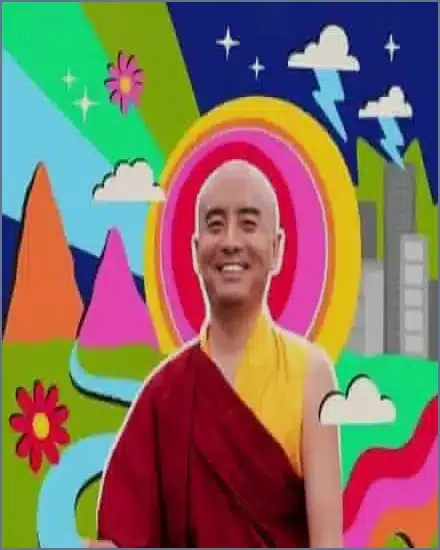
Yongey Mingyur Rinpoche, a Buddhist monk, is frequently identified as the happiest man on Earth based on scientific metrics. Brain scans have revealed that his neural activity displays off-the-charts levels of activation in the left prefrontal cortex, a region linked to joy, enthusiasm, and positive emotions. Notably, tests conducted when he was 41 years old suggested his brain resembled that of a 33-year-old. Beyond the data, his approach to life is defined by a consistent sense of levity and laughter.
Mingyur, whose honorary title translates roughly to "precious one," argues that happiness is a skill that can be developed. He notes that, as the Dalai Lama says, we have everything at the touch of a finger, yet when we feel lonely, incomplete, or bored, we protect ourselves with whatever is available—be it ice cream, a smartphone, or coffee. He suggests that we try to get away from these feelings, but they are actually a form of wisdom. The really important thing is to sit with them and embrace them as a path to explore. For instance, if you find yourself bored while watching a Netflix romcom and simultaneously scrolling on your phone, that is a signal that ever more stimulation will never be satisfying. Take it as a sign to switch everything off, look inward, and stop trying to fill the vacuum with superficial stuff.
A pivotal moment in his own journey occurred in 2011 when he left his monastery in the middle of the night with nothing but the clothes on his back, intending to live as a homeless yogi. After about three weeks, a severe bout of food poisoning left him paralysed by exhaustion and pain. While difficult, he now views this as the moment he truly began to understand the Tibetan Buddhist idea of relinquishing control. He insists that individuals do not need to endure such extreme circumstances to learn these lessons. Especially nowadays, modern life is full of adventure; when you turn 18, start a new job, or start a new relationship, each of those are opportunities for change. You don’t have to wait for these bigger moments: meeting a new group of people or taking up a new challenge can help increase your comfort levels with new things. Try implementing one small change every time you feel like you’ve spent a day just going through the motions, such as a new route home from work or cooking with one ingredient you’ve never used before. He finds it helpful to keep a little list of things to try, so when things get stultifying, he has a ready-made buffet to choose from.
Regarding meditation, Mingyur admits he felt bored the first time he learned it, questioning the repetition of breathing. However, he emphasizes that you can make everything a support for meditation—you can meditate anytime, anywhere, with anything. Furthermore, you must have a creative element; everything becomes a friend to the meditation. If there is traffic noise or someone nearby watching videos, the idea is to let that become a source of focus and calm. He suggests building up to this by listening to music, then waterfalls or birdsong, then loud conversations or construction. Eventually, he says, you should be able to meditate while a baby is crying.
His philosophy centers on three pillars: view, meditation, and application. The "view" is the mindset that everyone has an inner sky, containing the qualities of awareness, love, compassion, and wisdom. We practice meditation, and then we practice application—building new habits. It is easy to say people aren't nice, but there are great qualities in many people, and if you see that, it will manifest. But it is a habit: you have to keep doing it, and then you change. Mingyur suggests doing this in a small way every day. Maybe one day try appreciating your family, and the next, find positive things to say about your most annoying colleague.
Gratitude, he explains, should move from the incredibly general to the extremely specific. He suggests appreciating that you have senses, a roof above you, and friends or family. When you begin to appreciate these things, you start to appreciate the quality of your life. This does not necessarily mean you need a gratitude journal; instead, use little moments of downtime to notice how nice it is to be in the specific moment, whether sitting in a comfortable chair or watching your child swing a stick in the woods.
When dealing with panic attacks, which he experienced when young, he advises against fighting them. His father taught him that if you fight, panic becomes stronger, much like telling yourself not to think about an orange. There is no need to push panic away, because it is like a storm cloud in the sky; it comes and then it goes. You just have to connect with the inner sky. Whatever inner turmoil you are going through, remind yourself that it isn't actually changing anything fundamental in your brain; it will pass and things will feel better.
Ultimately, Mingyur believes that genuine happiness is when we let go of the feeling of dissatisfaction or incompleteness. If you only look for happiness, you will get the opposite. People think they will be happy if they make more money, move to a new country, or get a new job, but that only changes happiness a little bit before returning to baseline. If you practice breathing, love, and compassion, you can move that baseline over time. To start, simply sit and breathe naturally, focusing on the rise and fall of your abdomen or the sensation of air passing through your body. You might try mentally repeating a simple mantra, such as "May I be happy and free from suffering," to cultivate love towards yourself, and then extending that compassion to loved ones, pets, and eventually all other people.
He compares awareness to sunlight and emotional patterns to frost on the grass. When the sunlight manifests, the frost melts automatically—there is no fight. He tells stressed business leaders to just catch the anger and be with it for a second. Once you catch it, you have a choice, and it can transform. When you are momentarily furious, you don't need to meditate for 10 minutes; just avoid your autopilot response of snapping by noticing the anger, and watch as the emotion melts away. Finally, he notes that if you can really help others, you feel a different level of happiness than from having an ice cream or coffee. Check in on a neighbor in need today.
Related Articles

Md. Kazi Bijoy is a dedicated tech enthusiast and content creator with a passion for digital innovation. With years of experience in the tech industry, he specializes in breaking down complex topics into easy-to-understand guides. When he isn’t writing, he explores the latest gadgets and researches emerging trends in the digital world.