The Philippines continues to navigate a delicate diplomatic path in Southeast Asia, balancing its deepened defense alliance with the United States against complex security and economic relations with China and fellow members of the Association of Southeast Asian Nations (ASEAN). While Manila’s firm stance on territorial claims in the South China Sea sets it apart within the regional bloc, its broader diplomatic strategy reflects ongoing efforts to avoid an absolute rupture with Beijing while preserving consensus within ASEAN.
A key point of divergence between the Philippines and its regional neighbors lies in its security framework. Amid escalating maritime confrontations with Beijing, Manila has fortified defense cooperation with its treaty ally, the United States. This strategic positioning was highlighted in July 2026, which marked the tenth anniversary of the 2016 South China Sea Arbitral Tribunal Award issued by the Permanent Court of Arbitration (PCA). Fourteen nations joined the Philippines in a joint statement reaffirming the ruling's legally binding force. However, no other ASEAN member states signed onto that declaration.
Tensions between Manila and Beijing have manifested in repeated maritime skirmishes, including disputes over baselines drawn around Scarborough Shoal and harassment by Chinese Coast Guard and naval vessels near Second Thomas Shoal. In June 2026, Beijing retaliated by imposing sanctions on Philippine Secretary of National Defense Gilberto Teodoro and members of his immediate family. Later in November, Chinese officials directly criticized several Philippine politicians during a telephone exchange. Despite targeting Minister Teodoro, Beijing’s selective sanctions against an individual rather than the nation as a whole have been viewed either as an effort to capitalize on internal Philippine policy debates or as a deliberate measure to prevent total bilateral escalation.
Although the Philippines’ reliance on the U.S. alliance creates a distinct posture, other ASEAN claimant states face their own persistent friction with China over disputed waters. In March 2026, Vietnam lodged a formal protest demanding an immediate halt to Chinese land reclamation and facility construction in the Paracel Islands. Similarly, Malaysia announced ongoing monitoring of Chinese Coast Guard vessels operating within its exclusive economic zone off Sarawak, reaffirming its commitment to maintaining a national presence there. Bilateral relations between the Philippines and Vietnam have simultaneously strengthened; during a June 2026 visit to Manila by Vietnamese President To Lam, the two nations elevated their relationship to an Enhanced Strategic Partnership and signed a defense cooperation memorandum. Although Vietnam refrained from joining the July joint PCA statement, it issued a separate statement on the same day calling for peaceful conflict resolution under the United Nations Convention on the Law of the Sea (UNCLOS), effectively offering implicit support for the arbitral award.
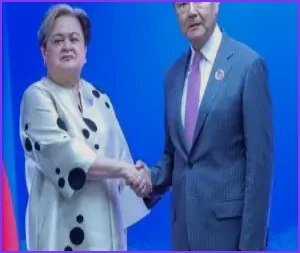
Within ASEAN forums, Manila has avoided aggressively pushing its unilateral South China Sea position, prioritizing its role as a regional consensus-builder when assuming the bloc's chair. The South China Sea section of the Joint Communique from the July 2026 ASEAN Foreign Ministers’ Meeting reflected virtually no language changes from the prior year. Furthermore, both Manila and Beijing have actively sought to prevent a complete collapse in relations. High-level interactions, including a July 22, 2026 meeting in Manila where Philippine Foreign Secretary Ma. Theresa Lazaro met Chinese Foreign Minister Wang Yi, alongside ongoing foreign ministers' meetings and telephone diplomacy, demonstrate mutual attempts at de-escalation. Concurrently, the Philippines is gradually integrating into Chinese-centered supply chain networks, mirroring historical shifts seen under the previous Arroyo and Duterte administrations where economic priorities influenced foreign policy.
Beyond its primary alliance with Washington, the Philippines has systematically expanded security ties with other key partners, notably Japan. Strategic cooperation between Manila and Tokyo has expanded rapidly following their inaugural 2+2 meeting in April 2022, driven by the entry into force of the Japan-Philippines Reciprocal Access Agreement (RAA), joint bilateral and multilateral military exercises, defense equipment and technology transfers, and capacity-building assistance. However, Manila's diplomatic approach remains distinct from Tokyo's; while Japan faces difficulties resuming substantive dialogue with Beijing, the Philippines retains functional communication channels with China and maintains flexibility for future policy adjustments.
You have reached the limit of 3 free articles this month.
You have read 2 of your 3 free articles this month.
Related Articles

Md. Kazi Bijoy is a dedicated tech enthusiast and content creator with a passion for digital innovation. With years of experience in the tech industry, he specializes in breaking down complex topics into easy-to-understand guides. When he isn’t writing, he explores the latest gadgets and researches emerging trends in the digital world.