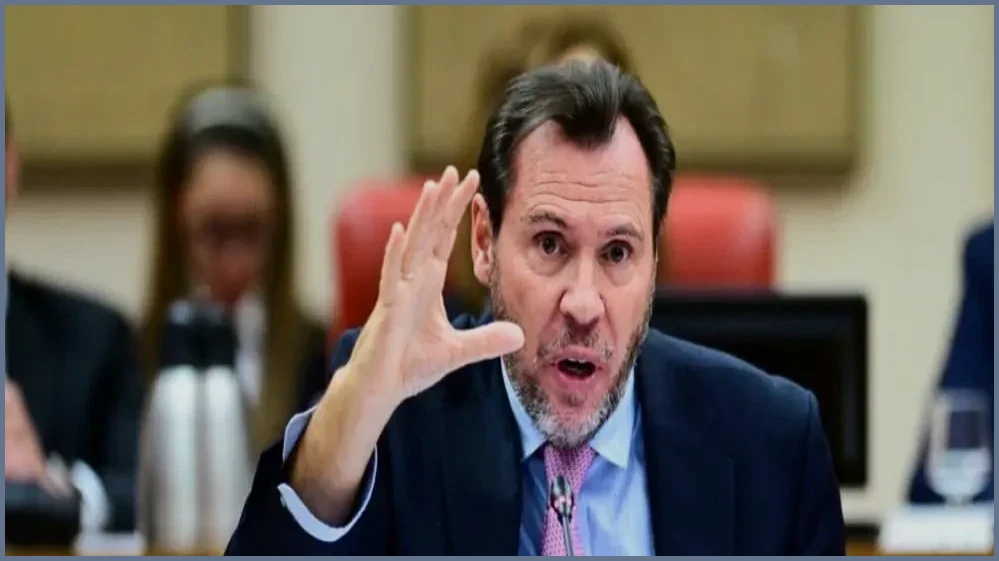
Spain's Transport Minister Óscar Puente has stepped down six days after a catastrophic high-speed train collision that claimed at least 69 lives and left dozens of passengers injured. The minister announced his decision before Congress on Tuesday evening, concluding a lengthy parliamentary session in which he presented new rail safety protocols while facing intense questioning from opposition lawmakers.
Addressing Congress, Puente stated that he was not only stepping down from his ministerial post but was also withdrawing his name from the candidate lists for Spain's upcoming early legislative elections scheduled for November 29. He cited the tragic sequence of events on the railway network, noting that a transport minister in a country like Spain cannot remain in office after two accidents of such magnitude in less than a year, referring back to a January rail disaster on the same line that killed 46 people.
The disaster occurred last Wednesday near the town of Urda, south of Madrid, when a moving passenger train slammed into the rear of a stationary train. The force of the impact made it one of modern Europe's worst rail disasters and Spain's deadliest crash since 2013. Emergency responders had to deploy heavy lifting machinery to cut through crushed and derailed carriages to liberate trapped survivors.
Scrutiny over Puente's tenure began immediately after the October 28 collision. Pressure mounted quickly from the main conservative opposition People's Party (PP) and the far-right Vox party, as well as from several political allies of the governing coalition. Opposition leaders insisted the minister must accept responsibility for a high-speed network whose safety Spaniards increasingly doubt, and whose credibility Prime Minister Pedro Sánchez admitted was broken.
Critics also condemned Puente for suggesting human error caused the disaster, accusing him of trying to deflect accountability from systemic cabinet failings.
Though Puente had publicly stated just days prior that he intended to remain in his post, his sudden resignation surprised many political observers. The departure comes at a delicate political juncture ahead of the November 29 general election. Analysts view the disaster as a severe blow to the Socialist-led government that complicates efforts by Sánchez to defy trailing poll numbers.
Facing a dilemma where staying in cabinet risked appearing indifferent to public grief and resigning risked acknowledging government blame, Puente chose to step aside, asserting that his decision was guided by political dignity. Prime Minister Pedro Sánchez praised his outgoing minister for confronting the situation directly, presenting solutions, and choosing to step down of his own accord out of dignity and respect for the disaster victims.
Political commentators note that Spaniards will now watch whether Puente's successor can rebuild public trust in the national rail system.
The mechanics of the collision involved a state-owned Renfe passenger train carrying 397 people that struck a private operator Iryo train carrying 147 passengers, which had come to a complete stop on the line. An initial computer failure within the automatic signalling network had forced all rail traffic along that specific section of track to halt.
Leaked audio recordings published by Spanish media revealed critical exchanges between Madrid's rail control center and train conductors shortly before the impact. The audio indicates that despite the Iryo train coming to a stop about 25 kilometers (15 miles) ahead, the approaching Renfe train was authorized to continue. In one recording, a controller instructs the Renfe driver to proceed under the Lateral Signalling Block protocol at normal speed.
When the driver seeks confirmation, asking, "At normal speed?" the operator confirms, "Yes." The Lateral Signalling Block serves as a backup operating procedure when primary automatic signalling or data links fail.
Subsequent audio captures the driver of the stopped Iryo train reporting a loss of communication with the automated safety system while halted in front of an entry signal at Urda. After being instructed to resume the journey, the Iryo driver called control back to report an inability to restart, stating that the vehicle's security system was preventing movement.
The recordings indicate that controllers were aware the Iryo train remained immobile on the track as the Renfe train moved toward it at speed. Private operator Iryo subsequently confirmed its train carriages were struck from behind.
"A transport minister in a country like Spain cannot remain in office after two accidents of this seriousness in less than a year," he said – a reference to January's crash on the same line which left 46 people dead.
Bloodied, dazed and angry – how passengers' rail journey turned to disaster in Spain
Related Articles

Meet Md. Rubel Rana
As a core contributor to Worlddincidents.com, Rubel Rana brings a unique perspective to the world of journalism. Whether it’s deep-diving into historical trivia or covering the latest global headlines, Rubel Rana is committed to delivering high-quality, high-impact articles. Their writing blends meticulous research with a compelling voice, helping readers stay informed and curious about the world around them.