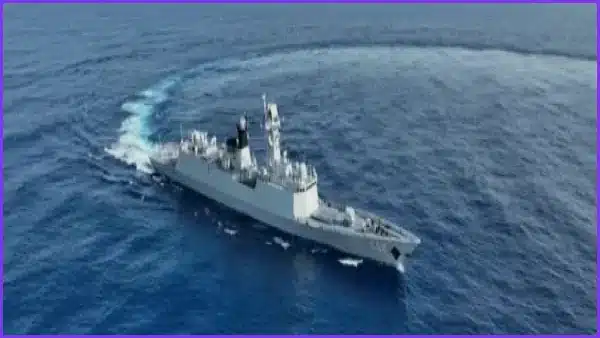
In a rare moment of diplomatic friction, the Taiwanese government has called on Indonesia to clarify a joint naval exercise it conducted with China in the waters east of Taiwan. The drill, which took place on the morning of August 12, 2026, between 6:30 a.m. and 9:30 a.m., highlighted escalating tensions in a maritime region that is also close to Japan and the Philippines.
The passing exercise, or passex, involved the Indonesian Navy frigate KRI I Gusti Ngurah Rai and the Chinese People’s Liberation Army Navy’s Honghe, a guided-missile frigate operating under the Eastern Theater Command. During the three-hour drill, the two warships practiced maritime maneuvers, including formation, maritime communications, and replenishment-at-sea, before concluding with a divergence ceremony.
Indonesia has defended the exercise, denying that it posed any threat to regional security. In an official statement, the Indonesian Navy explained, "The passing exercises are not war-fighting in nature, but rather a universal naval tradition conducted when passing through the waters of another country." The statement characterized such activities as "goodwill engagements that are commonly conducted by navies around the world as an expression of naval brotherhood and the maritime diplomacy associated with warships." Similarly, the Chinese government asserted that the drills were intended to serve the interests of "jointly safeguarding regional peace and stability."
While the exercise was small in scale, involving only two vessels, its location has raised concerns. According to a report by geointelligence firm ingeniSPACE, published by Domino Theory, the drill occurred within Taiwan’s exclusive economic zone (EEZ). The Indonesian frigate, operating with its Automatic Identification System (AIS) turned on, entered Taiwan’s EEZ and aligned with the Honghe. The Chinese vessel did not have its AIS activated, a common practice for Chinese military ships operating in the area. The Indonesian warship later sailed close to, but did not enter, Taiwan’s contiguous zone.
The Indonesian vessel’s journey highlights a complex web of regional security maneuvers. Prior to the drill with the Honghe, the KRI I Gusti Ngurah Rai participated in Orruda 2025, a bilateral exercise with the Russian navy in late July. It then docked at Japan's Yokosuka Naval Base from August 1 to August 8 before setting out for the joint exercise with China. Following the drill, the Indonesian vessel entered the Philippines' EEZ and was expected to pass through Scarborough Shoal, a highly contested reef claimed by both Manila and Beijing.
Analysts suggest the joint exercise may have been intended as a message against the deepening maritime cooperation between Japan and the Philippines. In late July, Japan and the Philippines conducted joint exercises with the United States in the South China Sea. These drills followed a series of tense confrontations near Scarborough Shoal, where Manila accused Beijing of firing water cannons at its ships, and China accused the Philippines of maintaining an illegal blockade. Furthermore, in late May, Japan and the Philippines agreed to delimit their overlapping EEZs and continental shelves east of Taiwan, a move widely seen as an effort to bolster cooperation in the event of a Taiwan conflict.
Because this overlapping area partially intersects with Taiwan's own EEZ, Taipei responded by asserting its sovereign claims, though Taiwanese political leaders have praised the bilateral talks. Meanwhile, Beijing strongly objected to the Japan-Philippines negotiations, asserting its claim over Taiwan and its surrounding waters. China demanded that Japan and the Philippines "immediately cease all illegal acts that undermine China’s sovereign rights and interests" and pledged "to strengthen control and management over relevant waters."
The joint drill underscores how the waters east of Taiwan are becoming a primary focus of cross-strait friction. In June, the China Coast Guard announced stepped-up patrols in the area as a direct response to the Japan-Philippines talks, drawing official concern from the United States, Britain, France, and Germany. More recently, during Typhoon Dolphin, China's Guangdong Maritime Safety Administration announced traffic controls for northbound vessels in the Taiwan Strait. Taiwan condemned the move, accusing Beijing of exploiting the natural disaster to reinforce its sovereignty claims, and issued maritime safety notices via coastal radio to reaffirm that the Taiwan Strait constitutes international waters.
Indonesia's apparent alignment with China has raised questions about whether it signals a policy shift under President Prabowo Subianto. The alignment carries historical irony; Prabowo, a former general during Suharto's New Order regime, has a controversial record marked by human rights abuse allegations. He was previously accused of fanning anti-Chinese sentiment and was seen by some as culpable for the 1998 anti-Chinese race riots in Indonesia, which left more than 1,000 people dead. However, Prabowo visited Beijing as president-elect, likely seeking to shed his anti-Chinese image, secure economic investments, and reassure Chinese Indonesian voters. China remains a dominant economic partner for Indonesia, operating mines and factories and funding major Belt and Road Initiative infrastructure projects.
Prabowo has stated his intention to maintain balanced, friendly relations with China, Japan, and the United States. However, a pivot toward Beijing would mirror the path of former Philippine President Rodrigo Duterte. Facing international prosecution by the International Criminal Court over his violent war on drugs, Duterte frequently criticized the U.S. and sought closer alignment with China. That policy was reversed under his successor, Ferdinand Marcos Jr., who restored close ties with Washington and Tokyo. Marcos has also shown greater interest in relations with Taiwan, congratulating President Lai Ching-te on his 2024 election victory and acknowledging that the Philippines is a stakeholder in any potential Taiwan conflict due to the more than 150,000 Filipinos, mostly blue-collar migrant workers, living there.
In April, former Philippine Army Vice Commander Leodevic B. Guinid emphasized that military interoperability between Taiwan and the Philippines would be essential to facilitate evacuations in the event of a war. While the Philippines has openly debated these contingency plans, a similar discussion has been largely absent in Indonesia, despite Indonesians being the largest foreign nationality in Taiwan. Approximately 350,000 Indonesian citizens, primarily blue-collar migrant workers, reside in Taiwan, yet there has been little public discourse regarding their safety or evacuation should a conflict erupt in the Taiwan Strait.
Related Articles

Meet Md. Rubel Rana
As a core contributor to Worlddincidents.com, Rubel Rana brings a unique perspective to the world of journalism. Whether it’s deep-diving into historical trivia or covering the latest global headlines, Rubel Rana is committed to delivering high-quality, high-impact articles. Their writing blends meticulous research with a compelling voice, helping readers stay informed and curious about the world around them.
1 thought on “Taiwan Demands Clarification Over Indonesian-Chinese Naval Drills”