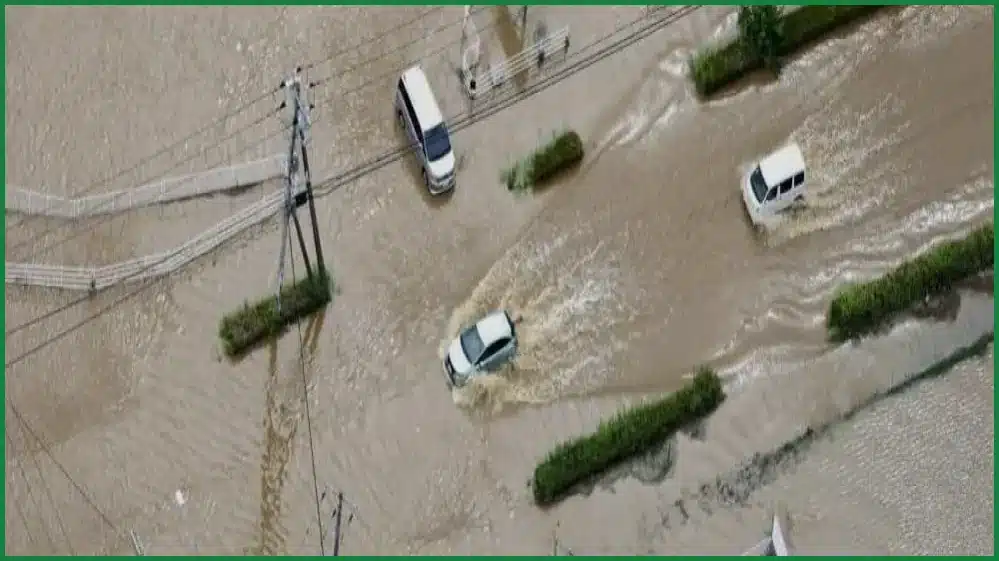
Record-breaking rainfall in eastern Japan has claimed at least eight lives and left thousands of travelers stranded at Tokyo's Narita Airport. The deluge, described by meteorologists and local authorities as "unprecedented," has caused massive infrastructure disruptions and cut power to more than 20,000 households across Chiba prefecture.
Chiba, which sits directly adjacent to Tokyo, recorded over 100mm of rain per hour starting Thursday afternoon. This volume represents approximately three times the average rainfall typically seen in August, making it the highest level of precipitation ever recorded in the country. Chiba Governor Toshihito Kumagai described the situation as extremely unusual even by Japan's historical weather standards, noting that despite his extensive disaster response experience, he had never encountered a case like this.
The torrential rains triggered a level five emergency warning on Thursday, the highest alert level available. Although local authorities downgraded the alert to level four by Friday morning, they emphasized that the risks of landslides and flooding remain critical. The extreme weather left more than 20,000 households in Chiba without electricity, while over 100,000 households were advised to evacuate on Thursday as landslides and power failures spread. In the town of Oamishirasato, cars were left abandoned in flooded streets.
The human toll of the storm has been severe, with at least eight deaths reported by public broadcaster NHK, Kyodo news agency, and the Asahi newspaper. Among the victims was a woman who died inside her car after it became submerged on a flooded road. Two other victims collapsed on the streets and subsequently passed away. Governor Kumagai stated that rescue teams are prioritizing saving lives and persisting with search operations.
Transport networks were severely crippled by the storm, leaving thousands stranded overnight at Narita Airport due to disrupted transportation to and from the facility. While airport officials stated that flights were scheduled to operate normally on Friday and flag carrier Japan Airlines anticipated only minor delays rather than cancellations, ground travel remained highly restricted. Several rail services were suspended on Friday morning, and major highways were shut down. Additionally, passengers were stranded at metro stations, while around 1,800 people sought shelter overnight inside the Chiba Prefectural Government building.
Local residents expressed shock at the speed of the deluge. A business owner in Ichikawa, Chiba, told NHK that the sudden onset of the rain took her completely by surprise, adding that the ongoing power outage made her worry about whether she could reopen her business in the coming days.
According to Japan's Meteorological Agency, the deluge was caused by a highly unstable atmospheric combination of warm, humid air flowing into eastern Japan and cold air aloft. The agency expects the heavy rainfall to persist through late Friday.
This extreme weather event is part of a broader pattern of severe storms affecting East Asia during what meteorologists forecast to be an unusually active typhoon season. Earlier in the week, Japan, China, and the Philippines were battered by three consecutive storms: Dolphin, Chan-Hom, and Peilou, which churned across the region simultaneously. Typhoon Dolphin brought heavy rain to Japan's Okinawa island, where it knocked out power to tens of thousands of properties, uprooted trees, and forced flight cancellations. In China, authorities evacuated more than one million people over the weekend as Dolphin, the strongest typhoon to hit the country this year, made landfall in the east. Meanwhile, in the Philippines, schools and government offices in the northern region were closed once again due to the persistent threat of flooding.
Related Articles

Mr. Udoy is a professional Web Developer and Blogger with 7+ years of experience in the tech world. He specializes in web architecture and digital storytelling. As the driving force behind worldincidents.com, he focuses on delivering high-quality, well-researched content to a global audience.