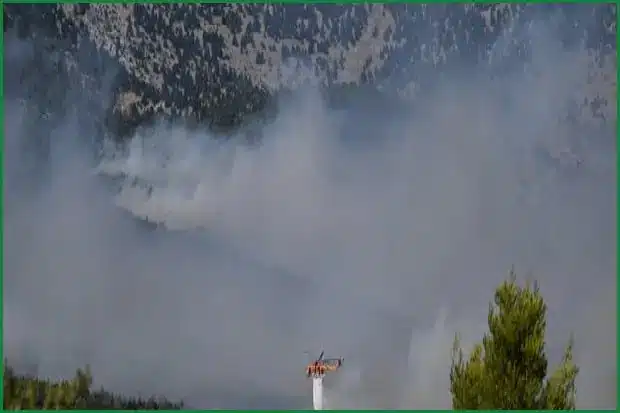
Two Greek firefighting helicopters collided in midair on Sunday, August 2, 2026, at 12:45 PM EDT, as they battled a wind-driven wildfire west of Athens, sending one of the aircraft crashing to the ground. The incident occurred over the Psatha area, involving two Bell helicopters that were each carrying a two-person crew.
The midair collision resulted in the deaths of two crew members, identified as one Greek and one Danish national. Two other crew members, one Greek and one British national, were recovered alive. No further details about the surviving crew members were immediately available, and it's not clear if the deceased crew members were on the same helicopter.
The fatal accident highlights the extreme dangers on the front lines of Europe's volatile wildfire emergency. Powered by gale-force winds, the flames have advanced deeper into the region of the Greek capital, triggering urgent evacuations. The fire originally broke out on Friday near Agios Vasileios before sweeping toward Porto Germeno and tearing into the forested mountains west of Athens.
Nearly 500 firefighters and 23 aircraft have been deployed to combat the blaze. However, violent wind gusts have severely hampered the aerial response, preventing some aircraft from reaching the sea to collect water. The rapid spread of the fire through western Attica, the region encompassing Athens, has threatened local communities and an industrial district. The unfolding crisis carries a grim resonance for the region, where the 2018 Mati wildfire—Europe's deadliest blaze this century—killed 104 people.
As smoke billowed over the mountains, authorities ordered the evacuation of Kandili, Agia Skepi, and Toutouli. Emergency crews are particularly concerned about Porto Germeno, a seaside community located on the Gulf of Corinth. Prime Minister Kyriakos Mitsotakis has been briefed on the ongoing operations. Due to the fire and heavy smoke cutting off the few roads leading out of coastal communities, sea rescue has often been the only escape route. Firefighters evacuated 254 people by sea on Friday and another 12 on Saturday.
The crisis is not isolated to the capital's outskirts. Elsewhere in Greece, flames have threatened homes on the Ionian island of Kefalonia, forcing inland evacuations as aircraft made targeted water drops. Firefighters are also battling another blaze near Nea Tenedos in Halkidiki. The casualties on Sunday add to a heavy toll for emergency services; earlier in the week, two firefighters died while fighting a blaze on Crete, and a third was killed in the Peloponnese.
"A pristine forest, a paradise, was surrendered to the hands of the fire," local farmer Minas Tzortzanis said on Saturday. "There are no words to explain what has happened. Destruction. Total destruction."
Across the continent, simultaneous disasters are stretching emergency services to their limits. In France and Spain, massive forest fires have forced roughly a third of a million people to flee their homes and vacation destinations at the height of the summer season. Europe entered 2026 following its worst fire year on record in 2025, which saw more than 3,860 square miles burned. According to the European Environment Agency, wildfires have been linked to nearly 800 deaths across Europe over the past four decades.
Scientists point to accelerating climate trends as a primary driver of the crisis. Europe is the world's fastest-warming continent, having warmed more than twice the global average since the 1980s, according to the European Union's Copernicus Climate Change Service. A rapid analysis by scientists at World Weather Attribution found that human-caused climate change made the extreme fire-weather conditions behind this year's French blazes at least twice as likely.
Related Articles

Mr. Udoy is a professional Web Developer and Blogger with 7+ years of experience in the tech world. He specializes in web architecture and digital storytelling. As the driving force behind worldincidents.com, he focuses on delivering high-quality, well-researched content to a global audience.
1 thought on “Two Dead After Firefighting Helicopters Collide in Greece”