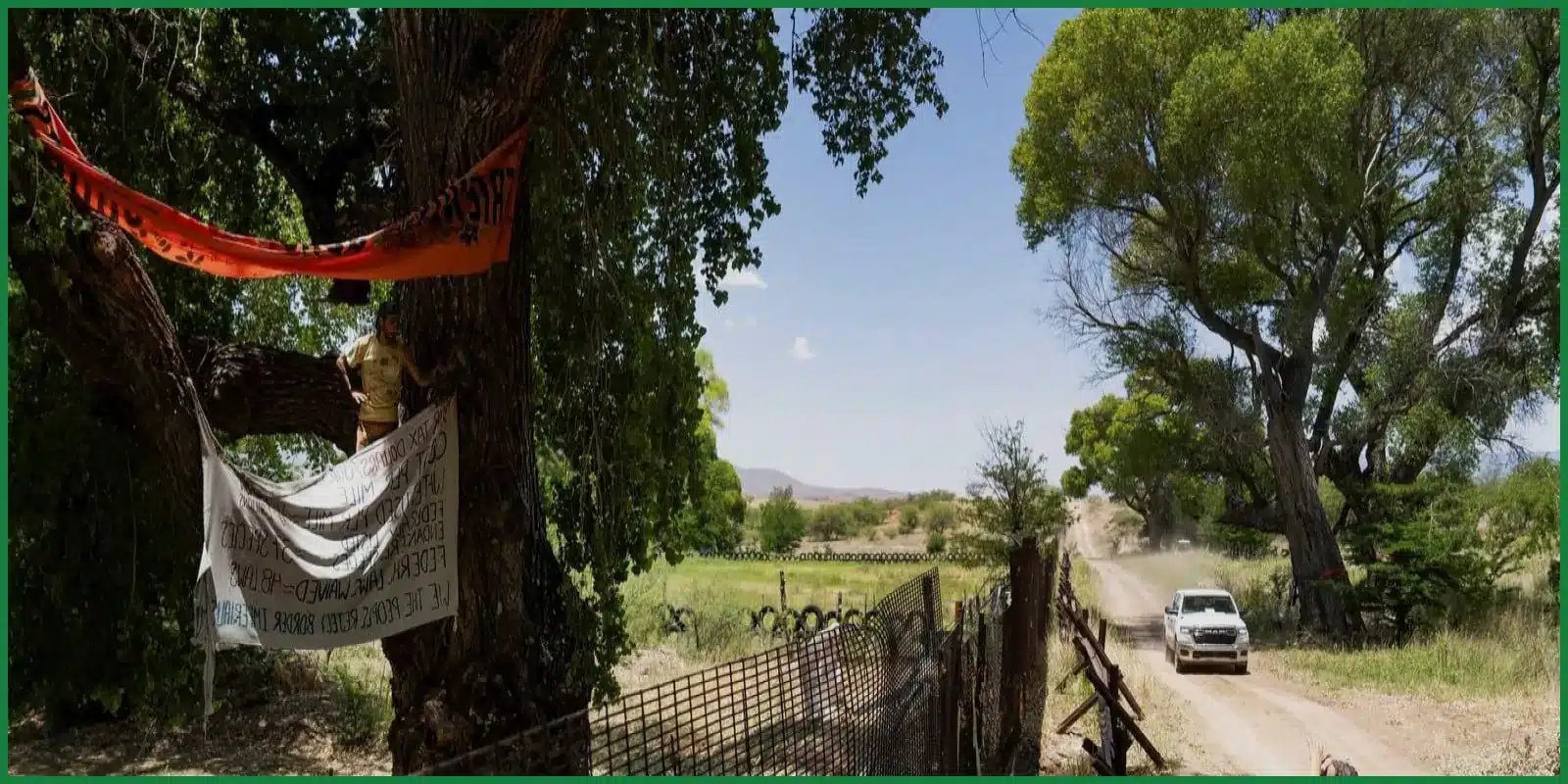
Conservationists have initiated a protest in Lochiel, Arizona, by staging a "tree sit" to prevent Department of Homeland Security contractors from removing historic cottonwood trees. The protest, which began on July 29, aims to halt the destruction of these trees, which stand directly in the path of the border wall being built under the direction of President Donald Trump.
The cottonwoods are considered remnants of a species that has existed along the U.S.-Mexico border for between 100 and 200 years. According to reports, there were originally four trees in the area, but contractors removed one on July 27. Conservationists are now rallying around the remaining trees, criticizing the Department of Homeland Security for failing to select an alternative construction route that would spare the natural landscape.
Advocates emphasize that these cottonwoods are vital to the local ecosystem. Russ McSpadden, a conservation advocate at the Center for Biological Diversity, a nonprofit founded in 1989 focused on protecting endangered species, described the trees as a "green ribbon that runs through the desert." He noted that the trees draw water to the surface, providing essential support for local wildlife, including jaguars and ocelots moving through the borderlands. Additionally, the trees provide habitat for various bird species, including the legally protected Cassin’s kingbird, which was observed nesting in one of the trees that has already been destroyed.
"Destroying these ancient cottonwoods is a death sentence for an entire ecosystem," McSpadden stated, adding that the trees have supported wildlife through centuries of environmental changes, only to be cleared for the administration's wall. In a formal letter to Homeland Security Secretary Markwayne Mullin, the Center for Biological Diversity argued that these ancient trees cannot be replaced and urged the agency to protect the borderlands landscape.
Homeland Security officials maintain that the removal of the trees is necessary for the construction of the border wall. However, they have not provided clarification on whether alternative routes were evaluated to avoid the trees, which can reach heights of 100 feet and widths of 50 feet. Participants in the tree sit have expressed their intention to remain in the branches for as long as possible to continue their protest.
The cottonwoods have provided people a shady gathering place for generations, conservationists say. And for local wildlife, the trees are essential for the area’s diverse and rare species, including potentially the few jaguars that range into the United States.
The group added Homeland Security and Border Patrol "have an opportunity and an obligation to prevent further harm to this irreplaceable borderlands landscape."
Related Articles

Md. Kazi Bijoy is a dedicated tech enthusiast and content creator with a passion for digital innovation. With years of experience in the tech industry, he specializes in breaking down complex topics into easy-to-understand guides. When he isn’t writing, he explores the latest gadgets and researches emerging trends in the digital world.