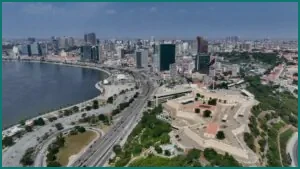
The Angolan city of Lobito, situated behind a natural harbor on the western coast of Africa, is rapidly developing into a major industrial port city. As the second-largest port along Angola's coastline, Lobito has grown steadily over the past two decades, strategically positioned as the starting point of the internationally funded Lobito Corridor. The path to this success has been complex. The Benguela Railway extends from Lobito deep into the African interior, carrying critical minerals like copper and cobalt from Zambia and the Democratic Republic of the Congo. While Angola's export focus has only recently shifted toward these minerals, its economy historically relied on oil exports from offshore reserves and terminals in Luanda and Cabinda. However, the volatility of global oil markets was highlighted in 2014 when plunging oil prices triggered a severe economic depression, forcing the country to transition toward the diversified market emerging today. This expanding market is increasingly integrating into global trade and is set to become vital for Asia-Pacific energy supplies and long-term trade links.
To sustain this development, Angola has adopted a novel debt restructuring approach that allows infrastructure projects to continue receiving support even after initial loans have served their primary purposes. This strategy highlights Angola's fiscal responsibility and its ambitious goal of diversifying its domestic economy. Concurrently, Angola has elevated its presence on the global stage. The ongoing energy crisis in the Gulf, which has severely restricted energy supplies across much of Asia, has presented a significant economic opportunity for the African nation. In January, President João Lourenço inaugurated a major aluminum plant in Bengo Province. This facility now produces 240 tons of aluminum ingots daily, directly addressing the 9 percent global supply deficit caused by the closure of the Strait of Hormuz. Furthermore, Angola is leveraging its natural gas reserves to secure $2 billion in new investments for an Ammonia-Urea complex. When this facility opens in 2027, it is projected to produce approximately 4,000 tons of fertilizer per day.
These developments are allowing Angolan trade to expand into entirely new markets while traditional partners continue to tap into its resources. Nations such as Australia, Vietnam, and Hong Kong are highly likely to increase their imports from Angola. Although the oil sector still dominates these emerging networks, they are fostering deeper cooperation across the entire supply chain, particularly as Angola builds out more value-added industries. These growing connections are highly significant for the Asia-Pacific region, where rising demand for energy and industrial inputs is actively reshaping global supply chains.
In Vietnam, Prime Minister Lê Minh Hưng recently suggested that bilateral cooperation with Angola must accelerate, pointing to Angola's recent role as Chair of the African Union. He emphasized that Vietnam could serve as Angola's gateway into the Association of Southeast Asian Nations (ASEAN), fostering multi-layered market integration that extends far beyond simple bilateral relations. Meanwhile, China stands out as Angola's second-largest African partner, a relationship driven primarily by oil exports. South Korea has also joined Vietnam in calling for new approaches to its relationship with Angola, driven in part by a need to prioritize new oil and liquefied natural gas (LNG) supply chains following the Gulf crisis. Ultimately, the expansion of the Lobito Corridor is the most significant driver of Angola's new partnerships with Asia, creating a crucial bridge between African critical minerals and energy resources and Asian manufacturing, technology, and consumer markets. This potential has already been bolstered by a Memorandum of Understanding between the European Union, the United States, and the African Development Bank, opening the door to substantial investments and cooperation with partners in the East.
You have reached the limit of 2 free articles this month.
Related Articles

Meet Md. Rubel Rana
As a core contributor to Worlddincidents.com, Rubel Rana brings a unique perspective to the world of journalism. Whether it’s deep-diving into historical trivia or covering the latest global headlines, Rubel Rana is committed to delivering high-quality, high-impact articles. Their writing blends meticulous research with a compelling voice, helping readers stay informed and curious about the world around them.