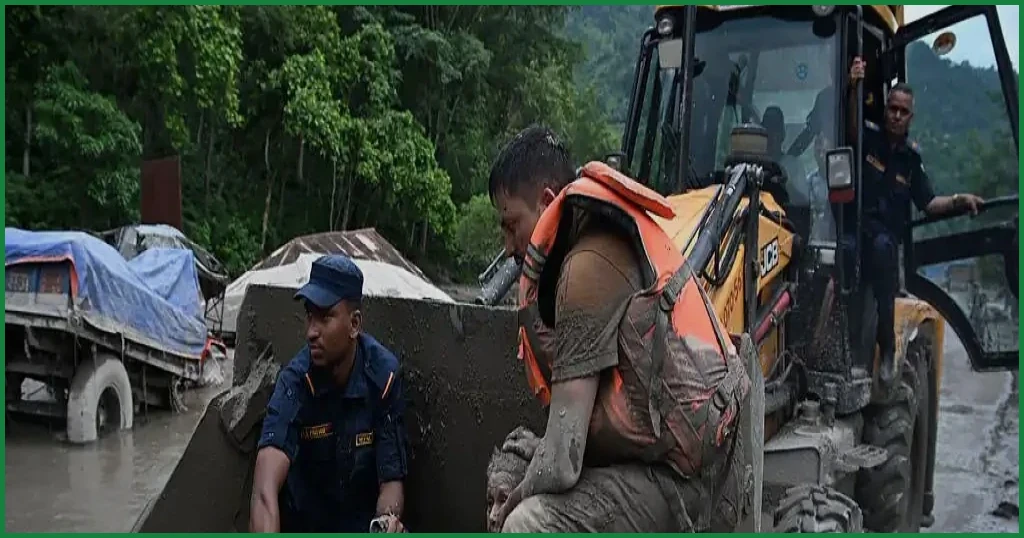
KATHMANDU, Nepal — Search and rescue operations have intensified along the devastated border region between Nepal and China as the confirmed death toll from catastrophic flash floods and landslides rose to 579 on Friday. Emergency responders are working against the clock to locate approximately 2,500 people who remain missing across both countries, while also managing the imminent threat of secondary flooding from a newly formed upstream lake.
The disaster, which struck on Wednesday, has left communities caked in thick brown mud and forced authorities to deploy helicopters to lift stranded survivors to safety. According to official reports, more than 3,700 people have been successfully rescued in Nepal, but 1,924 individuals remain unaccounted for in the country. On the Chinese side of the border, where five deaths have been confirmed, state media previously reported 558 people missing.
While local Nepalese media suggested that up to 12,000 people could still be missing, government officials have not confirmed that higher estimate. Hundreds of those unaccounted for are foreign nationals who were in the rugged border region for trekking, employment, or religious pilgrimages.
A fresh layer of anxiety spread Friday as Nepalese and Chinese authorities warned of potential downstream flooding from a new lake that formed upstream following Wednesday’s deluge. The Nepal Police issued an urgent alert after receiving reports that a dam on the Tibetan side of the border was overflowing, instructing security personnel and rescue workers to remain on high alert and evacuate to safer ground if necessary. Nepal Police spokesperson Abi Narayan Kafle confirmed that rescue operations are continuing under these highly hazardous conditions.
Meanwhile, China’s state broadcaster CCTV reported that the newly formed lake is located at an altitude of 9,680 feet—about 3,280 feet above Gyirong Port, the border crossing that was decimated by a wall of mud and water on Wednesday morning. Although the lake is situated more than six miles from the port, officials warned the flood risk remains high. CCTV later said flood risks from the overflowing lake were deemed "manageable," Reuters reported.
In Rasuwa, Nepalese Army rescuers focused their efforts on the Upper Trishuli-1 Hydropower Project, where dozens of workers were believed to be trapped inside a mud-filled hydropower tunnel. Video footage from the scene showed rescuers pulling a man covered in dark mud from the debris. Army spokesperson Brig.
Gen. Raja Ram Basnet described the immense difficulty of the operation, noting that identifying the entry and exit points of the tunnel has been complicated because the entire area is buried in mud. Basnet emphasized that rescuing any remaining survivors remains the military's top priority.
The Red Cross estimated on Friday that approximately 90,000 people have likely been impacted by the flooding. Scientists analyzing satellite and seismic data believe the disaster was triggered by a massive geological collapse. Bedrock beneath a high-altitude glacier in the Himalayan region gave way, dragging a vast portion of the glacier down with it.
The rockfall was so massive that it registered as a magnitude 5.2 seismic event. The resulting torrent of rock and melted glacial water surged into the river valleys below, sweeping away buildings, bridges, and roads across Tibet and Nepal.
Jakob Steiner, a geoscientist at the University of Graz in Austria currently based in Bangladesh, explained that satellite imagery shows a clean break where the lower part of the glacier sheared off, describing it as looking "like someone cut with a huge knife." Steiner and other climate scientists warned that the rapidly warming Hindu Kush Himalayan region—where roughly 78 percent of the glacier area between 14,760 and 19,685 feet is highly exposed to rising temperatures—is making such extreme events the "new normal."
The international community has rushed to assist in the relief efforts. U.S. State Department spokesperson Tommy Pigott announced Friday that 90 American citizens are among the missing, while five have been rescued. The U.S. Embassy in Nepal confirmed it is coordinating with local authorities to deliver emergency supplies.
Through Catholic Relief Services and its local partner Caritas Nepal, the U.S. is distributing more than 2.5 metric tons of food, 500 blankets, 500 mosquito nets, and 500 insulating foam sheets for temporary shelter flooring to schools in Rasuwa, with additional shipments planned.
In Washington, President Trump called the flooding terrible to see on Thursday, saying "strong, well-built buildings were wiped out like they were toothpicks." He added that the U.S. has offered Nepalese leaders any assistance they require.
Among the missing are dozens of religious pilgrims. Leslie Crespi, a community liaison for the Isha Foundation, a volunteer-run group founded by Indian spiritual leader Sadhguru Vasudev, revealed that about 80 pilgrims from 19 different countries are currently unaccounted for. This group includes 22 American adults, consisting of 13 women and nine men, who were participating in a 1,000-person pilgrimage to Mount Kailash in Tibet.
Crespi noted that the foundation has organized these journeys for 21 years without a single loss of life, and they are actively coordinating with the State Department and embassies to establish contact.
One U.S. citizen, Deepak Dandu, shared that his wife, Sridevi Vejella, is among the missing. She was crossing from China into Nepal at the Gyirong Port immigration complex when the flood hit. Dandu, whose wife was fulfilling a lifelong dream to visit the sacred site, said he was preparing to fly to Hyderabad, India, to support their deeply distressed son. "He is going through a lot, hearing all the news," Dandu said of his son. "I think he is really upset. I'm trying to go there and be with him."
Survivors have described scenes of absolute terror. Video footage from Wednesday captured stories-high torrents of water and mud obliterating buildings, vehicles, and bridges as residents fled. In Timure, the closest Nepalese village to the Chinese border, customs officer Karbir Gaire recalled the moment the disaster struck. Gaire was working on his computer at approximately 8 a.m. when the ground began to shake. While he managed to escape, his 15 colleagues remain missing.
Gaire described the event as looking "like a Hollywood movie scene," adding, "I don't call it a flood, it was a tsunami." Timure, which had a population of over 1,500, was a bustling border hub home to schools, hotels, cafes, banks, and government offices, much of which has now been replaced by vast plains of brown mud and upended concrete.
Related Articles

Mr. Udoy is a professional Web Developer and Blogger with 7+ years of experience in the tech world. He specializes in web architecture and digital storytelling. As the driving force behind worldincidents.com, he focuses on delivering high-quality, well-researched content to a global audience.