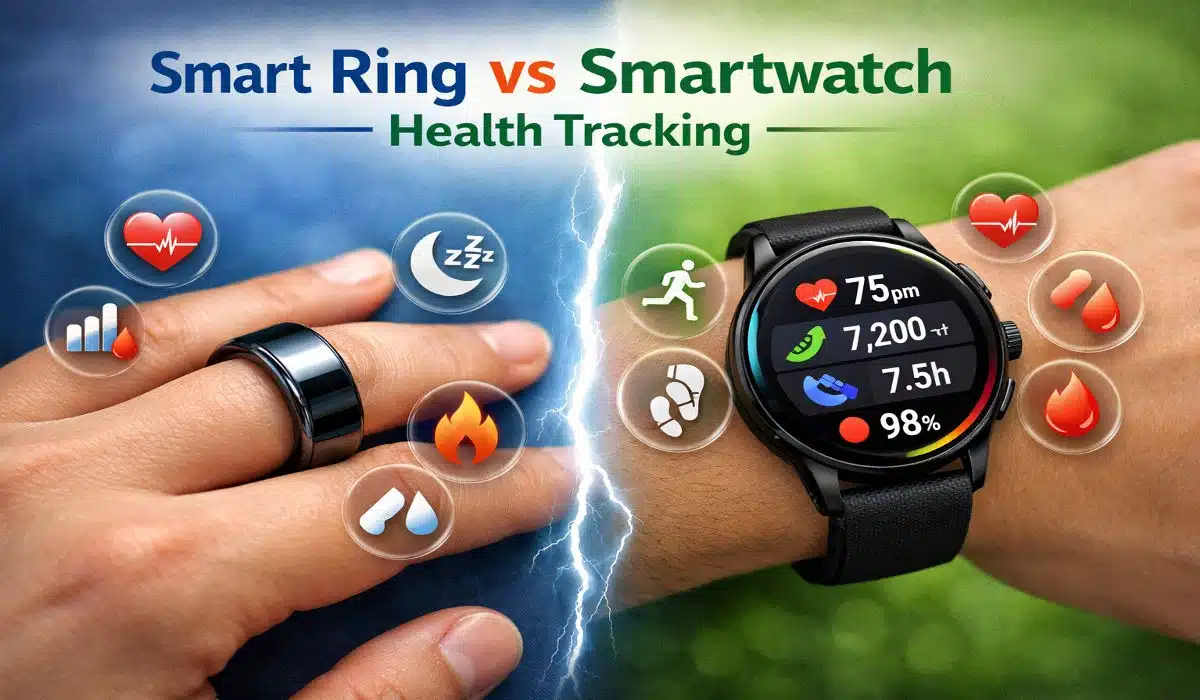
In 2026, the wearable market has reached a point of absolute refinement. No longer are we choosing between “cool gadgets”; we are choosing between two distinct philosophies of personal wellness. The debate over Smart ring vs Smartwatch health tracking has moved beyond mere aesthetics, focusing instead on data precision, lifestyle integration, and long-term compliance. Whether you are an elite athlete or a dedicated biohacker, understanding the nuances of these two form factors is essential for optimizing your health.
Form Factor and Daily Compliance
The most immediate difference in Smart ring vs Smartwatch health tracking lies in the physical design. A smartwatch is an “active” companion—it features a screen, delivers notifications, and demands your attention. In contrast, a smart ring like the Oura Ring 4 or Samsung Galaxy Ring 2 is a “passive” observer.
Comfort: Smart rings are lightweight (4g–8g) and screenless. For many, this makes them superior for 24/7 wear, especially during sleep.
The “Notification Fatigue”: Many users in 2026 are switching to rings to escape the constant buzzing of a wrist-bound device. If you want health data without the digital distractions, a ring is the clear winner.
Finger vs. Wrist Biometrics
When comparing Smart ring vs Smartwatch health tracking for technical accuracy, the finger actually has a biological advantage. The arteries in your fingers are closer to the skin surface and have a denser capillary network than the wrist.
PPG Sensor Quality: Because a ring fits snugly and doesn’t shift as much as a watch during sleep, it typically provides a “cleaner” signal for heart rate variability (HRV) and blood oxygen (SpO2).
Motion Artifacts: However, during intense workouts like weightlifting or running, smartwatches take the lead. The wrist is more stable during large muscle movements, making Smart ring vs Smartwatch health tracking favor the watch for active heart rate monitoring.
Sleep Tracking
In 2026, the Artemis Generation of health enthusiasts prioritizes recovery over everything else. In the realm of sleep, the Smart ring vs Smartwatch health tracking battle is often won by the ring.
Devices like the RingConn Gen 2 and Oura excel at detecting REM, deep, and light sleep stages with clinical-grade precision. Because a ring is more comfortable to wear to bed, “user compliance” is much higher. Many smartwatch users find chunky devices like the Apple Watch Ultra too intrusive for sleep, often leading them to charge the device overnight and missing out on crucial recovery data entirely.
Workout and Real-Time Feedback
If your primary goal is performance, the Smart ring vs Smartwatch health tracking comparison shifts back to the wrist.
Visual Data: A smartwatch provides real-time feedback on pace, distance, and heart rate zones.
GPS Integration: Most high-end smartwatches in 2026 feature dual-band GPS. Smart rings lack screens and built-in GPS, requiring you to carry your phone to map a run.
Interactivity: During a HIIT session, being able to glance at your wrist is a functional necessity that a ring simply cannot provide.
The Maintenance Factor
One of the most frustrating aspects of wearable tech is the “charge cycle.”
Smart Rings: Most 2026 models, such as the Galaxy Ring 2, last between 6 to 8 days on a single charge.
Smartwatches: Even with the efficiency of 2026 chipsets, most feature-rich watches require charging every 24 to 48 hours.
For long-term trends and “readiness” scores, the multi-day battery of a ring ensures fewer gaps in your data, which is a major point for Smart ring vs Smartwatch health tracking enthusiasts who value consistency.
Which Should You Choose?
Deciding between Smart ring vs Smartwatch health tracking depends entirely on your persona:
Choose a Smart Ring if: You prioritize sleep, recovery, and discreet health monitoring. You want a device that “disappears” into your life and only requires charging once a week.
Choose a Smartwatch if: You are an active trainer who needs real-time metrics, GPS mapping, and the convenience of notifications and music control on your wrist.
The Hybrid Approach: In 2026, many professionals wear both—a ring for 24/7 biometric baseline data and a watch specifically for training sessions.
Advanced Skin Temperature and Women’s Health Tracking
A significant differentiator in Smart ring vs Smartwatch health tracking is the integration of high-precision skin temperature sensors. While some 2026 smartwatches have temperature sensors, they are often affected by the wrist’s exposure to ambient air. In contrast, a smart ring like the Oura Ring 4 or Samsung Galaxy Ring 2 maintains a constant, snug fit against the finger’s thinner skin.
This makes smart rings far more effective for cycle tracking and fertility monitoring. By detecting minute baseline temperature shifts, smart rings can predict menstrual cycles and ovulation windows with much higher accuracy than a wrist-based watch. For users who prioritize reproductive health or want an early warning system for oncoming illness (detected through a rise in resting body temperature), the smart ring offers a superior biometric vantage point.
The Psychology of Tracking
When considering Smart ring vs Smartwatch health tracking, one must also look at the psychological “weight” of each device. A smartwatch is an active, data-rich environment that often encourages “obsessive” tracking—frequently checking steps, heart rate, and notifications throughout the day. This can lead to digital fatigue.
The smart ring, however, promotes a “passive” wellness philosophy. Since there is no screen, you aren’t constantly reminded of your stats. Instead, you check the app once or twice a day to review your “Readiness Score” or sleep quality. In 2026, many health-conscious users are choosing rings specifically to reduce screen time and anxiety while still maintaining a robust record of their physiological trends. This “set-and-forget” nature makes the Smart ring vs Smartwatch health tracking debate a question of mental peace versus real-time utility.
FAQ
Q1: Is a smart ring as accurate as a chest strap?
Ans: For resting metrics like HRV, yes. However, for high-intensity training, a chest strap or a high-end smartwatch remains the gold standard.
Q2: Can I wear a smart ring while lifting weights?
Ans: It is not recommended. Heavy bars can scratch the ring or pinch your finger. This is one area where Smart ring vs Smartwatch health tracking favors the watch.
Q3: Do smart rings require a subscription?
Ans: Some brands like Oura still use a subscription model for deep insights, while others like Samsung and RingConn offer subscription-free experiences in 2026.
read more: Dyson Handheld Fan

Mr. Udoy is a professional Web Developer and Blogger with 7+ years of experience in the tech world. He specializes in web architecture and digital storytelling. As the driving force behind worldincidents.com, he focuses on delivering high-quality, well-researched content to a global audience.
1 thought on “Smart Ring vs Smartwatch Health Tracking: Which Wearable Rules 2026?”