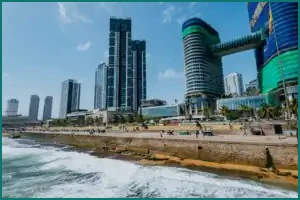
A surge in luxury apartment projects across Colombo, particularly within the Colombo Port City development, has outpaced the legal and institutional frameworks designed to oversee the real estate sector. While these high-end towers rise, concerns are mounting that the industry is becoming a hotbed for speculative investment rather than serving genuine housing needs, a shift that carries significant macroeconomic risks if left unchecked.
Recent months have seen major real estate firms launch significant projects in Colombo Port City, a development spearheaded by the China Harbor Engineering Company (CHEC) in partnership with the Sri Lankan government. These projects include both residential developments and a luxury twin residential tower in the Central Park district. The marketing strategies for these properties often emphasize high returns on investment through rapid price appreciation, with one firm even guaranteeing that investors could double their money within four years.
The financial scale of these developments is substantial. Three major projects alone have an estimated combined value of $650 million. By April of this year, the Sri Lankan Cabinet of Ministers had approved 77 Businesses of Strategic Importance (BSIs) for the Port City, attracting total investments of $2.19 billion to date. With entry-level prices for these luxury apartments starting at approximately $500,000, the market is increasingly driven by buyers looking for speculative gains rather than residential utility. While this speculative trend mirrors markets like Dubai, Sri Lanka lacks the robust regulatory infrastructure to manage such an industry.
Critics argue that Sri Lanka’s regulatory bodies are ill-equipped to manage this environment. The Condominium Management Authority (CMA), which is the primary entity responsible for overseeing apartment blocks, was originally established as the Common Amenities Board under a 1973 law. Its mandate was narrowly focused on maintaining common infrastructure like drainage, water, and elevators. Although a 2003 amendment broadened its scope, the CMA remains essentially a caretaker organization rather than a financial regulator capable of monitoring a multi-million-dollar, fast-moving pre-sales market.
A critical gap in the current legal landscape is the absence of mandatory requirements for escrow accounts. Currently, developers have full discretion over how they handle buyer funds. Consequently, payments made by investors are often diverted into the developer’s general finances instead of being protected in dedicated accounts. This creates a dangerous scenario where, should a project stall or a developer face insolvency, investors could lose their capital entirely. Furthermore, the lack of scrutiny means developers are effectively borrowing from the public without the oversight typically required by banking institutions. Financial experts warn that this could trigger a domino effect, similar to the real estate crisis seen in China, where the collapse of one developer impacted the broader economy. Embedding escrow accounts into law is considered an essential regulatory practice to ensure the stability of the growing real estate industry and the overall economy, yet Sri Lanka has not implemented such changes.
You have reached the limit of 2 free articles this month.
When property is treated as an investment, the promised return depends on price appreciation. Rental yields on new luxury apartments have been rising, but they come nowhere near the allure of doubling the underlying asset value. The money, in other words, is made through speculation on asset prices rather than steady rental income. That is normal for real estate everywhere, but a speculation-driven market carries risks that are usually contained through strong oversight, well-designed regulation, and strict enforcement by capable state institutions. Sri Lanka has almost none of these.
Related Articles

Meet Md. Rubel Rana
As a core contributor to Worlddincidents.com, Rubel Rana brings a unique perspective to the world of journalism. Whether it’s deep-diving into historical trivia or covering the latest global headlines, Rubel Rana is committed to delivering high-quality, high-impact articles. Their writing blends meticulous research with a compelling voice, helping readers stay informed and curious about the world around them.
1 thought on “Sri Lanka’s Luxury Property Boom Outpaces Current Regulatory Frameworks”