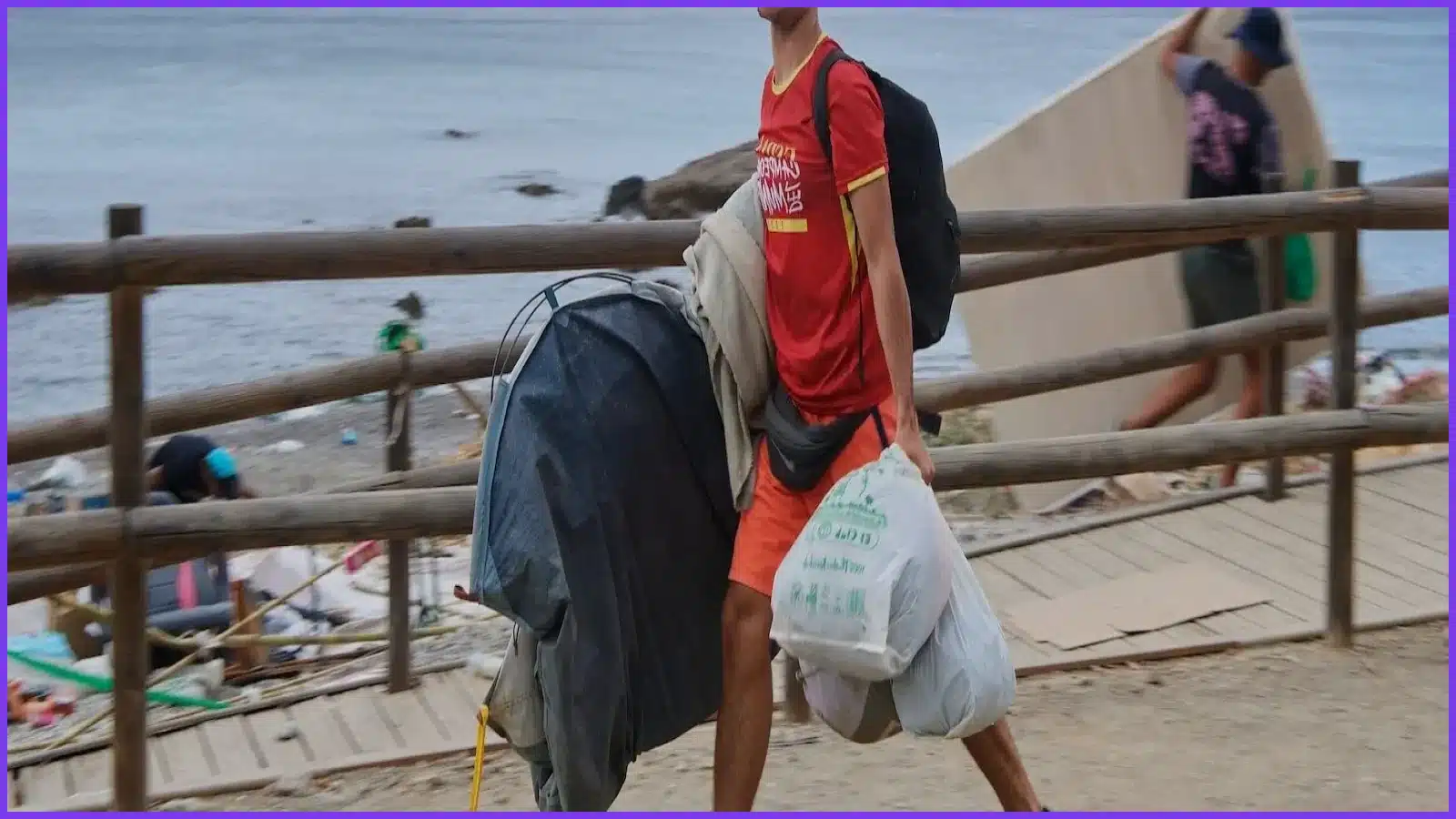
Spanish police on Thursday morning escorted hundreds of migrants from a beach away from Ceuta's city center to makeshift shelters, leaving behind a stark scene of the ongoing humanitarian crisis in the tiny Spanish enclave. For weeks, these individuals had lived on cardboard sheets and under reed huts, keeping their belongings in tattered plastic bags. Shortly after they were moved, other migrants began searching through the abandoned items, looking for anything usable, such as sheets, plastic chairs, or discarded mattresses.
The clearing of the beach highlights the immense administrative and humanitarian challenge facing authorities in the small territory of 84,000 people. Weeks after an unprecedented border surge saw more than 72,000 migrants enter the enclave neighboring Morocco, as many as 10,000 people, including women and children, are believed to still be in Ceuta. During the chaotic initial rush across the border, at least 90 people lost their lives.
While the vast majority of those who crossed eventually returned to Morocco due to the difficulty of staying in the exclave and the low probability of reaching mainland Europe, thousands chose to remain. Many have been hiding in the hills surrounding Ceuta, on its beaches, or outside the local migrant reception center. Disagreements persist over the exact number of people left; local city officials estimate between 9,000 and 10,000 migrants remain, including about 2,000 minors, based on food distribution figures. Meanwhile, Spain's interior ministry estimates the number is closer to 5,000.
The U.N. refugee agency has pointed to significant operational and humanitarian hurdles, particularly regarding access to basic services, food, and adequate shelter. Although the majority of the migrants who crossed the border in late July are Moroccan nationals, others have arrived from conflict-affected nations such as Sudan, Mali, and Yemen. Paula Barrachina, a spokesperson for the U.N. refugee agency in Spain, urged the Spanish government to expedite the processing of asylum applications, estimating that approximately 1,200 migrants currently in Ceuta may qualify for international protection.
In response, Spain's Minister of Inclusion, Social Security and Migration, Elma Saiz, stated on Thursday that the government is actively working to establish order and house those who remain. She announced that the state has secured accommodation space for 1,800 migrants by utilizing a parking lot and a military facility occasionally used for religious events. Additionally, the national government has allocated 6.5 million euros ($7.6 million) in emergency funding to assist Ceuta in managing the influx. Saiz commended the efforts of local organizations, noting that they have distributed approximately 4,000 meals daily since August 3.
However, local political leaders argue that the national response is insufficient. Ceuta Mayor Juan Jesús Vivas criticized the central government, accusing it of failing to properly control the situation. Despite the police operations on Thursday to escort several hundred mostly male migrants to shelters, many others could still be seen wandering the streets, while hundreds of women and minors found temporary refuge in informal shelters operated by local residents.
The migrants themselves face deep uncertainty. Khadija Rifai, a 20-year-old Moroccan woman, explained that while some help is being provided, older migrants feel neglected. "They help the minors and the youngsters, but they haven’t found any solutions for us," she said. Rifai had a normal life in Morocco but swam to Ceuta in late July with her husband in search of better healthcare and opportunities. While her husband was deported back to Morocco, Rifai managed to hide from the authorities. She hopes to eventually reach mainland Spain to reunite with him and start a family. "Even though we suffered here in Ceuta, we hope that once we reach the mainland, life will be good and we will have a house, a car, and everything we dreamed of," she added.
A spokesperson for the migration ministry explained that the government must evaluate each case individually before any final decisions can be made. This complex process requires police to identify everyone who entered illegally, verify their nationalities and backgrounds, determine who is eligible for international protection, and figure out who must be repatriated, either voluntarily or through forced deportation. In the meantime, hundreds of migrants recently demonstrated on a beach in Ceuta, holding Spanish flags and signs demanding "Asylum."
For many, the goal remains mainland Europe, but leaving the exclave is exceptionally difficult. Both Ceuta and Melilla, Spain's other North African territory, enforce strict exit checks at their ports and airports. This creates a massive barrier for those who entered illegally. Mohamed Yaqoub, an 18-year-old migrant from Chad, described hiding in the woods for days after being chased by Spanish soldiers in late July. He managed to avoid detection and now hopes to eventually travel to France to continue his studies. "We ask them to allow us entry and give us the necessary papers and documents," Yaqoub wrote in a cellphone note. "The most important thing for us is to get the papers."
Even so, an Associated Press photographer saw migrants roaming the streets Thursday. Elsewhere, hundreds of women and minors were sheltering in makeshift centers run by locals.
Related Articles

Mr. Udoy is a professional Web Developer and Blogger with 7+ years of experience in the tech world. He specializes in web architecture and digital storytelling. As the driving force behind worldincidents.com, he focuses on delivering high-quality, well-researched content to a global audience.
3 thoughts on “Thousands of Migrants Wait in Limbo in Spain’s Ceuta Enclave”