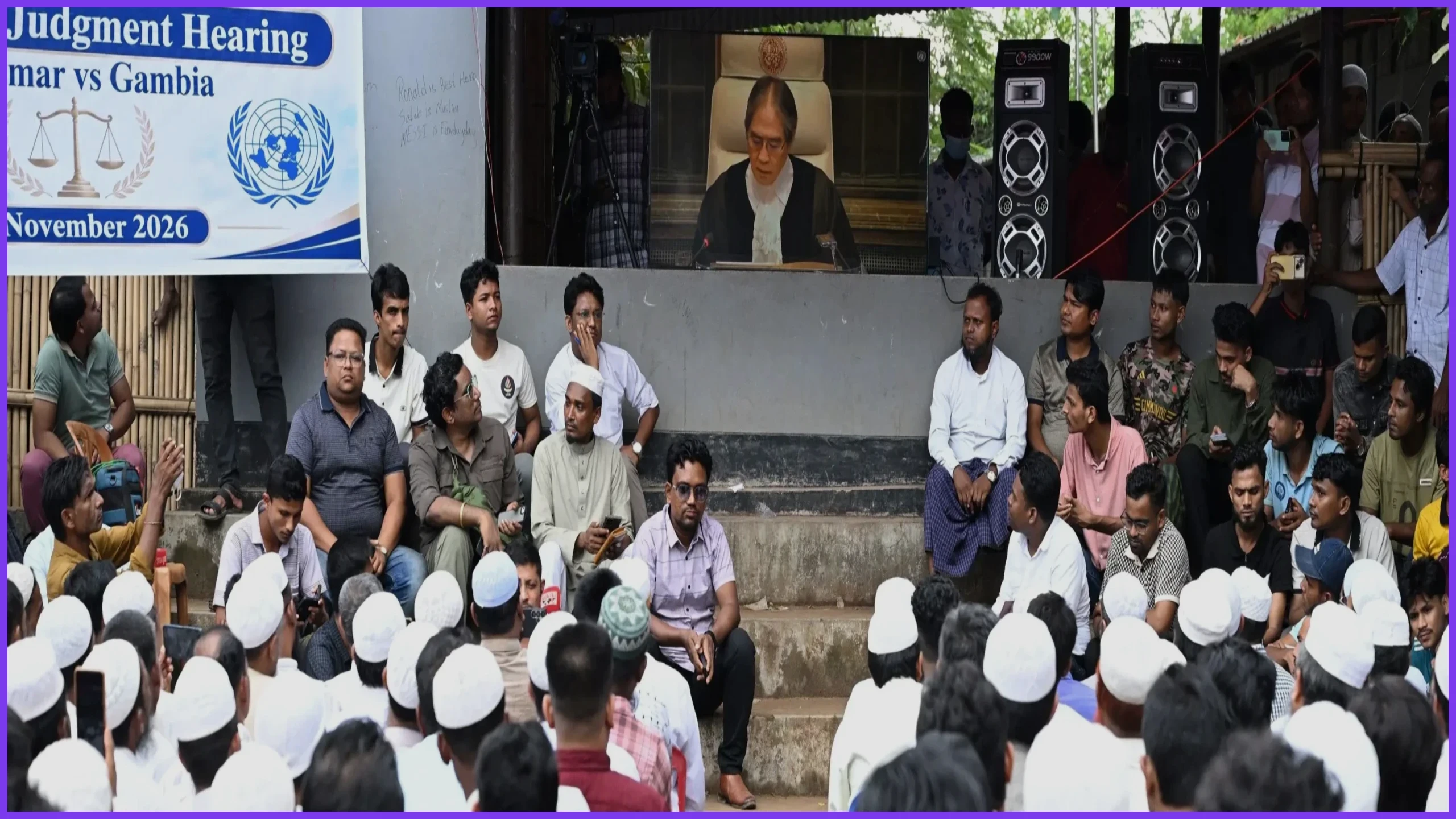
The International Court of Justice has declared Myanmar guilty of committing genocide against its Rohingya Muslim minority, marking the first time in history that an international tribunal has found a sovereign state responsible for the crime of genocide. Delivering the judgment on Thursday, the United Nations' highest judicial body determined that the military's 2017 violent campaign in Rakhine State was executed with the explicit intent to destroy the targeted population.
Presiding Judge Yuji Iwasawa told the court in The Hague that genocidal intent was the only reasonable inference to draw from the evidence presented. He stated that Myanmar's armed forces carried out extensive efforts to destroy evidence of their acts, including the systematic burning and bulldozing of cleared villages and the disposal of victims' bodies, while consistently failing to hold perpetrators accountable.
The historic verdict was decided by a 9-6 majority vote among a global panel of judges. By a majority vote, the court also found Myanmar in breach of multiple other obligations established under the 1948 Genocide Convention. The legal proceedings were originally initiated by The Gambia, focusing on the military's so-called clearance operations launched in late 2017 following violent assaults on more than 30 police outposts by militant fighters belonging to the Arakan Rohingya Salvation Army.
Addressing the context of the violence, the tribunal acknowledged the initial attacks by armed insurgents but decisively rejected Myanmar's defense that its actions constituted a legitimate counter-terrorism response. The judges found an overlap between a wide-reaching hate speech campaign that portrayed the Rohingya as sub-human and a security threat, and the subsequent military offensive that made wide-scale atrocities predictable and likely.
According to findings presented by the court, approximately 10,000 Rohingya were violently killed during the 2017 military campaign, while roughly 815,000 individuals were targeted in various ways. The military offensive prompted an unprecedented exodus, forcing more than 700,000 Rohingya to flee Buddhist-majority Myanmar—formerly known as Burma—on foot and by sea toward neighboring Bangladesh.
Detailing the nature of the operations, Iwasawa described widespread and indiscriminate atrocities, including the summary execution of men, brutal violence targeted at children, the deliberate burning of residential homes, and direct attacks on civilians attempting to cross the border into Bangladesh. The court also highlighted systematic and widespread sexual violence committed against Rohingya women and girls by military personnel and allied local Buddhist mobs.
Beyond the immediate military operations, the court examined state policies enforced against the Rohingya in the years leading up to 2017. Judges determined that measures imposing population controls, such as limiting married Rohingya couples to two children, were inherently discriminatory and specifically designed to erode the fundamental rights of the community.
Myanmar has consistently denied allegations of genocide, maintaining that its security forces were responding solely to insurgent threats posed by militant groups. In legal arguments delivered to the court in January, government representative Ko Ko Hlaing stated that the state was not obligated to remain idle while terrorists operated freely. Following Thursday's verdict, Ko Ko Hlaing offered no comment.
Although the tribunal concluded that Myanmar is legally required to pay proportionate reparations to victims, it deferred the determination of exact monetary figures and mechanics to a later date. As a civil tribunal rather than a criminal court, the International Court of Justice lacks direct enforcement powers, such as the authority to arrest individuals or issue prison sentences, leaving implementation dependent on political pressure and the UN Security Council.
The judgment holds major significance for international jurisprudence. Since the adoption of the Genocide Convention in the wake of the Holocaust, the ICJ had only twice before considered claims of state-backed genocide, concluding in both prior instances that the evidence was insufficient to directly attribute the actions to state authority. While dozens of individuals have previously been convicted of genocide, proving that crimes were directed as state policy carries a significantly higher evidentiary threshold.
In Bangladesh's Cox's Bazar refugee camps, where about one million Rohingya refugees currently reside, crowds gathered around large broadcast screens to watch the ruling live. Mohammed Nowkim, a displaced Rohingya now residing in Canada after fleeing Rakhine in 2017, described the decision as a long-awaited formal recognition of their suffering after decades of seeking justice.
Human rights organizations and international officials strongly endorsed the court's findings. UN High Commissioner for Human Rights Volker Türk characterized the atrocities inflicted on the Rohingya as a stain on the conscience of humanity, stressing that the ruling must immediately lead to concrete international action. Human Rights Watch praised the judgment as long-overdue validation for the survivors.
Legal experts emphasized the broader legal implications of the verdict. Human rights lawyer Philippe Sands KC, who assisted in presenting the case, described the decision as an historic milestone comparable to landmark international legal precedents such as the Nuremberg trials and the prosecution of Augusto Pinochet. Sands noted that the ruling sets a critical precedent for other pending genocide cases at the court, including South Africa's application against Israel regarding the conflict in Gaza, suggesting that a failure to hold Myanmar accountable would have severely undermined legal arguments in parallel proceedings.
Antonia Mulvey, executive director of Legal Action Worldwide, observed that the court established a groundbreaking precedent by explicitly classifying mass rape and sexual violence as constituent acts of genocide while firmly rejecting counter-terrorism justifications for state atrocities.
Diplomatic responses followed swiftly in Western capitals. A spokesperson for the United States Department of State emphasized the paramount importance of interpreting the Genocide Convention correctly while guarding against the politicization of international legal bodies, adding that Washington is thoroughly reviewing the decision. In London, United Kingdom Foreign Secretary Ed Miliband announced the immediate expulsion of Myanmar's military attaché and summoned its chargé d'affaires, promising further diplomatic measures in response to demands from cross-party members of Parliament to reinstate sanctions on Myanmar's military leadership.
Related Articles

Mr. Udoy is a professional Web Developer and Blogger with 7+ years of experience in the tech world. He specializes in web architecture and digital storytelling. As the driving force behind worldincidents.com, he focuses on delivering high-quality, well-researched content to a global audience.